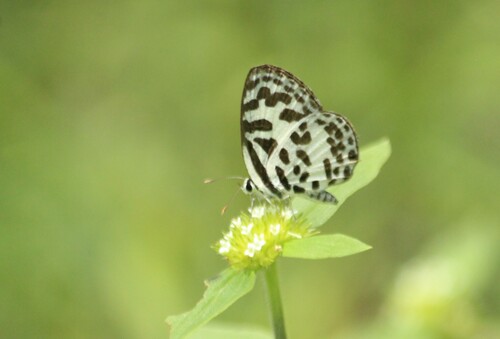
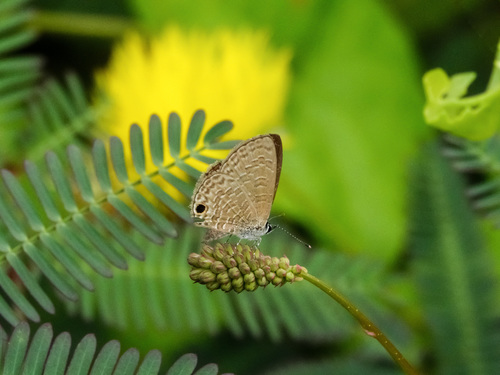
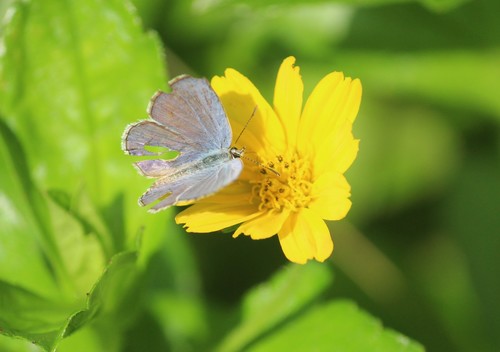
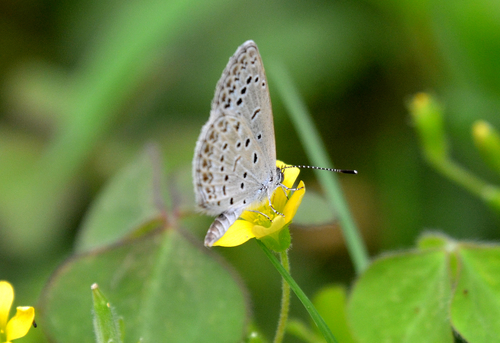
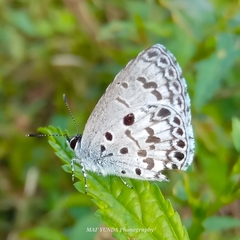
Common Hedge Blue

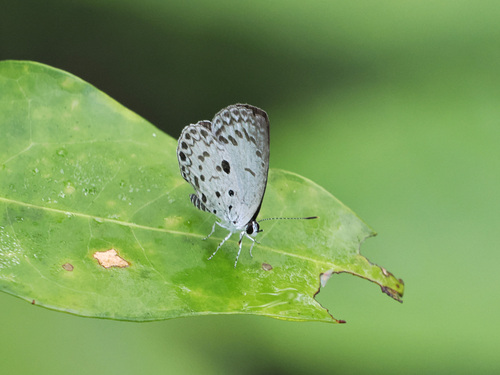
Common Hedge Blue

Acytolepis puspa

Daily sighting probability ~20% · Possible
at Jabalpur

In 3 days ~60% in a week ~80%

10 Verified sightings at Jabalpur
125 In all 9 parks From 2019 to 2026
September Best month
☀️ Diurnal When it's spotted

About the Common Hedge Blue

Acytolepis puspa, the common hedge blue, is a small butterfly found in Cambodia, India, Pakistan, Myanmar, Thailand, Malaysia, Singapur, Yunnan, Taiwan, Sri Lanka, Philippines, Borneo and New Guinea that belongs to the lycaenids or blues family. The species was first described by Thomas Horsfield in 1828.

The butterfly was earlier known as Lycaenopsis puspa (Toxopeus). It is the type species for the genus Acytolepis. Wet-season brood. male. Upperside: violaceous blue, with brilliant iridescent tints in certain lights. Forewing: the costa, apex and termen bordered with black, this edging narrows from base to the middle of the costa, then broadens greatly at apex, where it occupies the apical fourth of the wing, and is again narrowed below vein 4, whence it is continued as an even band to the tornus; on the disc beyond the apex of the cell the ground colour is sensibly paler, and the dark markings of the cell are faintly visible by transparency from below. Hindwing: the costa very broadly, the termen much more narrowly black; the black bordering on the latter consists of a series of rounded coalescent spots, which on the inner side are margined by faint... Wikipedia →
Global Distribution

Parks Where Found

# Park Country Daily sighting probability
1 Namdapha National Park 🇮🇳 India
~40%
2 Cuc Phuong National Park 🇻🇳 Vietnam
~30%
3 Kaeng Krachan National Park 🇹🇭 Thailand
~20%
4 Taman Negara National Park 🇲🇾 Malaysia
~10%
5 Sinharaja Forest Reserve 🇱🇰 Sri Lanka
~10%
6 Taroko National Park 🇹🇼 Taiwan
~10%
7 Doi Inthanon National Park 🇹🇭 Thailand
~10%
8 Cat Tien National Park 🇻🇳 Vietnam
~10%
9 Khao Yai National Park 🇹🇭 Thailand
~10%

Cities Where Found

# City Country Daily sighting probability
1 Jamshedpur 🇮🇳 India
~30%
2 Tuen Mun 🇨🇳 China
~30%
3 Jabalpur 🇮🇳 India
~20%
4 Nashik 🇮🇳 India
~20%
5 Mumbai 🇮🇳 India
~20%
6 Pune 🇮🇳 India
~20%
7 Hong Kong 🇨🇳 China
~10%
8 Bengaluru 🇮🇳 India
~10%
9 Dehradun 🇮🇳 India
~10%
10 Singapore 🇸🇬 Singapore
~10%

Before you go

What are the chances of seeing a Common Hedge Blue in Jabalpur?

Possible

About 20% of wildlife watchers report a Common Hedge Blue sighting in Jabalpur on a given day, based on 10 verified sightings from GBIF citizen-science data. It is the 44th most-seen of the 88 insects we can rate there. Over three days the chance rises to about 60%, and over a week to about 80%, if each day is a fresh chance.

When is the best time to see a Common Hedge Blue in Jabalpur?

September

In that month about 50% of wildlife watchers report a Common Hedge Blue in Jabalpur on a given day, against under 5% in November to August, the lowest months. That is one of Jabalpur's wettest months, with about 220 mm of rain against 5 mm in December.

What time of day is best to see a Common Hedge Blue?

Between 9 am and noon

Across all the parks we cover, that three-hour window holds the most Common Hedge Blue sightings with a recorded time, and about 9 in 10 of them come between 6 am and 6 pm: it is a daytime animal.

Is Jabalpur the best place to see a Common Hedge Blue?

3rd of 18

Of the 18 cities where we can rate Common Hedge Blue sightings, Jabalpur ranks 3rd at about 20%. The best odds are in Jamshedpur (India, about 30%) and Tuen Mun (China, about 30%).

Which relatives of the Common Hedge Blue live in Jabalpur?

Same family: Lycaenidae

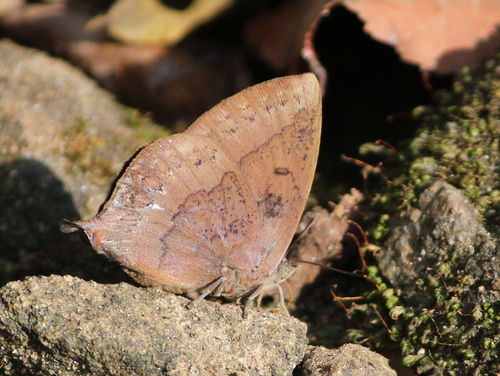
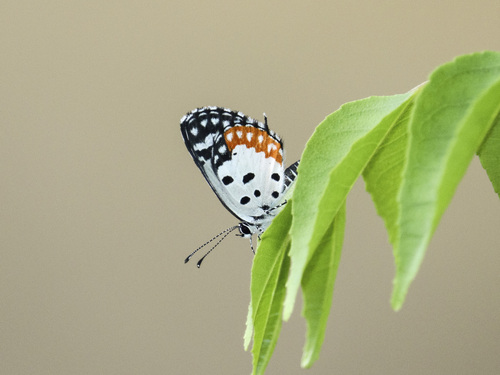
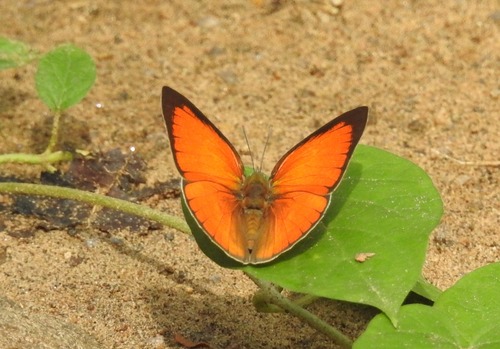
The closest relatives of the Common Hedge Blue that you can see in Jabalpur (family Lycaenidae, Gossamer-winged Butterflies) are Common Pierrot (about 40%), Purple Leaf Blue (about 40%) and Red Pierrot (about 30%), with each one's daily chance of a sighting.

Where does the Common Hedge Blue sighting chance come from?

GBIF citizen-science records

It is estimated from how often the Common Hedge Blue is recorded against all the insects logged in Jabalpur (10 verified sightings), calibrated against known sighting rates. Figures are rounded to the nearest 10% because citizen-science data supports honest approximations, not decimals, and months with records from fewer than five people show "—". How it works.

← Back to Jabalpur