Red-shouldered Macaw

Red-shouldered Macaw

Diopsittaca nobilis

Silhouette: Sheatherius · PhyloPic

LCLeast ConcernNTVUENCR
Daily sighting probability ~50% · Likely
at João Pessoa

In 3 days ~90% in a week >90%

177 Verified sightings at João Pessoa
841 In all 5 parks From 2019 to 2026
February Best month
☀️ Diurnal When it's spotted

About the Red-shouldered Macaw

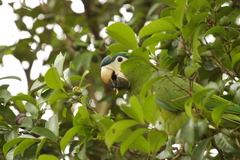
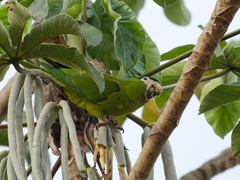
The red-shouldered macaw (Diopsittaca nobilis) is a small green South American parrot, a member of a large group of Neotropical parrots called macaws. The species is named for the red coverts on its wings. It is the smallest macaw, being 30 cm (12 in) in length – similar in size to the Aratinga parakeets. It is native to the tropical lowlands, savannahs, and swamplands of Brazil, the Guianas, Bolivia, Venezuela, and far south-eastern Peru. There are three subspecies: The noble macaw (Diopsittaca nobilis cumanensis), Hahn's macaw (Diopsittaca nobilis nobilis), and the long-winged macaw (Diopsittaca nobilis longipennis). The long-winged macaw is a poorly distinct third subspecies that has longer wings, but is otherwise similar to the noble macaw. The Hahn's subspecies is named for German zoologist Carl-Wilhelm Hahn, who in 1834 began compiling Ornithologischer Atlas oder naturgetreue Abbildung und Beschreibung der aussereuropäischen Vögel (Engl: Ornithological Atlas or natural depiction and description of birds from outside Europe).

Red-shouldered macaws are frequently bred in captivity for the pet trade, where they are sometimes described as mini-macaws. Though wild populations of red-shouldered macaws have declined locally due to habitat loss, they are listed as Least Concern by IUCN. They are listed on Appendix II of CITES, and trade is restricted. Wikipedia →

Sounds

Call0:37

Brazil · 2026

© JAYRSON ARAUJO DE OLIVEIRA · XC1164967 · CC BY-NC-SA 4.0

Flight call0:24

Guyana · 2025

© Richard E. Webster · XC1031776 · CC BY-NC-SA 4.0

Alarm call0:21

Brazil · 2025

© Fabrício Grigolin · XC1023352 · CC BY-NC-SA 4.0

Global Distribution

Parks Where Found

# Park Country Daily sighting probability
1 Emas National Park 🇧🇷 Brazil
~50%
2 Chapada dos Guimarães National Park 🇧🇷 Brazil
~20%
3 Tijuca National Park 🇧🇷 Brazil
~20%
4 Parque Estadual Encontro das Águas 🇧🇷 Brazil
<5%
5 Tambopata National Reserve 🇵🇪 Peru
<5%

Cities Where Found

# City Country Daily sighting probability
1 Maceió 🇧🇷 Brazil
~50%
2 João Pessoa 🇧🇷 Brazil
~50%
3 São Paulo 🇧🇷 Brazil
~30%
4 São Luís 🇧🇷 Brazil
~30%
5 Campo Grande 🇧🇷 Brazil
~20%
6 Campinas 🇧🇷 Brazil
~20%
7 Rio de Janeiro 🇧🇷 Brazil
~10%
8 Recife 🇧🇷 Brazil
~10%
9 Goiânia 🇧🇷 Brazil
~10%
10 Niterói 🇧🇷 Brazil
<5%

Zoos & Centres Where Found

# Zoo / Centre Country
1 Parque das Aves 🇧🇷 Brazil In captivity
2 Givskud Zoo 🇩🇰 Denmark In captivity
3 Beijing Zoo 🇨🇳 China In captivity
4 Lisbon Zoo 🇵🇹 Portugal In captivity
5 Zoológico Dois Irmãos 🇧🇷 Brazil In captivity
6 Bioparque Municipal Vesty Pakos 🇧🇴 Bolivia In captivity
7 Ueno Zoo 🇯🇵 Japan In captivity
8 Bird Paradise 🇸🇬 Singapore In captivity
9 Parc zoologique de Fréjus 🇫🇷 France In captivity
10 Rainforest Wild Asia 🇸🇬 Singapore In captivity
11 Rio de Janeiro Zoological Garden 🇧🇷 Brazil In captivity
12 Paphos Zoo 🇨🇾 Cyprus In captivity
13 Loro Parque 🇪🇸 Spain In captivity
14 Ueno Zoological Gardens (West Garden) 🇯🇵 Japan In captivity
15 Zoológico Municipal de Guarulhos 🇧🇷 Brazil In captivity
16 Gilcrease Nature Sanctuary 🇺🇸 United States In captivity
17 Bali Bird Park 🇮🇩 Indonesia In captivity
18 Castellar Zoo 🇪🇸 Spain In captivity
19 Zoológico do Município de São Bernardo do Campo 🇧🇷 Brazil In captivity
20 Birdworld Kuranda 🇦🇺 Australia In captivity
21 Bloedel Conservatory 🇨🇦 Canada In captivity
22 Kuranda Koala Gardens 🇦🇺 Australia In captivity
23 Bird Park 🇷🇺 Russia In captivity
24 Zoológico La Era de las aves 🇪🇸 Spain In captivity

Before you go

What are the chances of seeing a Red-shouldered Macaw in João Pessoa?

Likely

About 50% of wildlife watchers report a Red-shouldered Macaw sighting in João Pessoa on a given day, based on 177 verified sightings from GBIF citizen-science data. It is the 15th most-seen of the 99 birds we can rate there. Over three days the chance rises to about 90%, and over a week to over 90%, if each day is a fresh chance.

When is the best time to see a Red-shouldered Macaw in João Pessoa?

February

In that month about 70% of wildlife watchers report a Red-shouldered Macaw in João Pessoa on a given day, against about 40% in April, the lowest month.

What time of day is best to see a Red-shouldered Macaw?

Between 3 and 6 pm

Across all the parks we cover, that three-hour window holds the most Red-shouldered Macaw sightings with a recorded time, and about 9 in 10 of them come between 6 am and 6 pm: it is a daytime animal.

Is João Pessoa the best place to see a Red-shouldered Macaw?

Among the best

Of the 12 cities where we can rate Red-shouldered Macaw sightings, João Pessoa ranks 2nd at about 50%, level with the leaders once rounded. The best odds are in Maceió (Brazil, about 50%).

Which relatives of the Red-shouldered Macaw live in João Pessoa?

Same family: Psittacidae

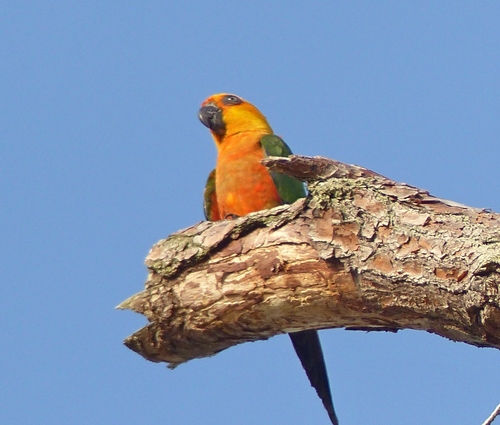
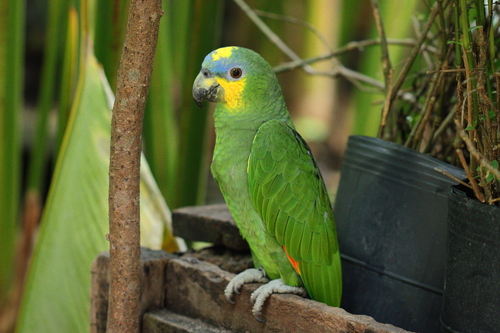
The closest relatives of the Red-shouldered Macaw that you can see in João Pessoa (family Psittacidae, New World and African Parrots) are Jandaya Parakeet (about 60%), Orange-winged Parrot (about 30%) and Blue-winged Parrotlet (about 20%), with each one's daily chance of a sighting.

Where does the Red-shouldered Macaw sighting chance come from?

GBIF citizen-science records

It is estimated from how often the Red-shouldered Macaw is recorded against all the birds logged in João Pessoa (177 verified sightings), calibrated against known sighting rates. Figures are rounded to the nearest 10% because citizen-science data supports honest approximations, not decimals, and months with records from fewer than five people show "—". How it works.

← Back to João Pessoa