Blue Pansy
Daily sighting probability ~10% · With luck
at Johannesburg

In 3 days ~30% in a week ~60%

46 Verified sightings at Johannesburg
302 In all 14 parks From 2019 to 2026
April Best month
☀️ Diurnal When it's spotted

About the Blue Pansy

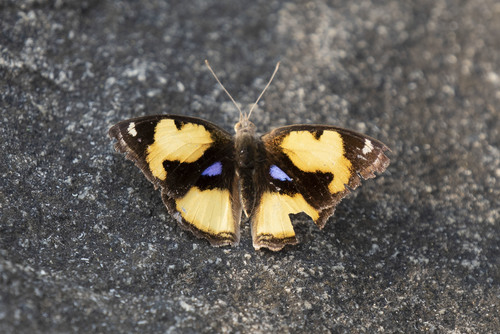
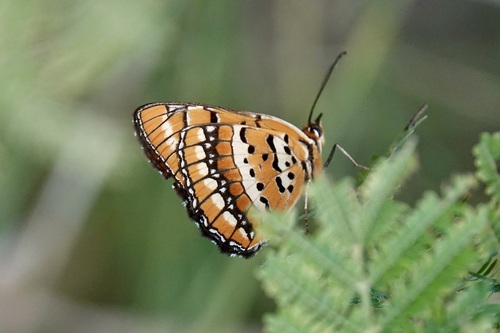
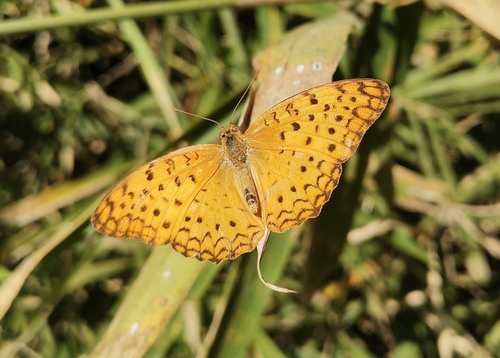
Junonia orithya is a nymphalid butterfly with many subspecies occurring from Africa, through South Asia, Southeast Asia, and Australia. In India, its common English name is the blue pansy, but in southern Africa it is known as the eyed pansy as the name blue pansy refers to Junonia oenone. In Australia, this butterfly is known as the blue argus, but this name also is used for the Aricia anteros in Europe.

The Blue Pansy has been declared as the state butterfly of the union territory of Jammu and Kashmir in India. Male upperside: somewhat more than half the forewing from base velvety black, apical half dull fuliginous; cell-area with or without two short transverse orange bars; a blue patch above, the tornus; the outer margin of the basal black area obliquely zigzag in a line from the middle of costa to apex of vein 2, including a large discal, generally obscure ocellus, which, however, in some specimens is prominently ringed with orange yellow. Beyond this a broad white irregularly oblique discal band followed by a short oblique preapical bar from costa; a small black orange-ringed ocellus beneath the bar, a subterminal continuous line of white spots in the interspaces... Wikipedia →
Global Distribution

Parks Where Found

# Park Country Daily sighting probability
1 Nitmiluk National Park 🇦🇺 Australia
~40%
2 Litchfield National Park 🇦🇺 Australia
~40%
3 Kakadu National Park 🇦🇺 Australia
~30%
4 Gunung Leuser National Park 🇮🇩 Indonesia
~30%
5 Khao Sok National Park 🇹🇭 Thailand
~30%
6 Khao Yai National Park 🇹🇭 Thailand
~20%
7 Ranthambore National Park 🇮🇳 India
~20%
8 Taroko National Park 🇹🇼 Taiwan
~20%
9 Sepilok 🇲🇾 Malaysia
~10%
10 Garden Route National Park 🇿🇦 South Africa
~10%
11 Addo Elephant National Park 🇿🇦 South Africa
~10%
12 Kaeng Krachan National Park 🇹🇭 Thailand
~10%
13 Masai Mara National Reserve 🇰🇪 Kenya
~10%
14 Daintree National Park 🇦🇺 Australia
~10%

Cities Where Found

# City Country Daily sighting probability
1 Naha 🇯🇵 Japan
~40%
2 Jodhpur 🇮🇳 India
~30%
3 Jakarta 🇮🇩 Indonesia
~30%
4 Jabalpur 🇮🇳 India
~30%
5 Yogyakarta 🇮🇩 Indonesia
~30%
6 Tasikmalaya 🇮🇩 Indonesia
~20%
7 Surakarta 🇮🇩 Indonesia
~20%
8 Bhopal 🇮🇳 India
~20%
9 Johor Bahru 🇲🇾 Malaysia
~20%
10 Surabaya 🇮🇩 Indonesia
~20%

Before you go

What are the chances of seeing a Blue Pansy in Johannesburg?

With luck

About 10% of wildlife watchers report a Blue Pansy sighting in Johannesburg on a given day, based on 46 verified sightings from GBIF citizen-science data. It is the 25th most-seen of the 213 insects we can rate there. Over three days the chance rises to about 30%, and over a week to about 60%, if each day is a fresh chance.

When is the best time to see a Blue Pansy in Johannesburg?

April

In that month about 30% of wildlife watchers report a Blue Pansy in Johannesburg on a given day, against under 5% in August and December, the lowest months.

What time of day is best to see a Blue Pansy?

Between 10 am and 1 pm

Across all the parks we cover, that three-hour window holds the most Blue Pansy sightings with a recorded time, and about 9 in 10 of them come between 6 am and 6 pm: it is a daytime animal.

Is Johannesburg the best place to see a Blue Pansy?

20th of 36

Of the 36 cities where we can rate Blue Pansy sightings, Johannesburg ranks 20th at about 10%. The best odds are in Naha (Japan, about 40%), Jodhpur (India, about 30%) and Jakarta (Indonesia, about 30%).

Which relatives of the Blue Pansy live in Johannesburg?

Same genus: Junonia

The closest relatives of the Blue Pansy that you can see in Johannesburg (genus Junonia, Buckeyes & Pansies) are Junonia archesia (about 30%), Yellow Pansy (about 20%) and Dark Blue Pansy (about 10%), with each one's daily chance of a sighting.

Where does the Blue Pansy sighting chance come from?

GBIF citizen-science records

It is estimated from how often the Blue Pansy is recorded against all the insects logged in Johannesburg (46 verified sightings), calibrated against known sighting rates. Figures are rounded to the nearest 10% because citizen-science data supports honest approximations, not decimals, and months with records from fewer than five people show "—". How it works.

← Back to Johannesburg