
Scarlet Skimmer

Scarlet Skimmer

Crocothemis servilia

Daily sighting probability ~30% · Possible
at Kanpur

In 3 days ~70% in a week ~90%

9 Verified sightings at Kanpur
390 In all 13 parks From 2019 to 2026
August Best month
☀️ Diurnal When it's spotted

About the Scarlet Skimmer

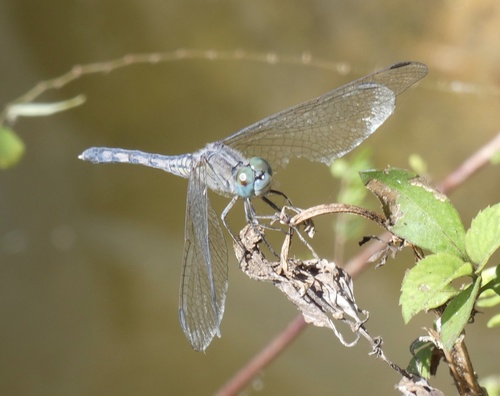
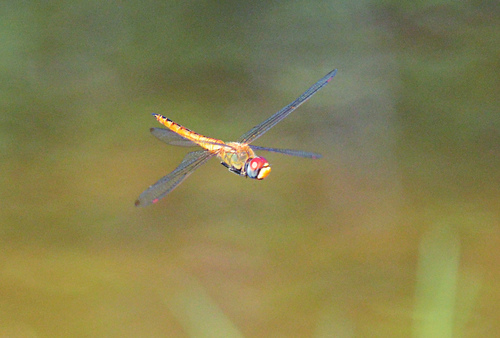
The scarlet skimmer or ruddy marsh skimmer (Crocothemis servilia) is a species of dragonfly of the family Libellulidae, native to east and southeast Asia and introduced to Jamaica, Florida, and Hawaii. It is a medium sized dragonfly. The male is blood-red, with a thin black line along the mid-dorsal abdomen in the nominate subspecies. Its eyes are blood-red above, purple laterally. Thorax is bright ferruginous, often blood-red on dorsum. Anal appendages are blood-red. Female is similar to the male, but with olivaceous-brown thorax and abdomen. The black mid-dorsal carina is rather broad.

It breeds in ponds, ditches, marshes, open swamps and rice fields. List of odonates of Sri Lanka List of odonates of India List of odonata of Kerala "Crocothemis servilia". Integrated Taxonomic Information System. Retrieved 9 February 2006.

Chen et al (2009) Common edible insects and their utilization in China. Entomological... Wikipedia →

Global Distribution

Parks Where Found

# Park Country Daily sighting probability
1 Sundarbans National Park 🇮🇳 India
~40%
2 Keoladeo National Park 🇮🇳 India
~40%
3 Royal Bardia National Park 🇳🇵 Nepal
~40%
4 Chitwan National Park 🇳🇵 Nepal
~30%
5 Everglades National Park 🇺🇸 United States
~20%
6 Ranthambore National Park 🇮🇳 India
~20%
7 Kaeng Krachan National Park 🇹🇭 Thailand
~20%
8 Kanha National Park 🇮🇳 India
~10%
9 Khao Yai National Park 🇹🇭 Thailand
~10%
10 Minneriya National Park 🇱🇰 Sri Lanka
~10%
11 Big Cypress National Preserve 🇺🇸 United States
~10%
12 Doi Inthanon National Park 🇹🇭 Thailand
~10%
13 Merritt Island National Wildlife Refuge 🇺🇸 United States
~10%

Cities Where Found

# City Country Daily sighting probability
1 Kota 🇮🇳 India
~70%
2 Vasai-Virar 🇮🇳 India
~40%
3 Kolkata 🇮🇳 India
~40%
4 Daegu 🇰🇷 South Korea
~40%
5 Raipur 🇮🇳 India
~40%
6 Durg 🇮🇳 India
~40%
7 Prayagraj 🇮🇳 India
~40%
8 Yogyakarta 🇮🇩 Indonesia
~40%
9 Thrissur 🇮🇳 India
~40%
10 Salem 🇮🇳 India
~40%

Before you go

What are the chances of seeing a Scarlet Skimmer in Kanpur?

Possible

About 30% of wildlife watchers report a Scarlet Skimmer sighting in Kanpur on a given day, based on 9 verified sightings from GBIF citizen-science data. It is the 9th most-seen of the 31 insects we can rate there. Over three days the chance rises to about 70%, and over a week to about 90%, if each day is a fresh chance.

When is the best time to see a Scarlet Skimmer in Kanpur?

August

In that month about 60% of wildlife watchers report a Scarlet Skimmer in Kanpur on a given day, against under 5% in March and April, the lowest months. That is one of Kanpur's wettest months, with about 220 mm of rain against almost none in November.

What time of day is best to see a Scarlet Skimmer?

Between 9 am and noon

Across all the parks we cover, that three-hour window holds the most Scarlet Skimmer sightings with a recorded time, and about 9 in 10 of them come between 6 am and 6 pm: it is a daytime animal.

Is Kanpur the best place to see a Scarlet Skimmer?

14th of 79

Of the 79 cities where we can rate Scarlet Skimmer sightings, Kanpur ranks 14th at about 30%. The best odds are in Kota (India, about 70%), Vasai-Virar (India, about 40%) and Kolkata (India, about 40%).

Which relatives of the Scarlet Skimmer live in Kanpur?

Same family: Libellulidae

The closest relatives of the Scarlet Skimmer that you can see in Kanpur (family Libellulidae, Skimmers) are Chalky Percher (about 30%), Granite Ghost (about 30%) and Wandering Glider (about 20%), with each one's daily chance of a sighting.

Where does the Scarlet Skimmer sighting chance come from?

GBIF citizen-science records

It is estimated from how often the Scarlet Skimmer is recorded against all the insects logged in Kanpur (9 verified sightings), calibrated against known sighting rates. Figures are rounded to the nearest 10% because citizen-science data supports honest approximations, not decimals, and months with records from fewer than five people show "—". How it works.

← Back to Kanpur