Himalayan Swiftlet

Himalayan Swiftlet

Aerodramus brevirostris

Silhouette: Aviceda (vectorized by T. Michael Keesey) · PhyloPic

LCLeast ConcernNTVUENCR
Daily sighting probability <5% · Rare
at Kathmandu

In 3 days <5%

25 Verified sightings at Kathmandu
1,354 In all 12 parks From 2019 to 2026
October Best month
☀️ Diurnal When it's spotted

About the Himalayan Swiftlet

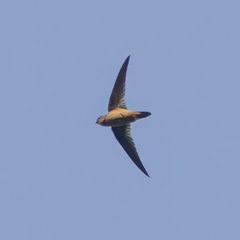
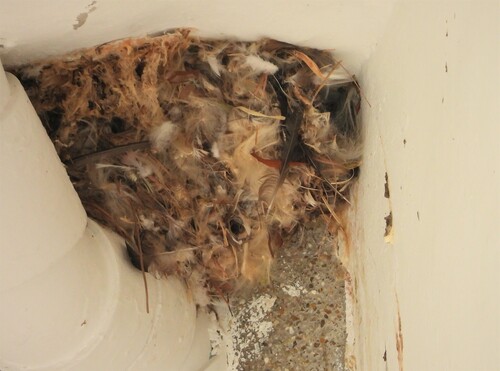
The Himalayan swiftlet (Aerodramus brevirostris) is a small swift. It is a common colonial breeder in the Himalayas and Southeast Asia. Some populations are migratory. This swiftlet was formerly placed in the genus Collocalia. Two of its five subspecies are frequently given full species status, A. b. rogersi as the Indochinese swiftlet, Aerodramus rogersi, and the isolated Javan form A. b. vulcanorum as the Volcano swiftlet, Aerodramus vulcanorum.

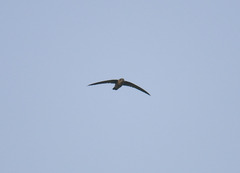
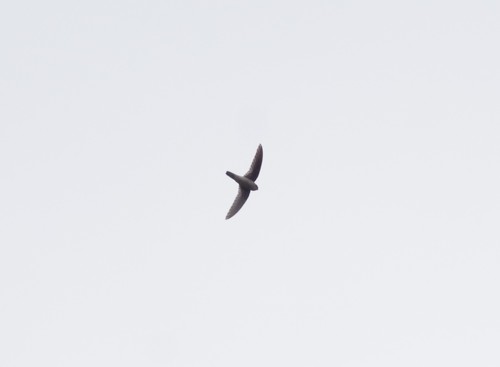
This 13–14 cm long swiftlet has swept-back wings that resemble a crescent or a boomerang. The body is slender, and the tail is forked. It is, in many respects, a typical swift, having narrow wings for fast flight, and a wide gape and small beak surrounded by bristles for catching insects in flight. Its legs are very short, preventing the bird from perching, but allowing it to cling to vertical surfaces.

It is mainly grey-brown above and paler brown below. It has a pale grey rump and a pale patch above and behind the bill. The sexes are similar, but the juvenile has a less distinct rump. There are five subspecies, differing mainly in the rump tone.

A. b. brevirostris breeds in the Himalayas east to Bangladesh, Myanmar... Wikipedia →
Sounds

Call1:25

China · 2023

© Bo Shunqi 薄顺奇 · XC841455 · CC BY-NC-SA 4.0

Call0:21

India · 2015

© Viral joshi · XC256353 · CC BY-NC-SA 4.0

Global Distribution

Parks Where Found

# Park Country Daily sighting probability
1 Khao Yai National Park 🇹🇭 Thailand
~20%
2 Namdapha National Park 🇮🇳 India
~10%
3 Langtang National Park 🇳🇵 Nepal
~10%
4 Kaeng Krachan National Park 🇹🇭 Thailand
~10%
5 Royal Manas National Park 🇧🇹 Bhutan
~10%
6 Doi Inthanon National Park 🇹🇭 Thailand
<5%
7 Jiuzhaigou National Park 🇨🇳 China
<5%
8 Jim Corbett National Park 🇮🇳 India
<5%
9 Royal Bardia National Park 🇳🇵 Nepal
<5%
10 Manas National Park 🇮🇳 India
<5%
11 Chitwan National Park 🇳🇵 Nepal
<5%
12 Kaziranga National Park 🇮🇳 India
<5%

Cities Where Found

# City Country Daily sighting probability
1 Chengdu 🇨🇳 China
<5%
2 Dhaka 🇧🇩 Bangladesh
<5%
3 Kathmandu 🇳🇵 Nepal
<5%
4 Dehradun 🇮🇳 India
<5%
5 Phnom Penh 🇰🇭 Cambodia
<5%

Before you go

What are the chances of seeing a Himalayan Swiftlet in Kathmandu?

Rare

Under 5% of wildlife watchers report a Himalayan Swiftlet sighting in Kathmandu on a given day, based on 25 verified sightings from GBIF citizen-science data. It is the 233rd most-seen of the 312 birds we can rate there. Over three days the chance rises to under 5%, if each day is a fresh chance.

When is the best time to see a Himalayan Swiftlet in Kathmandu?

Any time of year

In every month with enough records, under 5% of wildlife watchers report a Himalayan Swiftlet in Kathmandu on a given day, so our monthly data shows no clear season.

What time of day is best to see a Himalayan Swiftlet?

Between 7 and 10 am

Across all the parks we cover, that three-hour window holds the most Himalayan Swiftlet sightings with a recorded time, and about 8 in 10 of them come between 6 am and 6 pm: it is a daytime animal.

Is Kathmandu the best place to see a Himalayan Swiftlet?

Among the best

Of the 5 cities where we can rate Himalayan Swiftlet sightings, Kathmandu ranks 3rd at under 5%, level with the leaders once rounded. The best odds are in Chengdu (China, under 5%) and Dhaka (Bangladesh, under 5%).

Where does the Himalayan Swiftlet sighting chance come from?

GBIF citizen-science records

It is estimated from how often the Himalayan Swiftlet is recorded against all the birds logged in Kathmandu (25 verified sightings), calibrated against known sighting rates. Figures are rounded to the nearest 10% because citizen-science data supports honest approximations, not decimals, and months with records from fewer than five people show "—". How it works.

← Back to Kathmandu