Brown-breasted Flycatcher

Brown-breasted Flycatcher

Muscicapa muttui

Silhouette: Ekytza · PhyloPic

LCLeast ConcernNTVUENCR
Daily sighting probability <5% · Rare
at Kolkata

In 3 days ~10% in a week ~30%

468 Verified sightings at Kolkata
1,384 In all 11 parks From 2019 to 2026
October Best month
🌅 Crepuscular When it's spotted

About the Brown-breasted Flycatcher

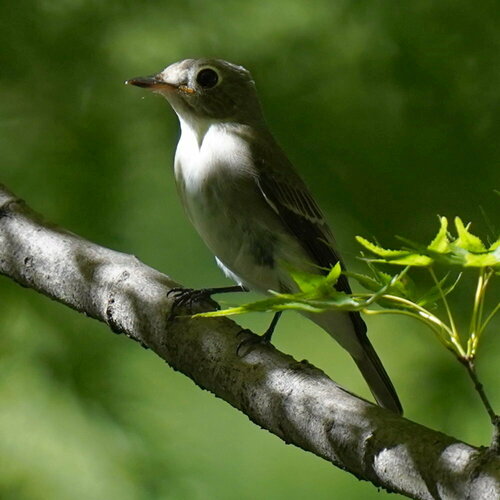
The brown-breasted flycatcher or Layard's flycatcher (Muscicapa muttui) is a small passerine bird in the flycatcher family Muscicapidae. The species breeds in north eastern India, central and Southern China and northern Burma and Thailand, and migrates to southern India and Sri Lanka. It forages for insects below the forest canopy, often close to the forest floor.

The brown-breasted flycatcher is 13–14 cm in length and weighs between 10 and 14 g. The overall colour of the upper parts is olive brown. Some of the feather shafts are darker. The upper tail coverts are brighter rufous as are the edges of the flight feathers. The tail feathers have rufous on the outer webs. The lores are pale and the eye ring is conspicuous. The chin and throat are white while the breast and sides of the body are pale brown. The middle of the body to the vent is buffy white. Submoustachial stripes are faint but mark the boundary of the pale chin while the legs and lower mandible are pale flesh coloured. The most similar species is the Asian brown flycatcher, which has black rather than pale legs. It was named by Layard after Muttu, his servant who brought him the specimen.

Although no ringing... Wikipedia →

Global Distribution

Parks Where Found

# Park Country Daily sighting probability
1 Sinharaja Forest Reserve 🇱🇰 Sri Lanka
~40%
2 Periyar National Park 🇮🇳 India
~10%
3 Wilpattu National Park 🇱🇰 Sri Lanka
~10%
4 Minneriya National Park 🇱🇰 Sri Lanka
~10%
5 Horton Plains National Park 🇱🇰 Sri Lanka
~10%
6 Mudumalai National Park 🇮🇳 India
<5%
7 Udawalawe National Park 🇱🇰 Sri Lanka
<5%
8 Yala National Park 🇱🇰 Sri Lanka
<5%
9 Bandipur National Park 🇮🇳 India
<5%
10 Nagarhole National Park 🇮🇳 India
<5%
11 Doi Inthanon National Park 🇹🇭 Thailand
<5%

Cities Where Found

# City Country Daily sighting probability
1 Thiruvananthapuram 🇮🇳 India
<5%
2 Kolkata 🇮🇳 India
<5%
3 Thrissur 🇮🇳 India
<5%
4 Jabalpur 🇮🇳 India
<5%
5 Chengdu 🇨🇳 China
<5%
6 Bengaluru 🇮🇳 India
<5%
7 Chennai 🇮🇳 India
<5%
8 Kozhikode 🇮🇳 India
<5%
9 Guangzhou 🇨🇳 China
<5%
10 Colombo [Sri Jayawardenepura Kotte] 🇱🇰 Sri Lanka
<5%

Before you go

What are the chances of seeing a Brown-breasted Flycatcher in Kolkata?

Rare

Under 5% of wildlife watchers report a Brown-breasted Flycatcher sighting in Kolkata on a given day, based on 468 verified sightings from GBIF citizen-science data. It is the 97th most-seen of the 247 birds we can rate there. Over three days the chance rises to about 10%, and over a week to about 30%, if each day is a fresh chance.

When is the best time to see a Brown-breasted Flycatcher in Kolkata?

April and October

In those months about 20% of wildlife watchers report a Brown-breasted Flycatcher in Kolkata on a given day, against under 5% in May–September and November–February, the lowest months.

What time of day is best to see a Brown-breasted Flycatcher?

Between 4 and 7 am

Across all the parks we cover, that three-hour window holds the most Brown-breasted Flycatcher sightings with a recorded time, and about 6 in 10 of them come between 6 am and 6 pm: it is most active around dawn and dusk.

Is Kolkata the best place to see a Brown-breasted Flycatcher?

Among the best

Of the 20 cities where we can rate Brown-breasted Flycatcher sightings, Kolkata ranks 2nd at under 5%, level with the leaders once rounded. The best odds are in Thiruvananthapuram (India, under 5%).

Where does the Brown-breasted Flycatcher sighting chance come from?

GBIF citizen-science records

It is estimated from how often the Brown-breasted Flycatcher is recorded against all the birds logged in Kolkata (468 verified sightings), calibrated against known sighting rates. Figures are rounded to the nearest 10% because citizen-science data supports honest approximations, not decimals, and months with records from fewer than five people show "—". How it works.

← Back to Kolkata