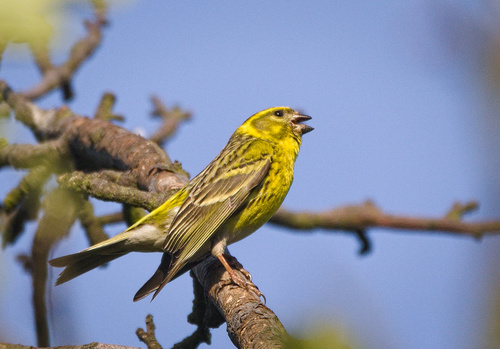
Cirl Bunting

Cirl Bunting

Emberiza cirlus

Silhouette: L. Shyamal · PhyloPic

LCLeast ConcernNTVUENCR
Daily sighting probability <5% · Rare
at Lisbon

In 3 days <5% in a week ~10%

64 Verified sightings at Lisbon
1,469 In all 10 parks From 2019 to 2026
November Best month
☀️🌙 Day & Night When it's spotted

About the Cirl Bunting

The cirl bunting ( SURL) (Emberiza cirlus) is a passerine bird in the bunting family Emberizidae, a group now separated by most modern authors from the finches, Fringillidae. It breeds across southern Europe, on the Mediterranean islands and in north Africa. It is a resident of these warmer areas, and does not migrate in winter. It is common in all sorts of open areas with some scrub or trees, but has a preference for sunny slopes. In the 19th century it was introduced to New Zealand and the persistent population remains in the South Island.

Changes in agricultural practice have affected this species very adversely at the northern fringes of its range, and in England, where it once occurred over much of the south of the country, it is now restricted to south Devon. The cirl bunting is the mascot on the signs for the village of Stokeinteignhead in Devon.

The cirl bunting was formally described by the Swedish naturalist Carl Linnaeus in 1766 in the twelfth edition of his Systema Naturae under its current binomial name Emberiza cirlus. The genus name Emberiza is from Old German Embritz, a bunting. The specific cirlus is from a local Italian name cirlo, for a type of bunting... Wikipedia →

Sounds

Alarm call0:27

Spain · 2026

© Jacobo Ramil Millarengo · XC1141666 · CC BY-NC-SA 4.0

Song0:18

France · 2025

© Azens · XC1007646 · CC BY-NC-SA 4.0

Call1:30

Italy · 2023

© Francesco Sottile · XC806644 · CC BY-NC-SA 4.0

Global Distribution

Parks Where Found

# Park Country Daily sighting probability
1 Cévennes National Park 🇫🇷 France
~20%
2 Sierra de Guadarrama National Park 🇪🇸 Spain
~10%
3 Sierra Nevada National Park 🇪🇸 Spain
~10%
4 Monfragüe National Park 🇪🇸 Spain
~10%
5 Pyrénées National Park 🇫🇷 France
~10%
6 Picos de Europa National Park 🇪🇸 Spain
~10%
7 Aigüestortes National Park 🇪🇸 Spain
<5%
8 Ordesa y Monte Perdido National Park 🇪🇸 Spain
<5%
9 Triglav National Park 🇸🇮 Slovenia
<5%
10 Doñana National Park 🇪🇸 Spain
<5%

Cities Where Found

# City Country Daily sighting probability
1 Marrakesh 🇲🇦 Morocco
<5%
2 Barcelona 🇪🇸 Spain
<5%
3 Athens 🇬🇷 Greece
<5%
4 Istanbul 🇹🇷 Turkey
<5%
5 Lisbon 🇵🇹 Portugal
<5%
6 Belgrade 🇷🇸 Serbia
<5%
7 Madrid 🇪🇸 Spain
<5%
8 Vienna 🇦🇹 Austria
<5%

Before you go

What are the chances of seeing a Cirl Bunting in Lisbon?

Rare

Under 5% of wildlife watchers report a Cirl Bunting sighting in Lisbon on a given day, based on 64 verified sightings from GBIF citizen-science data. It is the 120th most-seen of the 186 birds we can rate there. Over three days the chance rises to under 5%, and over a week to about 10%, if each day is a fresh chance.

When is the best time to see a Cirl Bunting in Lisbon?

Any time of year

In every month with enough records, under 5% of wildlife watchers report a Cirl Bunting in Lisbon on a given day, so our monthly data shows no clear season.

What time of day is best to see a Cirl Bunting?

Between 8 and 11 am

Across all the parks we cover, that three-hour window holds the most Cirl Bunting sightings with a recorded time, and about 7 in 10 of them come between 6 am and 6 pm: it is seen both by day and at night.

Is Lisbon the best place to see a Cirl Bunting?

Among the best

Of the 8 cities where we can rate Cirl Bunting sightings, Lisbon ranks 5th at under 5%, level with the leaders once rounded. The best odds are in Marrakesh (Morocco, under 5%), Barcelona (Spain, under 5%) and Athens (Greece, under 5%).

Where does the Cirl Bunting sighting chance come from?

GBIF citizen-science records

It is estimated from how often the Cirl Bunting is recorded against all the birds logged in Lisbon (64 verified sightings), calibrated against known sighting rates. Figures are rounded to the nearest 10% because citizen-science data supports honest approximations, not decimals, and months with records from fewer than five people show "—". How it works.

← Back to Lisbon