Saltbush Blue

Saltbush Blue

Theclinesthes serpentata

Daily sighting probability ~10% · With luck
at Melbourne

In 3 days ~30% in a week ~50%

386 Verified sightings at Melbourne
37 In all 4 parks From 2019 to 2026
April Best month
☀️ Diurnal When it's spotted

About the Saltbush Blue

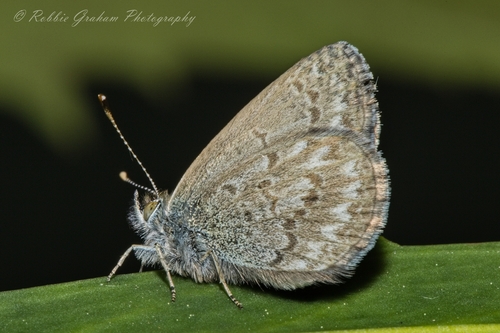
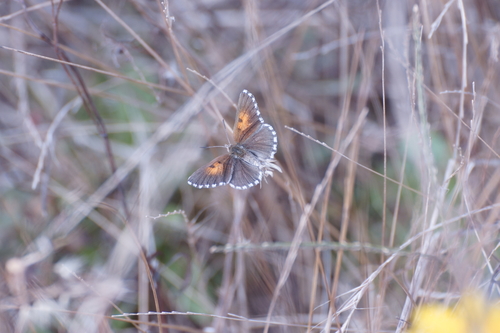
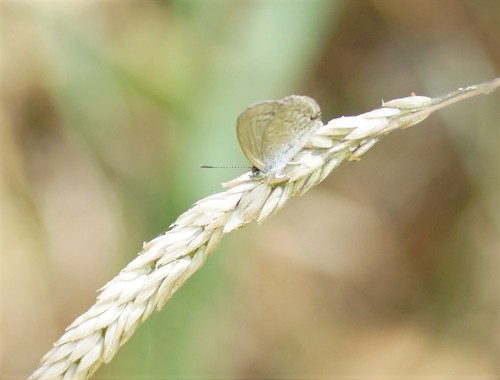
Theclinesthes serpentata, commonly known as the saltbush blue or chequered blue, is a species of butterfly in the family Lycaenidae that is native to Australia. The species was first described in 1869 by German entomologist and physician G. A. W. Herrich-Schäffer. It is common throughout all Australian states and territories, and can be found in a wide range of habitats.

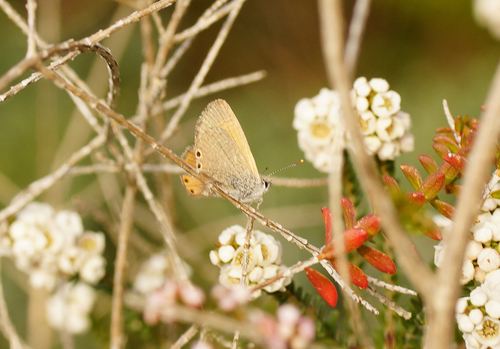
This is a very small butterfly, with a wingspan of 18 mm (0.71 in) for both male and female specimens. On the top side, the wings have broad margins of brown, with blue colouration towards the thorax. The underside is brown with patches of white. Male and female specimens have the same colouration, which ranges from mid to dark brown and purple-blue to blue. The larvae grow to 9mm in length, with a textured skin surface and colouration ranging from pale green to grey-green. The caterpillars blend in with their host plant, the saltbush, but have black and yellow stripes lining their back that can distinguish them.

The saltbush blue has a wide distribution, due to their preferential food plant being dispersed across biomes and states. Thus, the butterfly occupies a diverse range of habitats... Wikipedia →

Global Distribution

Parks Where Found

# Park Country Daily sighting probability
1 Hattah-Kulkyne National Park 🇦🇺 Australia
~20%
2 Rottnest Island 🇦🇺 Australia
~20%
3 Wilsons Promontory National Park 🇦🇺 Australia
~10%
4 Grampians National Park 🇦🇺 Australia
~10%

Cities Where Found

# City Country Daily sighting probability
1 Melbourne 🇦🇺 Australia
~10%
2 Perth 🇦🇺 Australia
<5%

Before you go

What are the chances of seeing a Saltbush Blue in Melbourne?

With luck

About 10% of wildlife watchers report a Saltbush Blue sighting in Melbourne on a given day, based on 386 verified sightings from GBIF citizen-science data. It is the 51st most-seen of the 875 insects we can rate there. Over three days the chance rises to about 30%, and over a week to about 50%, if each day is a fresh chance.

When is the best time to see a Saltbush Blue in Melbourne?

March and April

In those months about 20% of wildlife watchers report a Saltbush Blue in Melbourne on a given day, against under 5% in June to August, the lowest months.

What time of day is best to see a Saltbush Blue?

Between 10 am and 1 pm

Across all the parks we cover, that three-hour window holds the most Saltbush Blue sightings with a recorded time, and about 8 in 10 of them come between 6 am and 6 pm: it is a daytime animal.

Is Melbourne the best place to see a Saltbush Blue?

Yes

Of the 2 cities where we can rate Saltbush Blue sightings, Melbourne has the highest daily chance: about 10%. Next come Perth (Australia, under 5%).

Which relatives of the Saltbush Blue live in Melbourne?

Same family: Lycaenidae

The closest relatives of the Saltbush Blue that you can see in Melbourne (family Lycaenidae, Gossamer-winged Butterflies) are Lesser Grass Blue (about 20%), Zizina labradus (about 10%) and Common Imperial Blue (about 10%), with each one's daily chance of a sighting.

Where does the Saltbush Blue sighting chance come from?

GBIF citizen-science records

It is estimated from how often the Saltbush Blue is recorded against all the insects logged in Melbourne (386 verified sightings), calibrated against known sighting rates. Figures are rounded to the nearest 10% because citizen-science data supports honest approximations, not decimals, and months with records from fewer than five people show "—". How it works.

← Back to Melbourne