Satin Flycatcher

Satin Flycatcher

Myiagra cyanoleuca

Silhouette: Sheatherius · PhyloPic

LCLeast ConcernNTVUENCR
Daily sighting probability <5% · Rare
at Melbourne

In 3 days <5%

63 Verified sightings at Melbourne
326 In all 7 parks From 2019 to 2026
November Best month
☀️ Diurnal When it's spotted

About the Satin Flycatcher

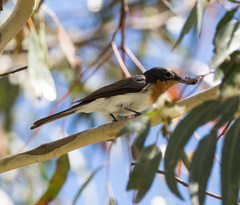
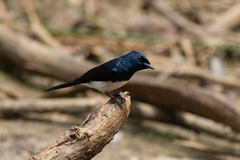
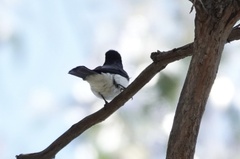
The satin flycatcher (Myiagra cyanoleuca) is a species of bird in the family Monarchidae. Males stand out with their blue-black feathers contrasting their white bellies, and the females with their bright orange throats. It breeds mostly in south-eastern Tasmania and Australia. It is declining throughout the eastern seaboard due to predation from the introduced Red Fox and habitat loss. It is a vagrant to New Zealand.

The satin flycatcher was originally described in the genus Platyrhynchos. Alternate names include satin Myiagra and satin Myiagra-flycatcher. The name Myiagra is derived from the Ancient Greek 'muia', meaning 'fly' (insect), and 'agreo', meaning 'seize' (thus, 'flycatcher'). Cyanoleuca is derived from 'cyanos' (blue) and 'leucos' (white).

The satin flycatcher is a member of the Monarchidae family, or the Monarchs, which contains around 100 small, passerine, insectivorous birds. The family stretches across much of the planet, with species living in Africa, Asia and the pacific amongst other areas.

The genus Myiagra is distinct from other members of the Monarchidae family by their obvious sexual dimorphism, egg patterns, and unpatterned crests... Wikipedia →

Sounds

Song0:30

Australia · 2020

© Marc Anderson · XC673994 · CC BY-NC-ND 4.0

Call0:13

Australia · 2019

© Ramit Singal · XC503532 · CC BY-NC-SA 4.0

Song0:15

Australia · 2015

© Dezmond Wells · XC301414 · CC BY-NC-SA 4.0

Global Distribution

Parks Where Found

# Park Country Daily sighting probability
1 Kosciuszko National Park 🇦🇺 Australia
~10%
2 Maria Island National Park 🇦🇺 Australia
~10%
3 Great Otway National Park 🇦🇺 Australia
~10%
4 Wilsons Promontory National Park 🇦🇺 Australia
<5%
5 Daintree National Park 🇦🇺 Australia
<5%
6 Grampians National Park 🇦🇺 Australia
<5%
7 Blue Mountains National Park 🇦🇺 Australia
<5%

Cities Where Found

# City Country Daily sighting probability
1 Melbourne 🇦🇺 Australia
<5%
2 Brisbane 🇦🇺 Australia
<5%
3 Sydney 🇦🇺 Australia
<5%

Before you go

What are the chances of seeing a Satin Flycatcher in Melbourne?

Rare

Under 5% of wildlife watchers report a Satin Flycatcher sighting in Melbourne on a given day, based on 63 verified sightings from GBIF citizen-science data. It is the 179th most-seen of the 236 birds we can rate there. Over three days the chance rises to under 5%, if each day is a fresh chance.

When is the best time to see a Satin Flycatcher in Melbourne?

Any time of year

In every month with enough records, under 5% of wildlife watchers report a Satin Flycatcher in Melbourne on a given day, so our monthly data shows no clear season.

What time of day is best to see a Satin Flycatcher?

Between 11 am and 2 pm

Across all the parks we cover, that three-hour window holds the most Satin Flycatcher sightings with a recorded time, and about 9 in 10 of them come between 6 am and 6 pm: it is a daytime animal.

Is Melbourne the best place to see a Satin Flycatcher?

Yes

Of the 3 cities where we can rate Satin Flycatcher sightings, Melbourne has the highest daily chance: under 5%. Next come Brisbane (Australia, under 5%) and Sydney (Australia, under 5%).

Where does the Satin Flycatcher sighting chance come from?

GBIF citizen-science records

It is estimated from how often the Satin Flycatcher is recorded against all the birds logged in Melbourne (63 verified sightings), calibrated against known sighting rates. Figures are rounded to the nearest 10% because citizen-science data supports honest approximations, not decimals, and months with records from fewer than five people show "—". How it works.

← Back to Melbourne