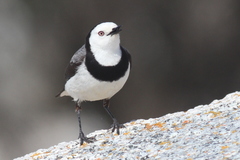
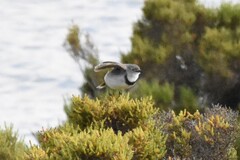
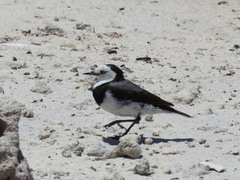

White-fronted Chat

White-fronted Chat

Epthianura albifrons

Silhouette: Rachael Joakim · PhyloPic

LCLeast ConcernNTVUENCR Endemic
Daily sighting probability <5% · Rare
at Melbourne

In 3 days <5%

148 Verified sightings at Melbourne
448 In all 7 parks From 2019 to 2026
February Best month
☀️ Diurnal When it's spotted

About the White-fronted Chat

The white-fronted chat (Epthianura albifrons) is a species of bird in the honeyeater family Meliphagidae native to southern Australia. The male has a white face bordered by a black breast band. It is insectivorous. Sir Willam Jardine and P.J.Selby described the white-fronted chat in 1828 as Acanthiza albifrons. Lesson described it in 1844 as Fluvicola leucocephala, and Brehm as Cinura torquata in 1845. John Gould named it Epthianura albifrons in 1838. The derivation of the generic name Epthianura is obscure, coming either from the Ancient Greek ephthos 'refined' or ephthinaō 'wasting away' and oura 'tail' (referring to the "short and truncated tail"). The specific epithet albifrons derives from the Latin albus 'white' and frons 'forehead'.

The species is monotypic; that is, no subspecies are recognised. Tasmanian birds were thought to have longer bills but this has not been borne out on further investigation. This species has collected many vernacular names. From its distinctive call were derived the names (banded) tintack, gar and tang, and the males' resemblance to a nun's habit led to the name (white-fronted) nun, and similarly moonface, moonbird, baldyhead, baldy... Wikipedia →

Sounds

Call0:20

Australia · 2023

© Romuald Mikusek · XC1062951 · CC BY-NC-SA 4.0

Call0:10

Australia · 2023

© Peter Boesman · XC859864 · CC BY-NC-ND 4.0

Call0:25

Australia · 2020

© Marc Anderson · XC594029 · CC BY-NC-ND 4.0

Global Distribution

Parks Where Found

# Park Country Daily sighting probability
1 Rottnest Island 🇦🇺 Australia
~40%
2 Maria Island National Park 🇦🇺 Australia
~30%
3 Flinders Ranges National Park 🇦🇺 Australia
~10%
4 Freycinet National Park 🇦🇺 Australia
<5%
5 Wilsons Promontory National Park 🇦🇺 Australia
<5%
6 Hattah-Kulkyne National Park 🇦🇺 Australia
<5%
7 Grampians National Park 🇦🇺 Australia
<5%

Cities Where Found

# City Country Daily sighting probability
1 Melbourne 🇦🇺 Australia
<5%

Before you go

What are the chances of seeing a White-fronted Chat in Melbourne?

Rare

Under 5% of wildlife watchers report a White-fronted Chat sighting in Melbourne on a given day, based on 148 verified sightings from GBIF citizen-science data. It is the 156th most-seen of the 236 birds we can rate there. Over three days the chance rises to under 5%, if each day is a fresh chance.

When is the best time to see a White-fronted Chat in Melbourne?

Any time of year

In every month with enough records, under 5% of wildlife watchers report a White-fronted Chat in Melbourne on a given day, so our monthly data shows no clear season.

What time of day is best to see a White-fronted Chat?

Between 10 am and 1 pm

Across all the parks we cover, that three-hour window holds the most White-fronted Chat sightings with a recorded time, and about 9 in 10 of them come between 6 am and 6 pm: it is a daytime animal.

Where else can you see a White-fronted Chat?

Only Melbourne, in our data

Melbourne is the only city on Wallace's Line with enough records to rate White-fronted Chat sightings: under 5% of wildlife watchers there report one on a given day.

Which relatives of the White-fronted Chat live in Melbourne?

Same family: Meliphagidae

The closest relatives of the White-fronted Chat that you can see in Melbourne (family Meliphagidae, Honeyeaters) are Noisy Miner (about 80%), Red Wattlebird (about 70%) and White-plumed Honeyeater (about 30%), with each one's daily chance of a sighting.

Where does the White-fronted Chat sighting chance come from?

GBIF citizen-science records

It is estimated from how often the White-fronted Chat is recorded against all the birds logged in Melbourne (148 verified sightings), calibrated against known sighting rates. Figures are rounded to the nearest 10% because citizen-science data supports honest approximations, not decimals, and months with records from fewer than five people show "—". How it works.

← Back to Melbourne