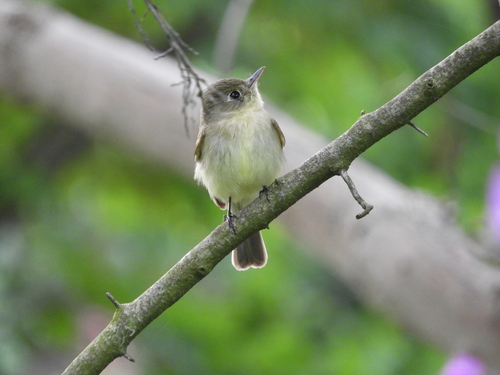
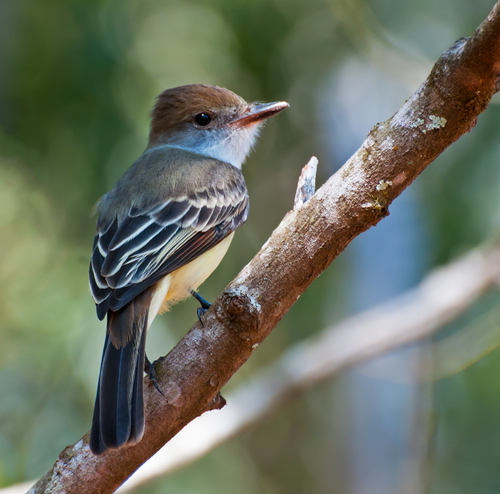
Cassin's Kingbird

Cassin's Kingbird

Tyrannus vociferans

Silhouette: Andy Wilson · PhyloPic

LCLeast ConcernNTVUENCR
Daily sighting probability <5% · Rare
at Mesa

In 3 days <5%

27 Verified sightings at Mesa
1,291 In all 15 parks From 2019 to 2026
September Best month
☀️ Diurnal When it's spotted

About the Cassin's Kingbird

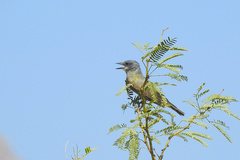
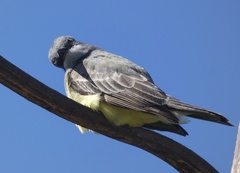
Cassin's kingbird (Tyrannus vociferans) is a large tyrant flycatcher native to western North America. The name of this bird commemorates the American ornithologist John Cassin. Cassin's kingbird was formally described in 1826 by English naturalist William Swainson under the current binomial name Tyrannus vociferans. The type locality is Temascaltepec, Mexico. The specific epithet vociferans is Latin for "shouting".

Two subspecies are recognised: They have a pale throat and deep yellow lower breast. Juveniles are duller and have pale edges on their wings. Measurements: Length: 8.3–9.1 in (21–23 cm) Weight: 1.6 oz (45 g) Wingspan: 41 cm Cassin's kingbird and the western kingbird are similar in appearance. Cassin's is a little larger than the western and the upper parts are a darker gray than the western. The most distinctive difference between these birds is that the Cassin's has a thin white edge... Wikipedia →

Sounds

Vesper calling1:02

United States · 2023

© Richard E. Webster · XC1034116 · CC BY-NC-SA 4.0

Call0:22

United States · 2025

© David Tattersley · XC999645 · CC BY-NC-SA 4.0

Song1:20

Mexico · 2021

© Manuel Grosselet · XC620778 · CC BY-NC-SA 4.0

Global Distribution

Parks Where Found

# Park Country Daily sighting probability
1 Reserva de la Biosfera Mariposa Monarca 🇲🇽 Mexico
~20%
2 Cabo Pulmo National Park 🇲🇽 Mexico
~20%
3 Guadalupe Mountains National Park 🇺🇸 United States
~10%
4 Bahía de Loreto National Park 🇲🇽 Mexico
~10%
5 Big Bend National Park 🇺🇸 United States
~10%
6 Saguaro National Park 🇺🇸 United States
<5%
7 Zion National Park 🇺🇸 United States
<5%
8 Cumbres de Monterrey National Park 🇲🇽 Mexico
<5%
9 El Vizcaíno Biosphere Reserve 🇲🇽 Mexico
<5%
10 Channel Islands National Park 🇺🇸 United States
<5%
11 Grand Canyon National Park 🇺🇸 United States
<5%
12 Cañón del Sumidero National Park 🇲🇽 Mexico
<5%
13 Joshua Tree National Park 🇺🇸 United States
<5%
14 Point Pelee National Park 🇨🇦 Canada
<5%
15 Everglades National Park 🇺🇸 United States
<5%

Cities Where Found

# City Country Daily sighting probability
1 León 🇲🇽 México
~80%
2 Puebla 🇲🇽 México
~50%
3 Mexico City 🇲🇽 México
~40%
4 Toluca 🇲🇽 México
~40%
5 San Diego 🇺🇸 United States
~40%
6 Los Angeles 🇺🇸 United States
~30%
7 Guadalajara 🇲🇽 México
~30%
8 Tijuana 🇲🇽 México
~30%
9 Torreón 🇲🇽 México
~20%
10 San Luis Potosí 🇲🇽 México
~10%

Before you go

What are the chances of seeing a Cassin's Kingbird in Mesa?

Rare

Under 5% of wildlife watchers report a Cassin's Kingbird sighting in Mesa on a given day, based on 27 verified sightings from GBIF citizen-science data. It is the 220th most-seen of the 268 birds we can rate there. Over three days the chance rises to under 5%, if each day is a fresh chance.

When is the best time to see a Cassin's Kingbird in Mesa?

Any time of year

In every month with enough records, under 5% of wildlife watchers report a Cassin's Kingbird in Mesa on a given day, so our monthly data shows no clear season.

What time of day is best to see a Cassin's Kingbird?

Between 8 and 11 am

Across all the parks we cover, that three-hour window holds the most Cassin's Kingbird sightings with a recorded time, and about 8 in 10 of them come between 6 am and 6 pm: it is a daytime animal.

Is Mesa the best place to see a Cassin's Kingbird?

12th of 15

Of the 15 cities where we can rate Cassin's Kingbird sightings, Mesa ranks 12th at under 5%. The best odds are in León (México, about 80%), Puebla (México, about 50%) and Mexico City (México, about 40%).

Where does the Cassin's Kingbird sighting chance come from?

GBIF citizen-science records

It is estimated from how often the Cassin's Kingbird is recorded against all the birds logged in Mesa (27 verified sightings), calibrated against known sighting rates. Figures are rounded to the nearest 10% because citizen-science data supports honest approximations, not decimals, and months with records from fewer than five people show "—". How it works.

← Back to Mesa