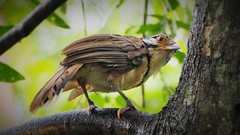
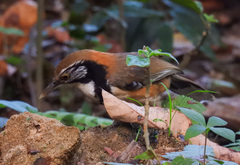
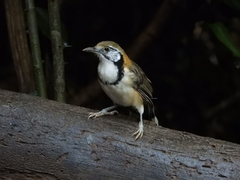
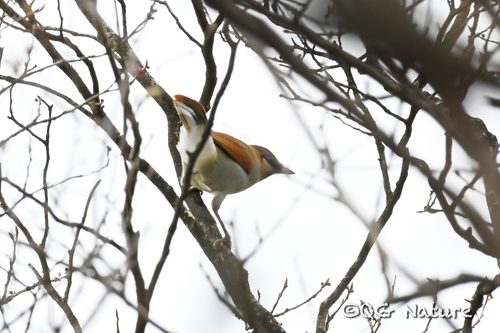
Greater Necklaced Laughing Thrush

Greater Necklaced Laughing Thrush

Garrulax pectoralis

Silhouette: Jiekun He · PhyloPic

Daily sighting probability ~30% · Possible
at Nanjing

In 3 days ~60% in a week ~90%

166 Verified sightings at Nanjing
1,875 In all 7 parks From 2019 to 2026
February Best month
🌅 Crepuscular When it's spotted

About the Greater Necklaced Laughing Thrush

The greater necklaced laughingthrush (Pterorhinus pectoralis) is a species of passerine bird in the family Leiothrichidae. It is found in Bangladesh, Bhutan, China, India, Laos, Myanmar, Nepal, Thailand and Vietnam. It is introduced to Hawaii. Its natural habitats are subtropical or tropical moist lowland forest and subtropical or tropical moist montane forest.

This species was formerly placed in the genus Garrulax but following the publication of a comprehensive molecular phylogenetic study in 2018, it was moved to the resurrected genus Pterorhinus. In mixed-species foraging flocks, greater necklaced laughingthrushes tend to be dominant. The mimicry of this species by the Lesser necklaced laughingthrush, which is not especially closely related, may have been selected for as a result.

Media related to Pterorhinus pectoralis at Wikimedia Commons Wikipedia →

Sounds

Recording0:34

Hong Kong SAR China · 2025

© lava_chen · iNaturalist · CC BY-NC 4.0

Recording0:09

China · 2026

© 王颖 · iNaturalist · CC BY-NC 4.0

Recording0:24

China · 2026

© 李德胜 · iNaturalist · CC BY-NC 4.0

Global Distribution

Parks Where Found

# Park Country Daily sighting probability
1 Kaeng Krachan National Park 🇹🇭 Thailand
~30%
2 Namdapha National Park 🇮🇳 India
~20%
3 Royal Manas National Park 🇧🇹 Bhutan
~10%
4 Chitwan National Park 🇳🇵 Nepal
<5%
5 Manas National Park 🇮🇳 India
<5%
6 Doi Inthanon National Park 🇹🇭 Thailand
<5%
7 Kaziranga National Park 🇮🇳 India
<5%

Cities Where Found

# City Country Daily sighting probability
1 Nanjing 🇨🇳 China
~30%
2 Changsha 🇨🇳 China
~20%
3 Guangzhou 🇨🇳 China
~10%
4 Hong Kong 🇨🇳 China
<5%
5 Tuen Mun 🇨🇳 China
<5%
6 Hangzhou 🇨🇳 China
<5%

Before you go

What are the chances of seeing a Greater Necklaced Laughing Thrush in Nanjing?

Possible

About 30% of wildlife watchers report a Greater Necklaced Laughing Thrush sighting in Nanjing on a given day, based on 166 verified sightings from GBIF citizen-science data. It is the 32nd most-seen of the 162 birds we can rate there. Over three days the chance rises to about 60%, and over a week to about 90%, if each day is a fresh chance.

When is the best time to see a Greater Necklaced Laughing Thrush in Nanjing?

November to June

In those months about 30% of wildlife watchers report a Greater Necklaced Laughing Thrush in Nanjing on a given day, against about 20% in July to October, the lowest months.

What time of day is best to see a Greater Necklaced Laughing Thrush?

Between 3 and 6 am

Across all the parks we cover, that three-hour window holds the most Greater Necklaced Laughing Thrush sightings with a recorded time, and about half of them come between 6 am and 6 pm: it is most active around dawn and dusk.

Is Nanjing the best place to see a Greater Necklaced Laughing Thrush?

Yes

Of the 6 cities where we can rate Greater Necklaced Laughing Thrush sightings, Nanjing has the highest daily chance: about 30%. Next come Changsha (China, about 20%) and Guangzhou (China, about 10%).

Which relatives of the Greater Necklaced Laughing Thrush live in Nanjing?

Same genus: Garrulax

The closest relatives of the Greater Necklaced Laughing Thrush that you can see in Nanjing (genus Garrulax, Typical Laughingthrushes) are Masked Laughingthrush (about 70%), Buffy Laughingthrush (about 10%) and Chinese Hwamei (about 10%), with each one's daily chance of a sighting.

Where does the Greater Necklaced Laughing Thrush sighting chance come from?

GBIF citizen-science records

It is estimated from how often the Greater Necklaced Laughing Thrush is recorded against all the birds logged in Nanjing (166 verified sightings), calibrated against known sighting rates. Figures are rounded to the nearest 10% because citizen-science data supports honest approximations, not decimals, and months with records from fewer than five people show "—". How it works.

← Back to Nanjing