Yellow-wattled Lapwing

Yellow-wattled Lapwing

Vanellus malabaricus

Silhouette: Rebecca Groom · PhyloPic

LCLeast ConcernNTVUENCR
Daily sighting probability <5% · Rare
at New Delhi

In 3 days ~10%

185 Verified sightings at New Delhi
3,131 In all 13 parks From 2019 to 2026
August Best month
🌅 Crepuscular When it's spotted

About the Yellow-wattled Lapwing

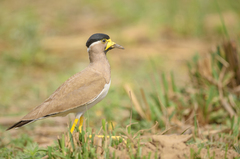
The yellow-wattled lapwing (Vanellus malabaricus) is a lapwing that is endemic to the Indian subcontinent. It is found mainly on the dry plains of peninsular India and has a sharp call and is capable of fast flight. Although they do not migrate, they are known to make seasonal movements in response to rains. They are dull grey brown with a black cap, yellow legs and a triangular wattle at the base of the beak. Like other lapwings and plovers, they are ground birds and their nest is a mere collection of tiny pebbles within which their well camouflaged eggs are laid. The chicks are nidifugous, leaving the nest shortly after hatching and following their parents to forage for food.

The yellow-wattled lapwing was described by the French polymath Georges-Louis Leclerc, Comte de Buffon in his Histoire Naturelle des Oiseaux in 1781. The bird was also illustrated in a hand-coloured plate engraved by François-Nicolas Martinet in the Planches Enluminées D'Histoire Naturelle. This plate was produced under the supervision of Edme-Louis Daubenton to accompany Buffon's text. Neither the plate caption nor Buffon's description included a scientific name but in 1783 the Dutch naturalist... Wikipedia →

Sounds

Call0:25

India · 2025

© Peter Boesman · XC1030952 · CC BY-NC-ND 4.0

Alarm call0:17

India · 2016

© Dilip KG · XC333310 · CC BY-NC-SA 4.0

Call0:21

India · 2018

© ARUN PRABHU · XC426343 · CC BY-NC-SA 4.0

Global Distribution

Parks Where Found

# Park Country Daily sighting probability
1 Yala National Park 🇱🇰 Sri Lanka
~50%
2 Udawalawe National Park 🇱🇰 Sri Lanka
~50%
3 Kanha National Park 🇮🇳 India
~20%
4 Mudumalai National Park 🇮🇳 India
~20%
5 Bandhavgarh National Park 🇮🇳 India
~20%
6 Wilpattu National Park 🇱🇰 Sri Lanka
~10%
7 Gir National Park 🇮🇳 India
~10%
8 Bandipur National Park 🇮🇳 India
~10%
9 Keoladeo National Park 🇮🇳 India
~10%
10 Ranthambore National Park 🇮🇳 India
~10%
11 Satpura National Park 🇮🇳 India
<5%
12 Nagarhole National Park 🇮🇳 India
<5%
13 Jim Corbett National Park 🇮🇳 India
<5%

Cities Where Found

# City Country Daily sighting probability
1 Rajkot 🇮🇳 India
~10%
2 Thrissur 🇮🇳 India
~10%
3 Prayagraj 🇮🇳 India
~10%
4 Indore 🇮🇳 India
~10%
5 Tiruppur 🇮🇳 India
~10%
6 Ranchi 🇮🇳 India
~10%
7 Gwalior 🇮🇳 India
~10%
8 Lucknow 🇮🇳 India
~10%
9 Bhubaneshwar 🇮🇳 India
~10%
10 Mysuru 🇮🇳 India
~10%

Before you go

What are the chances of seeing a Yellow-wattled Lapwing in New Delhi?

Rare

Under 5% of wildlife watchers report a Yellow-wattled Lapwing sighting in New Delhi on a given day, based on 185 verified sightings from GBIF citizen-science data. It is the 117th most-seen of the 248 birds we can rate there. Over three days the chance rises to about 10%, if each day is a fresh chance.

When is the best time to see a Yellow-wattled Lapwing in New Delhi?

Any time of year

In every month with enough records, under 5% of wildlife watchers report a Yellow-wattled Lapwing in New Delhi on a given day, so our monthly data shows no clear season.

What time of day is best to see a Yellow-wattled Lapwing?

Between 3 and 6 am

Across all the parks we cover, that three-hour window holds the most Yellow-wattled Lapwing sightings with a recorded time, and about half of them come between 6 am and 6 pm: it is most active around dawn and dusk.

Is New Delhi the best place to see a Yellow-wattled Lapwing?

22nd of 34

Of the 34 cities where we can rate Yellow-wattled Lapwing sightings, New Delhi ranks 22nd at under 5%. The best odds are in Rajkot (India, about 10%), Thrissur (India, about 10%) and Prayagraj (India, about 10%).

Where does the Yellow-wattled Lapwing sighting chance come from?

GBIF citizen-science records

It is estimated from how often the Yellow-wattled Lapwing is recorded against all the birds logged in New Delhi (185 verified sightings), calibrated against known sighting rates. Figures are rounded to the nearest 10% because citizen-science data supports honest approximations, not decimals, and months with records from fewer than five people show "—". How it works.

← Back to New Delhi