Curl-crested Jay

Curl-crested Jay

Cyanocorax cristatellus

Silhouette: Sheatherius · PhyloPic

LCLeast ConcernNTVUENCR
Daily sighting probability <5% · Rare
at Niterói

In 3 days <5%

7 Verified sightings at Niterói
706 In all 6 parks From 2019 to 2026
October Best month
☀️ Diurnal When it's spotted

About the Curl-crested Jay

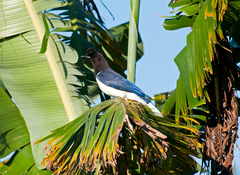
The curl-crested jay (Cyanocorax cristatellus) is a species of jay native to South America. This New World jay is a beautiful and large (35 cm/14 in overall) bird with predominantly dark blue back, an almost black head and neck, and snow-white chest and underparts. They have a pronounced curled crest rising from just behind the beak; the crest is on average larger in males, but the sexes are generally quite similar.

The voice is a loud, gray, graa, gray-gray-gray, sometimes repeated 8-10 times. They sound similar to crow. Curl-crested jays are native to the cerrados of central and southern and the caatinga of north-eastern Brazil. In the southeast Amazon Basin, curl-crested jay ranges into the upstream headwater regions adjacent to the northwestern cerrado. In the west, the extreme headwaters of the west-flowing Guaporé River on the Brazil-Bolivia are home. For the southeast Amazon, the north-flowing rivers that limit the range are the Tapajós on the west, the Xingu River, then the adjacent drainage to the east, the Araguaia-Tocantins River system. The range continues easterly and southerly through the cerrado. The range on the river systems is only the upstream half of the drainages. They can also be found in extreme northern Paraguay. Altogether, they are limited by the extent of habitat, but wherever this is suitable, they may not be rare. For example, they are the most commonly seen corvid in the Serra do Cipó National Park.

They live in groups of from 6 to 12 individuals, moving from food source to food source during the day. They leave a lookout nearby to keep watch for predators. This bird is a generalist, eating almost anything, including eggs and nestlings of other birds, insects, arthropods, and small vertebrates like geckos. It also likes palm nuts and is particularly fond of the seeds of the native Inga laurina and the fruits of the introduced umbrella tree (Heptapleurum actinophyllum). Curl-crested jays have even been observed spending the early morning in a pequi tree (Caryocar brasiliense) where they fed on nectar, and perhaps also on invertebrates which had visited the mainly night-blooming flowers of this plant.

This jay is not considered a threatened species by the IUCN, and in fact they are at present expanding their range. However, range expansions may only be temporary and populations may eventually disappear from formerly settled locations again. Wikipedia →

Sounds

Call0:58

Brazil · 2026

© JAYRSON ARAUJO DE OLIVEIRA · XC1136277 · CC BY-NC-SA 4.0

Alarm call0:31

Brazil · 2024

© rafarrinho · XC1041439 · CC BY-NC-SA 4.0

Canto1:26

Brazil · 2015

© Caio Brito · XC427282 · CC BY-NC-SA 4.0

Global Distribution

Parks Where Found

# Park Country Daily sighting probability
1 Emas National Park 🇧🇷 Brazil
~80%
2 Serra da Canastra National Park 🇧🇷 Brazil
~20%
3 Itatiaia National Park 🇧🇷 Brazil
~10%
4 Chapada dos Guimarães National Park 🇧🇷 Brazil
~10%
5 Tijuca National Park 🇧🇷 Brazil
<5%
6 Serra dos Órgãos National Park 🇧🇷 Brazil
<5%

Cities Where Found

# City Country Daily sighting probability
1 Campinas 🇧🇷 Brazil
~10%
2 Rio de Janeiro 🇧🇷 Brazil
~10%
3 Belo Horizonte 🇧🇷 Brazil
<5%
4 Brasilia 🇧🇷 Brazil
<5%
5 São Paulo 🇧🇷 Brazil
<5%
6 Niterói 🇧🇷 Brazil
<5%

Zoos & Centres Where Found

# Zoo / Centre Country
1 Zoológico Municipal de Guarulhos 🇧🇷 Brazil In captivity
2 Zooparque Itatiba 🇧🇷 Brazil In captivity

Before you go

What are the chances of seeing a Curl-crested Jay in Niterói?

Rare

Under 5% of wildlife watchers report a Curl-crested Jay sighting in Niterói on a given day, based on 7 verified sightings from GBIF citizen-science data. It is the 101st most-seen of the 116 birds we can rate there. Over three days the chance rises to under 5%, if each day is a fresh chance.

When is the best time to see a Curl-crested Jay in Niterói?

Any time of year

In every month with enough records, under 5% of wildlife watchers report a Curl-crested Jay in Niterói on a given day, so our monthly data shows no clear season.

What time of day is best to see a Curl-crested Jay?

Between 7 and 10 am

Across all the parks we cover, that three-hour window holds the most Curl-crested Jay sightings with a recorded time, and about 9 in 10 of them come between 6 am and 6 pm: it is a daytime animal.

Is Niterói the best place to see a Curl-crested Jay?

6th of 6

Of the 6 cities where we can rate Curl-crested Jay sightings, Niterói ranks 6th at under 5%. The best odds are in Campinas (Brazil, about 10%), Rio de Janeiro (Brazil, about 10%) and Belo Horizonte (Brazil, under 5%).

Which relatives of the Curl-crested Jay live in Niterói?

Same order: Passeriformes

The closest relatives of the Curl-crested Jay that you can see in Niterói (order Passeriformes, Perching Birds) are Great Kiskadee (over 90%), Bananaquit (over 90%) and Palm Tanager (about 90%), with each one's daily chance of a sighting.

Where does the Curl-crested Jay sighting chance come from?

GBIF citizen-science records

It is estimated from how often the Curl-crested Jay is recorded against all the birds logged in Niterói (7 verified sightings), calibrated against known sighting rates. Figures are rounded to the nearest 10% because citizen-science data supports honest approximations, not decimals, and months with records from fewer than five people show "—". How it works.

← Back to Niterói