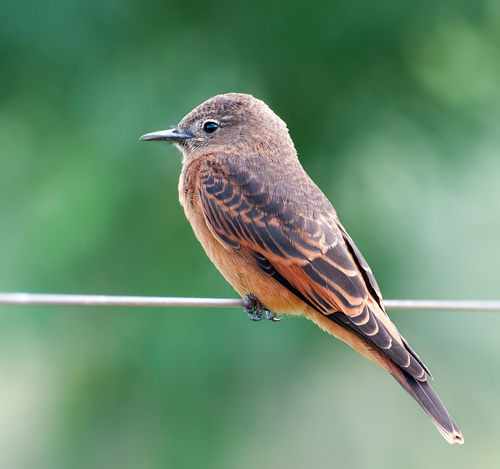
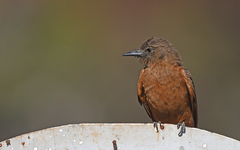

Cliff Flycatcher

Cliff Flycatcher

Hirundinea ferruginea

Silhouette: Emily Willoughby · PhyloPic

LCLeast ConcernNTVUENCR
Daily sighting probability ~30% · Possible
at Niterói

In 3 days ~70% in a week ~90%

512 Verified sightings at Niterói
2,331 In all 10 parks From 2019 to 2026
May Best month
☀️ Diurnal When it's spotted

About the Cliff Flycatcher

The cliff flycatcher (Hirundinea ferruginea) is a species of bird in the family Tyrannidae, the tyrant flycatchers. It is known in every mainland South American country except Chile and may occur there as well. The cliff flycatcher was formally described in 1788 by the German naturalist Johann Friedrich Gmelin in his revised and expanded edition of Carl Linnaeus's Systema Naturae. He placed it with the todies in the genus Todus and coined the binomial name Todus ferrugineus. Gmelin based his description on the "ferruginous bellied tody" from Cayenne that had been described in 1782 by the English ornithologist John Latham in his book A General Synopsis of Birds. Latham had access to a specimen in the Leverian Museum in London. The cliff flycatcher is the only species in the genus Hirundinea that was introduced in 1837 by the French naturalists Alcide d'Orbigny and Frédéric de Lafresnaye The genus name Hirundinea is Latin meaning "of swallows"; the specific epithet ferruginea is Latin meaning "rusty-colored" or "ferruginous".

The cliff flycatcher's further taxonomy is unsettled. The International Ornithological Congress, the South American Classification... Wikipedia →

Sounds

Call0:43

Ecuador · 2024

© Matthew L. Brady · XC977317 · CC BY-NC-SA 4.0

Recording0:36

Uruguay · 2024

© Guillermo Menéndez (gmmv80) · XC881591 · CC BY-NC-SA 4.0

Song0:07

Brazil · 2023

© JAYRSON ARAUJO DE OLIVEIRA · XC857551 · CC BY-NC-SA 4.0

Global Distribution

Parks Where Found

# Park Country Daily sighting probability
1 Itatiaia National Park 🇧🇷 Brazil
~60%
2 Serra dos Órgãos National Park 🇧🇷 Brazil
~50%
3 Chapada dos Guimarães National Park 🇧🇷 Brazil
~20%
4 Chapada Diamantina National Park 🇧🇷 Brazil
~20%
5 Serra da Canastra National Park 🇧🇷 Brazil
~20%
6 Amboró National Park 🇧🇴 Bolivia
~10%
7 Tijuca National Park 🇧🇷 Brazil
~10%
8 Emas National Park 🇧🇷 Brazil
<5%
9 Sierra de la Macarena National Park 🇨🇴 Colombia
<5%
10 Podocarpus National Park 🇪🇨 Ecuador
<5%

Cities Where Found

# City Country Daily sighting probability
1 Niterói 🇧🇷 Brazil
~30%
2 São Paulo 🇧🇷 Brazil
~10%
3 Campinas 🇧🇷 Brazil
~10%
4 Cochabamba 🇧🇴 Bolivia
~10%
5 Rio de Janeiro 🇧🇷 Brazil
~10%
6 Santos 🇧🇷 Brazil
<5%
7 Belo Horizonte 🇧🇷 Brazil
<5%
8 Cordoba 🇦🇷 Argentina
<5%
9 Curitiba 🇧🇷 Brazil
<5%

Before you go

What are the chances of seeing a Cliff Flycatcher in Niterói?

Possible

About 30% of wildlife watchers report a Cliff Flycatcher sighting in Niterói on a given day, based on 512 verified sightings from GBIF citizen-science data. It is the 16th most-seen of the 116 birds we can rate there. Over three days the chance rises to about 70%, and over a week to about 90%, if each day is a fresh chance.

When is the best time to see a Cliff Flycatcher in Niterói?

March–June and October

In those months about 40% of wildlife watchers report a Cliff Flycatcher in Niterói on a given day, against about 20% in December to February, the lowest months.

What time of day is best to see a Cliff Flycatcher?

Between 11 am and 2 pm

Across all the parks we cover, that three-hour window holds the most Cliff Flycatcher sightings with a recorded time, and about 8 in 10 of them come between 6 am and 6 pm: it is a daytime animal.

Is Niterói the best place to see a Cliff Flycatcher?

Yes

Of the 9 cities where we can rate Cliff Flycatcher sightings, Niterói has the highest daily chance: about 30%. Next come São Paulo (Brazil, about 10%) and Campinas (Brazil, about 10%).

Which relatives of the Cliff Flycatcher live in Niterói?

Same family: Tyrannidae

The closest relatives of the Cliff Flycatcher that you can see in Niterói (family Tyrannidae, Tyrant Flycatchers) are Great Kiskadee (over 90%), Tropical Kingbird (about 80%) and Boat-billed Flycatcher (about 40%), with each one's daily chance of a sighting.

Where does the Cliff Flycatcher sighting chance come from?

GBIF citizen-science records

It is estimated from how often the Cliff Flycatcher is recorded against all the birds logged in Niterói (512 verified sightings), calibrated against known sighting rates. Figures are rounded to the nearest 10% because citizen-science data supports honest approximations, not decimals, and months with records from fewer than five people show "—". How it works.

← Back to Niterói