Black-billed Cuckoo

Black-billed Cuckoo

Coccyzus erythropthalmus

Silhouette: Andy Wilson · PhyloPic

LCLeast ConcernNTVUENCR
Daily sighting probability <5% · Rare
at Panama City

In 3 days <5%

30 Verified sightings at Panama City
910 In all 9 parks From 2019 to 2026
October Best month
☀️ Diurnal When it's spotted

About the Black-billed Cuckoo

The black-billed cuckoo (Coccyzus erythropthalmus) is a New World species in the Cuculidae (cuckoo) family. The scientific name is from Ancient Greek. The genus name, kokkuzo, means to call like a common cuckoo, and erythropthalmus is from eruthros, "red" and ophthalmos, "eye".

It is very similar to, and overlaps in range with, the closely related yellow-billed cuckoo. A distinguishing characteristic of the family Cuculidae is laying eggs in the nests of other birds. Although many cuckoos are obligate brood parasites, C. erythropthalmus often incubate their own chicks.

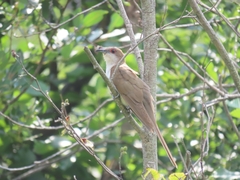
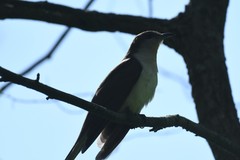
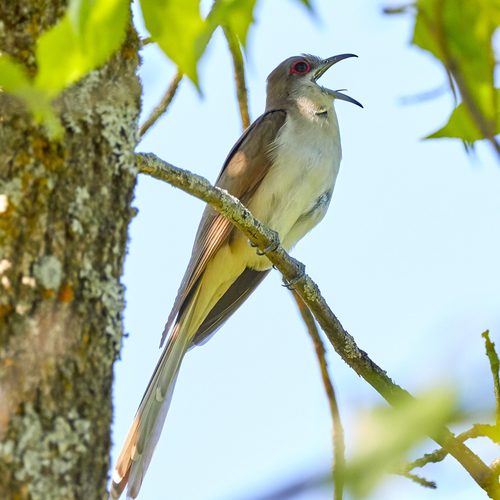
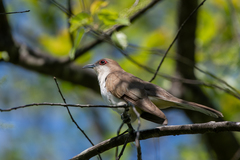
Adults have a long, graduated brown tail and a black, slightly downcurved bill. The head and upper parts are brown and the underparts are white. The feet are zygodactylous. Juveniles are drabber and may contain some rufous coloration on the wing. The adults have a narrow, red orbital ring while the juveniles' is yellow. Black-billed cuckoo chicks have white, sparsely distributed, sheath-like down that contrasts heavily with their black skin. They also have complex, creamy-colored structures on their mouth and tongue, which may appear like warts or some type of parasitic infection however they are normal... Wikipedia →
Sounds

Call1:09

United States · 2021

© Christopher McPherson · XC690971 · CC BY-NC-SA 4.0

Song0:05

United States · 2019

© Mark Nenadov · XC547273 · CC BY-NC-SA 4.0

Song0:21

United States · 2015

© Jacob Saucier · XC500139 · CC BY-NC-SA 4.0

Global Distribution

Parks Where Found

# Park Country Daily sighting probability
1 Riding Mountain National Park 🇨🇦 Canada
~10%
2 Point Pelee National Park 🇨🇦 Canada
<5%
3 Isle Royale National Park 🇺🇸 United States
<5%
4 Shenandoah National Park 🇺🇸 United States
<5%
5 Parque Natural Metropolitano 🇵🇦 Panama
<5%
6 Acadia National Park 🇺🇸 United States
<5%
7 Manu National Park 🇵🇪 Peru
<5%
8 Great Smoky Mountains National Park 🇺🇸 United States
<5%
9 Soberanía National Park 🇵🇦 Panama
<5%

Cities Where Found

# City Country Daily sighting probability
1 San Antonio 🇺🇸 United States
<5%
2 Chicago 🇺🇸 United States
<5%
3 Panama City 🇵🇦 Panama
<5%
4 New York City 🇺🇸 United States
<5%
5 Minneapolis [Saint Paul] 🇺🇸 United States
<5%
6 Montreal 🇨🇦 Canada
<5%
7 Bogota 🇨🇴 Colombia
<5%
8 Toronto 🇨🇦 Canada
<5%
9 Baltimore 🇺🇸 United States
<5%
10 Boston 🇺🇸 United States
<5%

Before you go

What are the chances of seeing a Black-billed Cuckoo in Panama City?

Rare

Under 5% of wildlife watchers report a Black-billed Cuckoo sighting in Panama City on a given day, based on 30 verified sightings from GBIF citizen-science data. It is the 255th most-seen of the 363 birds we can rate there. Over three days the chance rises to under 5%, if each day is a fresh chance.

When is the best time to see a Black-billed Cuckoo in Panama City?

Any time of year

In every month with enough records, under 5% of wildlife watchers report a Black-billed Cuckoo in Panama City on a given day, so our monthly data shows no clear season.

What time of day is best to see a Black-billed Cuckoo?

Between 8 and 11 am

Across all the parks we cover, that three-hour window holds the most Black-billed Cuckoo sightings with a recorded time, and about 9 in 10 of them come between 6 am and 6 pm: it is a daytime animal.

Is Panama City the best place to see a Black-billed Cuckoo?

Among the best

Of the 16 cities where we can rate Black-billed Cuckoo sightings, Panama City ranks 3rd at under 5%, level with the leaders once rounded. The best odds are in San Antonio (United States, under 5%) and Chicago (United States, under 5%).

Where does the Black-billed Cuckoo sighting chance come from?

GBIF citizen-science records

It is estimated from how often the Black-billed Cuckoo is recorded against all the birds logged in Panama City (30 verified sightings), calibrated against known sighting rates. Figures are rounded to the nearest 10% because citizen-science data supports honest approximations, not decimals, and months with records from fewer than five people show "—". How it works.

← Back to Panama City