Common European Scorpionfly

Common European Scorpionfly

Panorpa communis

Daily sighting probability ~10% · With luck
at Paris

In 3 days ~20% in a week ~40%

44 Verified sightings at Paris
91 In all 8 parks From 2019 to 2026
April Best month
☀️ Diurnal When it's spotted

About the Common European Scorpionfly

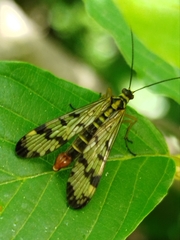
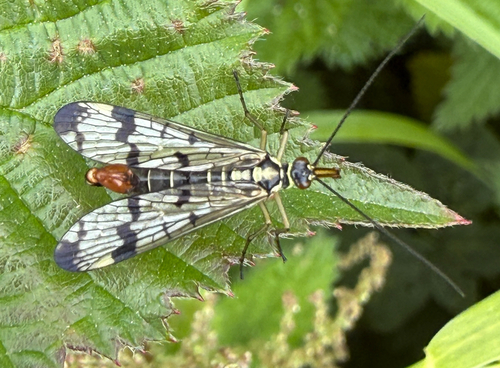
Panorpa communis, the common scorpionfly, is a species of scorpionfly. This species is native to Europe (except Iceland and Ireland) and Northern Asia (except China). These scorpionflies can be usually found in hedgerows and patches of nettle.

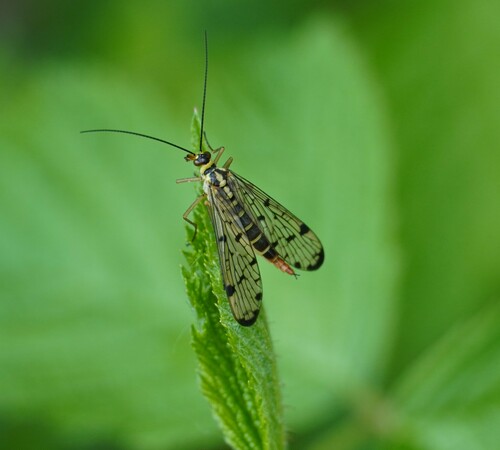
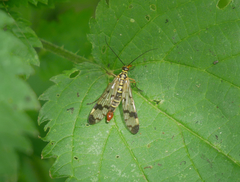
Panorpa communis can reach a body length of about 30 millimetres (1.2 in). The common scorpionfly has a black and yellow body, with a reddish head and tail. The male has a pair of claspers at the end of its tail (for holding the female during mating), giving it a scorpion-like appearance, although it is not a stinger.

The adult insect has a wingspan of about 35 millimetres (1.4 in), with wings that are mostly clear, but have many dark spots or patches. Its head, mounted with large eyes, is drawn into a prominent, downward pointing beak, which opens at the tip of its head. Females are longer, heavier, and have longer legs than males.

In the female, the eighth abdominal segment is the shortest, almost twice shorter than the seventh; the sixth is narrowed towards the back. The larva resembles a caterpillar and grows up to 20 millimetres (0.79 in) long. It has three pairs of thoracic legs and eight... Wikipedia →
Global Distribution

Parks Where Found

# Park Country Daily sighting probability
1 Białowieża National Park 🇵🇱 Poland
~10%
2 Bavarian Forest National Park 🇩🇪 Germany
~10%
3 Tatra National Park 🇸🇰 Slovakia
~10%
4 Mercantour National Park 🇫🇷 France
~10%
5 Fertő-Hanság National Park 🇭🇺 Hungary
~10%
6 Snowdonia National Park 🇬🇧 United Kingdom
~10%
7 Pyrénées National Park 🇫🇷 France
<5%
8 Wadden Sea National Park 🇩🇪 Germany
<5%

Cities Where Found

# City Country Daily sighting probability
1 Kharkiv 🇺🇦 Ukraine
~10%
2 Warsaw 🇵🇱 Poland
~10%
3 Hamburg 🇩🇪 Germany
~10%
4 Kyiv 🇺🇦 Ukraine
~10%
5 Rotterdam [The Hague] 🇳🇱 Netherlands
~10%
6 Essen 🇩🇪 Germany
~10%
7 Amsterdam 🇳🇱 Netherlands
~10%
8 Turin 🇮🇹 Italy
~10%
9 Cologne 🇩🇪 Germany
~10%
10 Berlin 🇩🇪 Germany
~10%

Before you go

What are the chances of seeing a Common European Scorpionfly in Paris?

With luck

About 10% of wildlife watchers report a Common European Scorpionfly sighting in Paris on a given day, based on 44 verified sightings from GBIF citizen-science data. It is the 191st most-seen of the 916 insects we can rate there. Over three days the chance rises to about 20%, and over a week to about 40%, if each day is a fresh chance.

When is the best time to see a Common European Scorpionfly in Paris?

April to July

In those months about 10% of wildlife watchers report a Common European Scorpionfly in Paris on a given day, against under 5% in August to March, the lowest months.

What time of day is best to see a Common European Scorpionfly?

Between 1 and 4 pm

Across all the parks we cover, that three-hour window holds the most Common European Scorpionfly sightings with a recorded time, and about 9 in 10 of them come between 6 am and 6 pm: it is a daytime animal.

Is Paris the best place to see a Common European Scorpionfly?

Among the best

Of the 26 cities where we can rate Common European Scorpionfly sightings, Paris ranks 14th at about 10%, level with the leaders once rounded. The best odds are in Kharkiv (Ukraine, about 10%), Warsaw (Poland, about 10%) and Hamburg (Germany, about 10%).

Where does the Common European Scorpionfly sighting chance come from?

GBIF citizen-science records

It is estimated from how often the Common European Scorpionfly is recorded against all the insects logged in Paris (44 verified sightings), calibrated against known sighting rates. Figures are rounded to the nearest 10% because citizen-science data supports honest approximations, not decimals, and months with records from fewer than five people show "—". How it works.

← Back to Paris