Southern Green Stink Bug

Southern Green Stink Bug

Nezara viridula

Daily sighting probability ~30% · Possible
at Paris

In 3 days ~60% in a week ~90%

703 Verified sightings at Paris
402 In all 13 parks From 2019 to 2026
September Best month
☀️ Diurnal When it's spotted

About the Southern Green Stink Bug

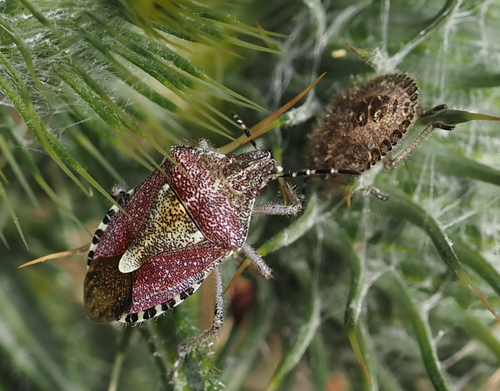
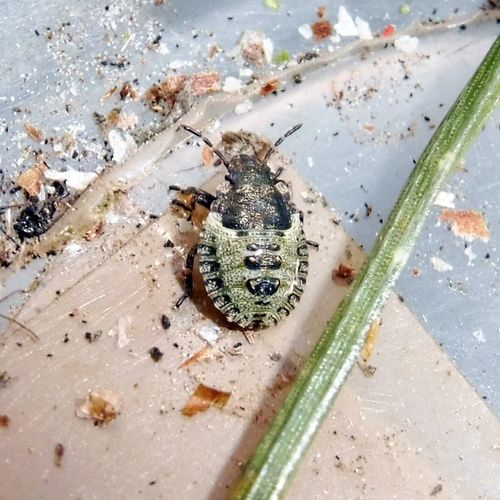
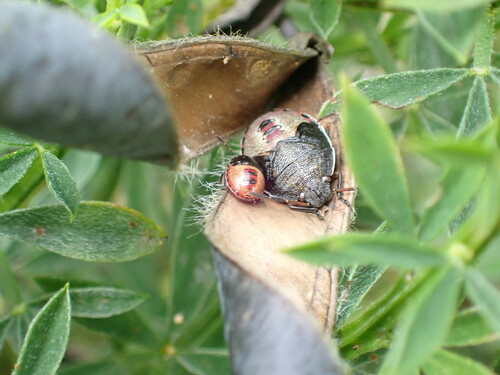
Nezara viridula, commonly known as the southern green stink bug (USA), southern green shield bug (UK) or green vegetable bug (Australia and New Zealand), is a plant-feeding stink bug. Believed to have originated in Ethiopia, it can now be found across the world. Because of its preference for certain species of legumes, such as beans and soybeans, it is an economically important pest on such crops.

Nezara viridula is a cosmopolitan species, living in tropical and subtropical regions of the Americas, Africa, Asia, Australasia, and Europe between 45 degrees north and 45 degrees south. Its exact origin is unknown, but it is believed to have originated from the Ethiopia region of East Africa, from where it has spread around the world due to its strong flight and human transport along trade routes.

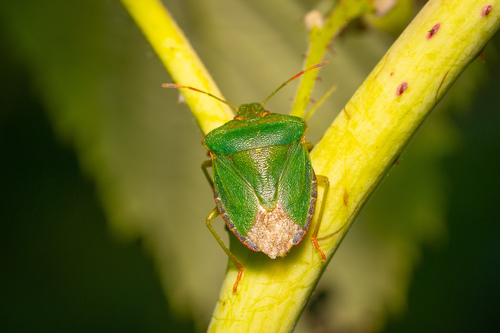
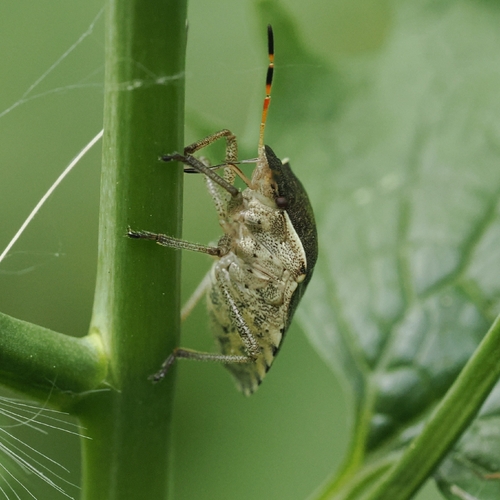
The adult males can reach a body length (from front to elytral apex) of about 12.1 millimetres (0.48 in), while females are bigger, reaching a size of about 13.1 millimetres (0.52 in). The body is usually bright green and shield-shaped and the eyes are most commonly reddish, but they may also be black. There is a row of three white spots on the scutellum. They... Wikipedia →

Global Distribution

Parks Where Found

# Park Country Daily sighting probability
1 Sierra Nevada National Park 🇪🇸 Spain
~20%
2 Cévennes National Park 🇫🇷 France
~20%
3 Abel Tasman National Park 🇳🇿 New Zealand
~10%
4 Fertő-Hanság National Park 🇭🇺 Hungary
~10%
5 Egmont National Park 🇳🇿 New Zealand
~10%
6 Sierra de Guadarrama National Park 🇪🇸 Spain
~10%
7 Pyrénées National Park 🇫🇷 France
~10%
8 Camargue 🇫🇷 France
~10%
9 Galápagos Islands 🇪🇨 Ecuador
~10%
10 Table Mountain National Park 🇿🇦 South Africa
~10%
11 Addo Elephant National Park 🇿🇦 South Africa
~10%
12 Garden Route National Park 🇿🇦 South Africa
~10%
13 Kruger National Park 🇿🇦 South Africa
<5%

Cities Where Found

# City Country Daily sighting probability
1 Vienna 🇦🇹 Austria
~30%
2 Budapest 🇭🇺 Hungary
~30%
3 Mendoza 🇦🇷 Argentina
~30%
4 Lyon 🇫🇷 France
~30%
5 Paris 🇫🇷 France
~30%
6 Turin 🇮🇹 Italy
~20%
7 London 🇬🇧 United Kingdom
~20%
8 Izmir 🇹🇷 Turkey
~20%
9 Brussels 🇧🇪 Belgium
~20%
10 Lusaka 🇿🇲 Zambia
~20%

Before you go

What are the chances of seeing a Southern Green Stink Bug in Paris?

Possible

About 30% of wildlife watchers report a Southern Green Stink Bug sighting in Paris on a given day, based on 703 verified sightings from GBIF citizen-science data. It is the 4th most-seen of the 916 insects we can rate there. Over three days the chance rises to about 60%, and over a week to about 90%, if each day is a fresh chance.

When is the best time to see a Southern Green Stink Bug in Paris?

September

In that month about 50% of wildlife watchers report a Southern Green Stink Bug in Paris on a given day, against about 10% in December to May, the lowest months.

What time of day is best to see a Southern Green Stink Bug?

Between 10 am and 1 pm

Across all the parks we cover, that three-hour window holds the most Southern Green Stink Bug sightings with a recorded time, and about 7 in 10 of them come between 6 am and 6 pm: it is a daytime animal.

Is Paris the best place to see a Southern Green Stink Bug?

Among the best

Of the 75 cities where we can rate Southern Green Stink Bug sightings, Paris ranks 5th at about 30%, level with the leaders once rounded. The best odds are in Vienna (Austria, about 30%), Budapest (Hungary, about 30%) and Mendoza (Argentina, about 30%).

Where does the Southern Green Stink Bug sighting chance come from?

GBIF citizen-science records

It is estimated from how often the Southern Green Stink Bug is recorded against all the insects logged in Paris (703 verified sightings), calibrated against known sighting rates. Figures are rounded to the nearest 10% because citizen-science data supports honest approximations, not decimals, and months with records from fewer than five people show "—". How it works.

← Back to Paris