Heliotrope Moth

Heliotrope Moth

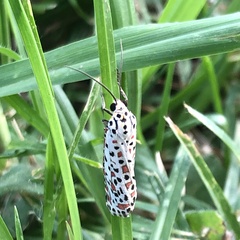
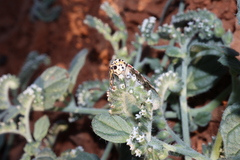
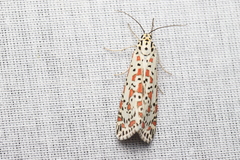
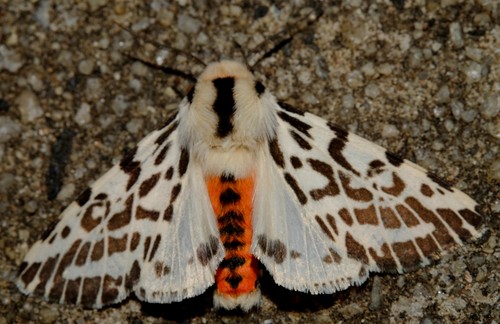
Utetheisa pulchelloides

Daily sighting probability <5% · Rare
at Perth

In 3 days ~10% in a week ~20%

7 Verified sightings at Perth
119 In all 7 parks From 2019 to 2026
March Best month
☀️🌙 Day & Night When it's spotted

About the Heliotrope Moth

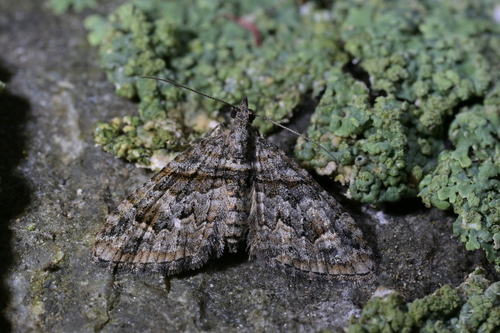
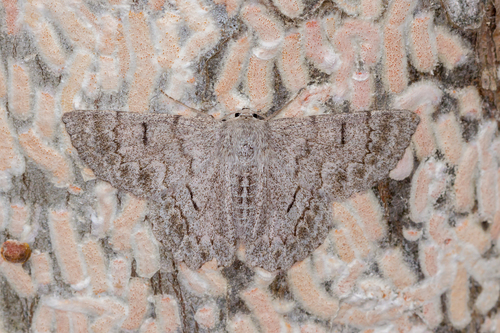
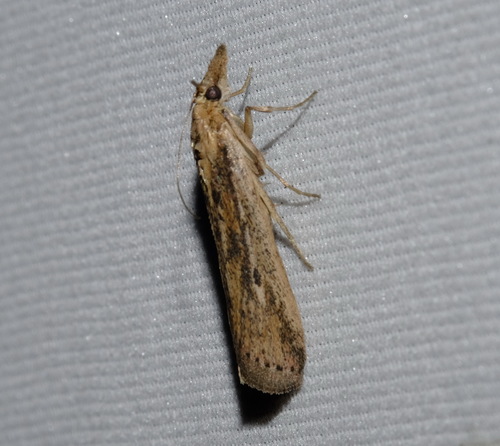
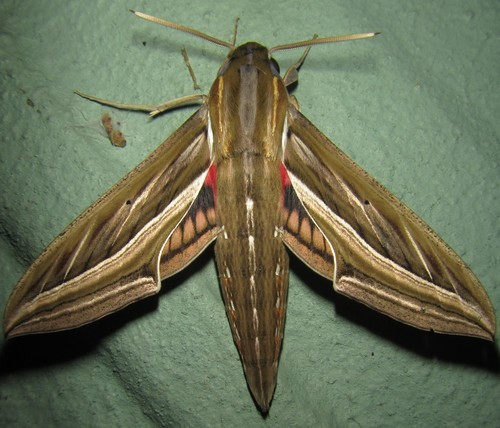
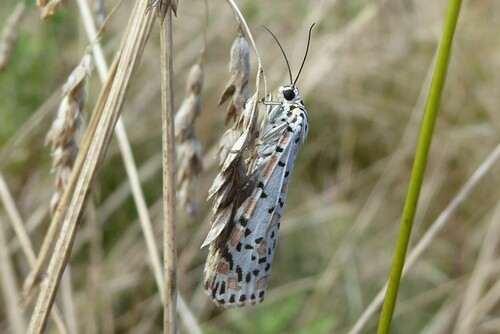
Utetheisa pulchelloides, the heliotrope moth, is a moth of the family Erebidae. It is found in the Indo-Australian region including Borneo, Hong Kong, New Zealand, Papua, Seychelles, most of Australia, Tenerife, La Línea de la Concepción [Cádiz] and Greece. The species was first described by George Hampson in 1907.

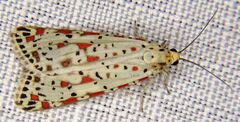
Adults undertake extensive and frequent migratory flights and can reach the most remote oceanic islands, such as Henderson Island and Ducie Island. Hindwing of male with no fold or glandular tuft on inner margin. Head and thorax yellowish. Collar and tegula each with two black spots. Each thoracic segment with one each black spot. Third joint of palpi black and abdomen whitish. Forewing white with five interrupted scarlet bands with series of black spots between them. A marginal series of black spots present. Hindwings are semi-diaphanous white, but some specimen with black on the discocellulars. A very irregular black sub-marginal band, broad at apical area and between veins 1b and 3. Larva dark grey with a dorsal white band and sub-dorsal series of red spots. Head yellow. It pupates in a loose cocoon that spun in the leaf litter on the ground below the... Wikipedia →

Global Distribution

Parks Where Found

# Park Country Daily sighting probability
1 Flinders Ranges National Park 🇦🇺 Australia
~30%
2 Hattah-Kulkyne National Park 🇦🇺 Australia
~30%
3 Great Otway National Park 🇦🇺 Australia
~10%
4 Kosciuszko National Park 🇦🇺 Australia
~10%
5 Grampians National Park 🇦🇺 Australia
~10%
6 Blue Mountains National Park 🇦🇺 Australia
~10%
7 Daintree National Park 🇦🇺 Australia
~10%

Cities Where Found

# City Country Daily sighting probability
1 Melbourne 🇦🇺 Australia
~10%
2 Chennai 🇮🇳 India
~10%
3 Brisbane 🇦🇺 Australia
~10%
4 Sydney 🇦🇺 Australia
<5%
5 Perth 🇦🇺 Australia
<5%
6 Auckland 🇳🇿 New Zealand
<5%

Before you go

What are the chances of seeing a Heliotrope Moth in Perth?

Rare

Under 5% of wildlife watchers report a Heliotrope Moth sighting in Perth on a given day, based on 7 verified sightings from GBIF citizen-science data. It is the 206th most-seen of the 275 insects we can rate there. Over three days the chance rises to about 10%, and over a week to about 20%, if each day is a fresh chance.

When is the best time to see a Heliotrope Moth in Perth?

March and May–July

In those months about 10% of wildlife watchers report a Heliotrope Moth in Perth on a given day, against under 5% in April and August–February, the lowest months. Those are among Perth's wettest months, with about 85 mm of rain a month against 10 mm in December.

What time of day is best to see a Heliotrope Moth?

Between 8 and 11 pm

Across all the parks we cover, that three-hour window holds the most Heliotrope Moth sightings with a recorded time, and about 6 in 10 of them come between 6 am and 6 pm: it is seen both by day and at night.

Is Perth the best place to see a Heliotrope Moth?

5th of 6

Of the 6 cities where we can rate Heliotrope Moth sightings, Perth ranks 5th at under 5%. The best odds are in Melbourne (Australia, about 10%), Chennai (India, about 10%) and Brisbane (Australia, about 10%).

Which relatives of the Heliotrope Moth live in Perth?

Same family: Erebidae

The closest relatives of the Heliotrope Moth that you can see in Perth (family Erebidae, Underwing, Tiger, Tussock, and Allied Moths) are Black-And-White Tiger Moth (about 20%), Southern Moon Moth (about 20%) and White Cedar Moth (about 10%), with each one's daily chance of a sighting.

Where does the Heliotrope Moth sighting chance come from?

GBIF citizen-science records

It is estimated from how often the Heliotrope Moth is recorded against all the insects logged in Perth (7 verified sightings), calibrated against known sighting rates. Figures are rounded to the nearest 10% because citizen-science data supports honest approximations, not decimals, and months with records from fewer than five people show "—". How it works.
← Back to Perth