About the Imperial Moth
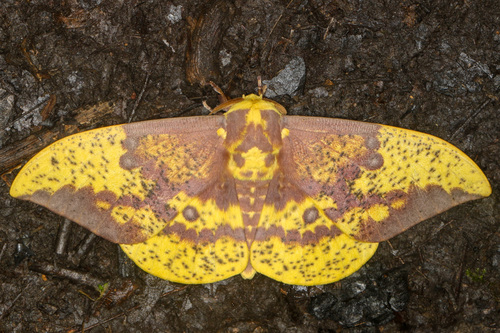
Eacles imperialis, the imperial moth, is a member of the family Saturniidae and subfamily Ceratocampinae. It is found mainly in the East of South America and North America, from the center of Argentina to south Canada. The species was first described by Dru Drury in 1773.
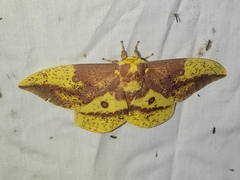
The wingspan of an adult is between 80 and 175 mm (3+1⁄8 and 6+7⁄8 inches). There is a high amount of variation within this species. The colors of the adult are always primarily yellow with red, brown, and purple blotches but can vary distinctly on this. Light and dark morphs of this species are found in both the northern and southern regions of their range. Individuals from the northern regions of their native range may tend to have fewer dark markings. Larvae can be small (approximately 10–15 mm long) and orange with black transverse bands and large spines in the first instar, to 3–5.5 inches (75–100 mm) long in the fifth instar with long hairs and shorter spines and color morphs varying between dark brown and burgundy with white spiracle patches, and green with yellow spiracle patches.
Imperial moths (their many regional morphs, subspecies, and sibling species) range from Argentina... Wikipedia →