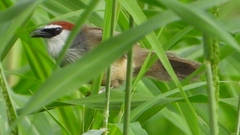
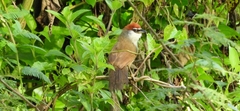
Chestnut-capped Babbler

Chestnut-capped Babbler

Timalia pileata

Silhouette: Sheatherius · PhyloPic

LCLeast ConcernNTVUENCR
Daily sighting probability ~20% · Possible
at Phnom Penh

In 3 days ~40% in a week ~70%

359 Verified sightings at Phnom Penh
1,354 In all 11 parks From 2019 to 2026
April Best month
🌅 Crepuscular When it's spotted

About the Chestnut-capped Babbler

The chestnut-capped babbler (Timalia pileata) is a passerine bird of the family Timaliidae. It is monotypic within the genus Timalia. The chestnut-capped babbler is placed as the sole species in the genus Timalia. It is divided into six subspecies with the following distribution:

T. p. bengalensis – lower Himalayas (Uttarakhand in India, Nepal, Bangladesh, Bhutan, northeastern India, and northwestern Myanmar) south to Odisha in India T. p. smithi – northern Myanmar to southern China, northern Thailand and northern Indochina

T. p. intermedia – central and southern Myanmar to southwestern Thailand T. p. patriciae – western part of the central plains of Thailand T. p. dictator – eastern and southeastern Thailand to southern Indochina This species is most closely related to the two Indian species, the tawny-bellied babbler and the dark-fronted babbler. Together they form a sister group to the rest of the species in the family Timaliidae. The chestnut-capped babbler is a medium-sized (15.5–17 cm) babbler with a fairly long, wedge-shaped tail and a thick, black bill. The plumage is unbarred brown with characteristic... Wikipedia →

Sounds

Call0:34

China · 2026

© Bo Shunqi 薄顺奇 · XC1097801 · CC BY-NC-SA 4.0

Song0:26

India · 2025

© Peter Boesman · XC1030919 · CC BY-NC-ND 4.0

Subsong0:48

Vietnam · 2024

© Ding Li Yong · XC861963 · CC BY-NC-ND 4.0

Global Distribution

Parks Where Found

# Park Country Daily sighting probability
1 Manas National Park 🇮🇳 India
~20%
2 Chitwan National Park 🇳🇵 Nepal
~20%
3 Kaziranga National Park 🇮🇳 India
~20%
4 Royal Bardia National Park 🇳🇵 Nepal
~10%
5 Cat Tien National Park 🇻🇳 Vietnam
~10%
6 Sundarbans National Park 🇮🇳 India
~10%
7 Kaeng Krachan National Park 🇹🇭 Thailand
<5%
8 Royal Manas National Park 🇧🇹 Bhutan
<5%
9 Jim Corbett National Park 🇮🇳 India
<5%
10 Khao Yai National Park 🇹🇭 Thailand
<5%
11 Doi Inthanon National Park 🇹🇭 Thailand
<5%

Cities Where Found

# City Country Daily sighting probability
1 Chattogram 🇧🇩 Bangladesh
~30%
2 Tamluk 🇮🇳 India
~30%
3 Phnom Penh 🇰🇭 Cambodia
~20%

Before you go

What are the chances of seeing a Chestnut-capped Babbler in Phnom Penh?

Possible

About 20% of wildlife watchers report a Chestnut-capped Babbler sighting in Phnom Penh on a given day, based on 359 verified sightings from GBIF citizen-science data. It is the 31st most-seen of the 154 birds we can rate there. Over three days the chance rises to about 40%, and over a week to about 70%, if each day is a fresh chance.

When is the best time to see a Chestnut-capped Babbler in Phnom Penh?

February–July and October–December

In those months about 20% of wildlife watchers report a Chestnut-capped Babbler in Phnom Penh on a given day, against about 10% in January and August–September, the lowest months.

What time of day is best to see a Chestnut-capped Babbler?

Between 1 and 4 am

Across all the parks we cover, that three-hour window holds the most Chestnut-capped Babbler sightings with a recorded time, and about 6 in 10 of them come between 6 pm and 6 am: it is most active around dawn and dusk.

Is Phnom Penh the best place to see a Chestnut-capped Babbler?

3rd of 3

Of the 3 cities where we can rate Chestnut-capped Babbler sightings, Phnom Penh ranks 3rd at about 20%. The best odds are in Chattogram (Bangladesh, about 30%) and Tamluk (India, about 30%).

Where does the Chestnut-capped Babbler sighting chance come from?

GBIF citizen-science records

It is estimated from how often the Chestnut-capped Babbler is recorded against all the birds logged in Phnom Penh (359 verified sightings), calibrated against known sighting rates. Figures are rounded to the nearest 10% because citizen-science data supports honest approximations, not decimals, and months with records from fewer than five people show "—". How it works.

← Back to Phnom Penh