Eastern Phoebe

Eastern Phoebe

Sayornis phoebe

Silhouette: Emily Willoughby · PhyloPic

LCLeast ConcernNTVUENCR
Daily sighting probability <5% · Rare
at Puebla

In 3 days ~10%

12 Verified sightings at Puebla
21,398 In all 19 parks From 2019 to 2026
January Best month
☀️ Diurnal When it's spotted

About the Eastern Phoebe

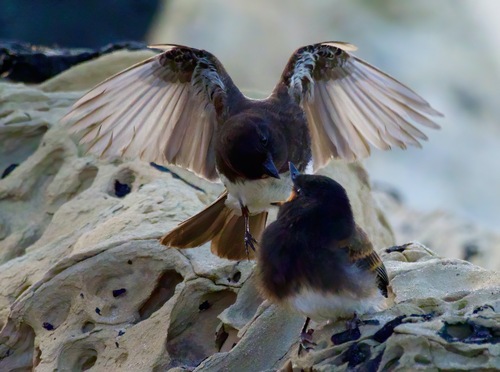
The eastern phoebe (Sayornis phoebe) is a small passerine bird. The genus name Sayornis is constructed from the specific part of Charles Lucien Bonaparte's name for Say's phoebe, Muscicapa saya, and Ancient Greek ornis, "bird". Phoebe is an alternative name for the Roman moon goddess Diana, but it may also have been chosen to imitate the bird's call.

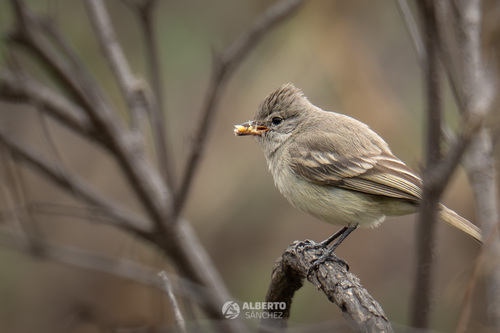
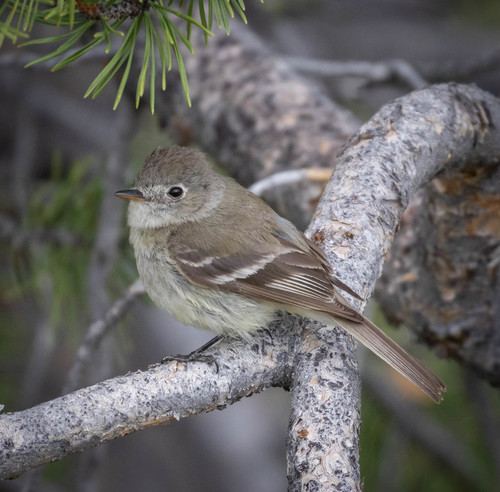
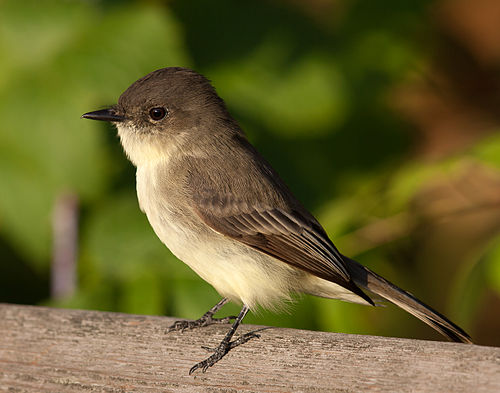
Measurements: Length: 5.5–6.7 in (14–17 cm) Weight: 0.6–0.7 oz (16–21 g) Wingspan: 10.2–11.0 in (26–28 cm) This species appears remarkably big-headed, especially if it puffs up the small crest. Its plumage is gray-brown above. It has a white throat, dirty gray breast, and buffish underparts which become whiter during the breeding season. Two indistinct buff bars are present on each wing. Its all-dark bill and lack of an eye ring and wingbars distinguish it from other North American tyrant flycatchers, and it pumps its tail up and down like other phoebes when perching on a branch. The eastern phoebe's call is a sharp chip, and the song, from which it may get its name, is fee-bee.

The eastern wood pewee (Contopus virens) is extremely similar in appearance. It lacks the buff hue usually present on the lighter parts of the... Wikipedia →
Sounds

Song0:50

United States · 2022

© David A. Brinkman · XC713591 · CC BY-NC-SA 4.0

Uncertain0:10

United States · 2020

© Brian Hendrix · XC593638 · CC BY-NC-SA 4.0

Alarm call0:33

United States · 2017

© Jorge de Leon Cardozo · XC375493 · CC BY-NC-SA 4.0

Global Distribution

Parks Where Found

# Park Country Daily sighting probability
1 Great Smoky Mountains National Park 🇺🇸 United States
~50%
2 Shenandoah National Park 🇺🇸 United States
~40%
3 Congaree National Park 🇺🇸 United States
~40%
4 Everglades National Park 🇺🇸 United States
~40%
5 Big Cypress National Preserve 🇺🇸 United States
~30%
6 Elk Island National Park 🇨🇦 Canada
~30%
7 Acadia National Park 🇺🇸 United States
~30%
8 Merritt Island National Wildlife Refuge 🇺🇸 United States
~20%
9 Voyageurs National Park 🇺🇸 United States
~20%
10 Riding Mountain National Park 🇨🇦 Canada
~20%
11 Cumbres de Monterrey National Park 🇲🇽 Mexico
~20%
12 Point Pelee National Park 🇨🇦 Canada
~10%
13 Big Bend National Park 🇺🇸 United States
~10%
14 Isle Royale National Park 🇺🇸 United States
<5%
15 Arrecifes de Cozumel National Park 🇲🇽 Mexico
<5%
16 Banff National Park 🇨🇦 Canada
<5%
17 Padre Island National Seashore 🇺🇸 United States
<5%
18 Celestún Biosphere Reserve 🇲🇽 Mexico
<5%
19 Channel Islands National Park 🇺🇸 United States
<5%

Cities Where Found

# City Country Daily sighting probability
1 San Antonio 🇺🇸 United States
~50%
2 Austin 🇺🇸 United States
~40%
3 Dallas 🇺🇸 United States
~30%
4 Orlando 🇺🇸 United States
~30%
5 Houston 🇺🇸 United States
~20%
6 Washington 🇺🇸 United States
~20%
7 Baltimore 🇺🇸 United States
~20%
8 Montreal 🇨🇦 Canada
~20%
9 Miami 🇺🇸 United States
~10%
10 Philadelphia 🇺🇸 United States
~10%

Before you go

What are the chances of seeing an Eastern Phoebe in Puebla?

Rare

Under 5% of wildlife watchers report an Eastern Phoebe sighting in Puebla on a given day, based on 12 verified sightings from GBIF citizen-science data. It is the 124th most-seen of the 164 birds we can rate there. Over three days the chance rises to about 10%, if each day is a fresh chance.

When is the best time to see an Eastern Phoebe in Puebla?

December and January

In those months about 10% of wildlife watchers report an Eastern Phoebe in Puebla on a given day, against under 5% in February to November, the lowest months. Those are among Puebla's driest months, with about 10 mm of rain a month against 170 mm in September.

What time of day is best to see an Eastern Phoebe?

Between 8 and 11 am

Across all the parks we cover, that three-hour window holds the most Eastern Phoebe sightings with a recorded time, and about 9 in 10 of them come between 6 am and 6 pm: it is a daytime animal.

Is Puebla the best place to see an Eastern Phoebe?

20th of 26

Of the 26 cities where we can rate Eastern Phoebe sightings, Puebla ranks 20th at under 5%. The best odds are in San Antonio (United States, about 50%), Austin (United States, about 40%) and Dallas (United States, about 30%).

Where does the Eastern Phoebe sighting chance come from?

GBIF citizen-science records

It is estimated from how often the Eastern Phoebe is recorded against all the birds logged in Puebla (12 verified sightings), calibrated against known sighting rates. Figures are rounded to the nearest 10% because citizen-science data supports honest approximations, not decimals, and months with records from fewer than five people show "—". How it works.

← Back to Puebla