Red-footed Tortoise

Red-footed Tortoise

Chelonoidis carbonarius

Silhouette: Kai Caspar · PhyloPic

Daily sighting probability <5% · Rare
at Rio de Janeiro

In 3 days ~10% in a week ~30%

7 Verified sightings at Rio de Janeiro
25 In all 3 parks From 2019 to 2026
March Best month
☀️ Diurnal When it's spotted

About the Red-footed Tortoise

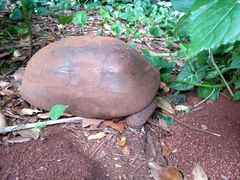
The red-footed tortoise (Chelonoidis carbonarius) is a species of tortoise from northern South America. These medium-sized tortoises generally average 30 cm (12 in) as adults, but can reach over 40 cm (16 in). They have dark-colored (nearly black), “loaf”-shaped carapaces (top shell) with a lighter patch in the middle of each scute (shell segment), and a somewhat lighter-colored plastron (underbelly). They also have dark limbs dotted with brightly-colored scales, from which they get their name, that range from pale yellow to vivid or dark red. Visible differences are noted between red-footed tortoises from varying eco-regions. They are closely related to the more easterly-distributed yellow-footed tortoise (C. denticulatus) of the Amazon Basin.

Their natural habitat ranges from savannah to forest edges around the Amazon Basin. They are omnivorous tortoises, consuming a wide assortment of plants, grasses, flowers, fruit and (notably) fungi, as well as the occasional earthworm or other invertebrate. When presented with the opportunity, many tortoises will also scavenge on carrion. They do not brumate, due to their equatorial home range, but may aestivate in the hotter, drier months.

Red-footed (and yellow-footed) tortoises are popularly kept as pets. Over-collection of eggs, and the capturing of mature animals, from their native habitat has caused them to be listed as “vulnerable” to extinction, despite the relative ease of captive breeding and the availability of captive-bred tortoises. Additionally, many remote tribal groups living in South America still consider the tortoises a basic source of meat, and many are unaware of the species’ overall plight; many travelers and activists report seeing live red-footed tortoises for sale in markets where bushmeat and live animals are sold. Eggs, hatchlings, and even mature tortoises are food for many animal predators, including caimans, crocodiles and giant otters (if near water), as well as birds of prey, bushdogs, jaguars, jaguarundis, margays, certain monkeys, ocelots, pumas and tayras. Population density ranges from locally common to very scarce due, in-part, to habitat destruction and the aforementioned over-collection for food and the pet trade.

The species name has often been misspelled as carbonaria, an error introduced in the 1980s when Chelonoidis was elevated to genus and mistakenly treated as feminine, an error recognized and fixed in 2017. Wikipedia →

Global Distribution

Parks Where Found

# Park Country Daily sighting probability
1 Emas National Park 🇧🇷 Brazil
~30%
2 Soberanía National Park 🇵🇦 Panama
~10%
3 Parque Natural Metropolitano 🇵🇦 Panama
~10%

Cities Where Found

# City Country Daily sighting probability
1 João Pessoa 🇧🇷 Brazil
~50%
2 Santa Cruz de la Sierra 🇧🇴 Bolivia
~40%
3 Salvador 🇧🇷 Brazil
~30%
4 Maceió 🇧🇷 Brazil
~20%
5 Campo Grande 🇧🇷 Brazil
~20%
6 Medellín 🇨🇴 Colombia
~10%
7 Rio de Janeiro 🇧🇷 Brazil
<5%
8 Panama City 🇵🇦 Panama
<5%

Zoos & Centres Where Found

# Zoo / Centre Country
1 Busch Gardens Tampa 🇺🇸 United States In captivity
2 Pairi Daiza 🇧🇪 Belgium In captivity
3 National Zoological Park 🇺🇸 United States In captivity
4 Shedd Aquarium 🇺🇸 United States In captivity
5 ZooParc de Beauval 🇫🇷 France In captivity
6 Copenhagen Zoo 🇩🇰 Denmark In captivity
7 Dublin Zoo 🇮🇪 Ireland In captivity
8 Cincinnati Zoo and Botanical Garden 🇺🇸 United States In captivity
9 The Blue Planet 🇩🇰 Denmark In captivity
10 Antwerp Zoo 🇧🇪 Belgium In captivity
11 Parque das Aves 🇧🇷 Brazil In captivity
12 Barcelona Zoo 🇪🇸 Spain In captivity
13 North Carolina Zoo 🇺🇸 United States In captivity
14 Zlín-Lešná Zoo 🇨🇿 Czechia In captivity
15 Zoobotanic Park of Brusque 🇧🇷 Brazil In captivity
16 Zoo Miami 🇺🇸 United States In captivity
17 Lion Country Safari 🇺🇸 United States In captivity
18 Toronto Zoo 🇨🇦 Canada In captivity
19 Taipei Zoo 🇹🇼 Taiwan In captivity
20 Bronx Zoo 🇺🇸 United States In captivity
21 长沙生态动物园 🇨🇳 China In captivity
22 Parc zoologique de Montpellier 🇫🇷 France In captivity
23 Safari Madrid 🇪🇸 Spain In captivity
24 Parque y Zoológico Nacional Arquitecto Manuel Valverde Podestá 🇩🇴 Dominican Republic In captivity
25 WildFlorida Safaris 🇺🇸 United States In captivity
26 Nanjing Hongshan Forest Zoo 🇨🇳 China In captivity
27 Banham Zoo 🇬🇧 United Kingdom In captivity
28 Detroit Zoo 🇺🇸 United States In captivity
29 Jacksonville Zoo and Gardens 🇺🇸 United States In captivity
30 Cape May County Park & Zoo 🇺🇸 United States In captivity
31 Silesian Zoological Garden 🇵🇱 Poland In captivity
32 São Paulo Zoo 🇧🇷 Brazil In captivity
33 Flamingo Land Resort 🇬🇧 United Kingdom In captivity
34 Parque Municipal Summit 🇵🇦 Panama In captivity
35 Selwo Aventura 🇪🇸 Spain In captivity
36 Skandinavisk Dyrepark 🇩🇰 Denmark In captivity
37 Toyama Municipal Family Park Zoo 🇯🇵 Japan In captivity
38 Parco Natura Viva 🇮🇹 Italy In captivity
39 Yaroslavl Zoo 🇷🇺 Russia In captivity
40 Карельский зоопарк 🇷🇺 Russia In captivity
41 Dakota Zoo 🇺🇸 United States In captivity
42 Safari de Peaugres Circuit Auto 🇫🇷 France In captivity
43 Granby Zoo 🇨🇦 Canada In captivity
44 Kyiv Zoo 🇺🇦 Ukraine In captivity
45 Burgers' Ocean 🇳🇱 Netherlands In captivity
46 Berlin Zoological Garden 🇩🇪 Germany In captivity
47 Royal Burgers' Zoo 🇳🇱 Netherlands In captivity
48 Terra Natura Benidorm 🇪🇸 Spain In captivity
49 Wrocław Zoological Garden 🇵🇱 Poland In captivity
50 Zoológico de Goiânia 🇧🇷 Brazil In captivity

Closest Relatives at Rio de Janeiro

No species of the same family or order lives in Rio de Janeiro, so these are its closest relatives here: other reptiles.

Before you go

What are the chances of seeing a Red-footed Tortoise in Rio de Janeiro?

Rare

Under 5% of wildlife watchers report a Red-footed Tortoise sighting in Rio de Janeiro on a given day, based on 7 verified sightings from GBIF citizen-science data. It is the 14th most-seen of the 16 reptiles we can rate there. Over three days the chance rises to about 10%, and over a week to about 30%, if each day is a fresh chance.

When is the best time to see a Red-footed Tortoise in Rio de Janeiro?

March, August, October and December

In those months about 10% of wildlife watchers report a Red-footed Tortoise in Rio de Janeiro on a given day, against under 5% in January–February, April–July, September and November, the lowest months.

What time of day is best to see a Red-footed Tortoise?

Between 2 and 5 pm

Across all the parks we cover, that three-hour window holds the most Red-footed Tortoise sightings with a recorded time, and about 9 in 10 of them come between 6 am and 6 pm: it is a daytime animal.

Is Rio de Janeiro the best place to see a Red-footed Tortoise?

7th of 8

Of the 8 cities where we can rate Red-footed Tortoise sightings, Rio de Janeiro ranks 7th at under 5%. The best odds are in João Pessoa (Brazil, about 50%), Santa Cruz de la Sierra (Bolivia, about 40%) and Salvador (Brazil, about 30%).

Where does the Red-footed Tortoise sighting chance come from?

GBIF citizen-science records

It is estimated from how often the Red-footed Tortoise is recorded against all the reptiles logged in Rio de Janeiro (7 verified sightings), calibrated against known sighting rates. Figures are rounded to the nearest 10% because citizen-science data supports honest approximations, not decimals, and months with records from fewer than five people show "—". How it works.

← Back to Rio de Janeiro