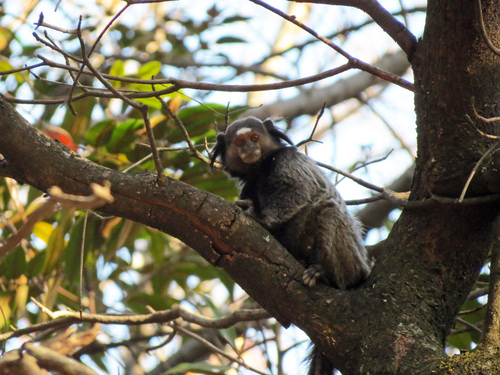
Southern Tamandua

Southern Tamandua

Tamandua tetradactyla

Silhouette: Kai Caspar · PhyloPic

LCLeast ConcernNTVUENCR
Daily sighting probability <5% · Rare
at Rio de Janeiro

In 3 days ~10% in a week ~30%

5 Verified sightings at Rio de Janeiro
28 In all 3 parks From 2019 to 2026
November Best month
☀️🌙 Day & Night When it's spotted

About the Southern Tamandua

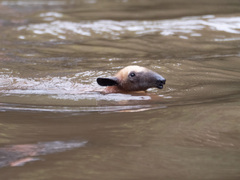
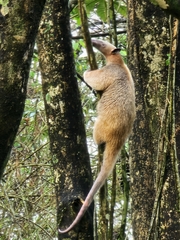
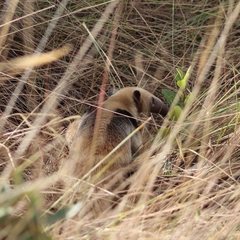
The southern tamandua (Tamandua tetradactyla), also called the collared anteater or lesser anteater, is a species of anteater from South America and the island of Trinidad in the Caribbean. It is a solitary animal found in many habitats, from mature to highly disturbed secondary forests and arid savannas. It feeds on ants, termites, and bees. Its very strong foreclaws can be used to break insect nests and to defend itself.

The southern tamandua is found in Trinidad and throughout South America from Venezuela to northern Argentina, southern Brazil, and Uruguay at elevations up to 1,600 m (5,200 ft). It inhabits both wet and dry forests, including tropical rainforest, savanna, and thorn scrub. It seems to be most common in habitats near streams and rivers, especially those thick with vines and epiphytes (presumably because its prey is common in these areas).

The oldest fossil tamanduas date from the Pleistocene of South America, although genetic evidence suggests they may have diverged from their closest relative, the giant anteater, in the late Miocene, 12.9 million years ago.

The four recognised subspecies of Tamandua tetradactyla are... Wikipedia →

Global Distribution

Parks Where Found

# Park Country Daily sighting probability
1 Manu National Park 🇵🇪 Peru
~10%
2 Tambopata National Reserve 🇵🇪 Peru
~10%
3 Tijuca National Park 🇧🇷 Brazil
~10%

Cities Where Found

# City Country Daily sighting probability
1 Rio de Janeiro 🇧🇷 Brazil
<5%

Zoos & Centres Where Found

# Zoo / Centre Country
1 Busch Gardens Tampa 🇺🇸 United States In captivity
2 San Diego Zoo 🇺🇸 United States In captivity
3 National Zoological Park 🇺🇸 United States In captivity
4 Zoo Miami 🇺🇸 United States In captivity
5 San Diego Zoo Safari Park 🇺🇸 United States In captivity
6 Minnesota Zoo 🇺🇸 United States In captivity
7 Poznań Nowe Zoo 🇵🇱 Poland In captivity
8 Zoological Garden of Belo Horizonte 🇧🇷 Brazil In captivity
9 Zoológico de Brasília 🇧🇷 Brazil In captivity
10 Curitiba Zoo 🇧🇷 Brazil In captivity
11 Chester Zoo 🇬🇧 United Kingdom In captivity
12 Los Angeles Zoo 🇺🇸 United States In captivity
13 São Paulo Zoo 🇧🇷 Brazil In captivity
14 Parque Municipal Summit 🇵🇦 Panama In captivity
15 Colchester Zoo 🇬🇧 United Kingdom In captivity
16 Dierenpark Hoenderdaell 🇳🇱 Netherlands In captivity
17 Parque Zoobotânico Getúlio Vargas 🇧🇷 Brazil In captivity
18 Parque Zoobotânico Arruda Câmara (BICA) 🇧🇷 Brazil In captivity
19 Wilhelma 🇩🇪 Germany In captivity
20 Zoo Opole 🇵🇱 Poland In captivity
21 Zoológico Dois Irmãos 🇧🇷 Brazil In captivity
22 San Antonio Zoo 🇺🇸 United States In captivity
23 Budapest Zoo & Botanical Garden 🇭🇺 Hungary In captivity
24 Łódź Zoo 🇵🇱 Poland In captivity
25 London Zoo 🇬🇧 United Kingdom In captivity
26 Ueno Zoo 🇯🇵 Japan In captivity
27 Faunia 🇪🇸 Spain In captivity
28 Rio de Janeiro Zoological Garden 🇧🇷 Brazil In captivity
29 Parque Ecológico de São Carlos 🇧🇷 Brazil In captivity
30 Bauru Zoo 🇧🇷 Brazil In captivity
31 Krefelder Zoo 🇩🇪 Germany In captivity
32 Bioparque Los Ocarros 🇨🇴 Colombia In captivity
33 Sacramento Zoo 🇺🇸 United States In captivity
34 Papiliorama 🇨🇭 Switzerland In captivity
35 Kobe Animal Kingdom 🇯🇵 Japan In captivity
36 Staten Island Zoo 🇺🇸 United States In captivity
37 Zoológico 🇧🇷 Brazil In captivity
38 Sao Paulo aquarium 🇧🇷 Brazil In captivity
39 Ralph Perkins II Wildlife Center and Woods Garden 🇺🇸 United States In captivity
40 The Green Planet 🇦🇪 United Arab Emirates In captivity
41 Amazon Rescue Center 🇵🇪 Peru In captivity
42 Belo Horizonte Aquarium 🇧🇷 Brazil In captivity
43 Cali Zoo 🇨🇴 Colombia In captivity
44 GüiráOga 🇦🇷 Argentina In captivity
45 Landgoed Hoenderdaell 🇳🇱 Netherlands In captivity
46 The National Aquarium Abu Dhabi 🇦🇪 United Arab Emirates In captivity
47 Wiwa Quito 🇪🇨 Ecuador In captivity
48 Zoológico Miguél Álvarez del Toro 🇲🇽 Mexico In captivity
49 Zooparque Itatiba 🇧🇷 Brazil In captivity

Before you go

What are the chances of seeing a Southern Tamandua in Rio de Janeiro?

Rare

Under 5% of wildlife watchers report a Southern Tamandua sighting in Rio de Janeiro on a given day, based on 5 verified sightings from GBIF citizen-science data. It is the 15th most-seen of the 15 mammals we can rate there. Over three days the chance rises to about 10%, and over a week to about 30%, if each day is a fresh chance.

When is the best time to see a Southern Tamandua in Rio de Janeiro?

June, August and November–January

In those months about 10% of wildlife watchers report a Southern Tamandua in Rio de Janeiro on a given day, against under 5% in February–May, July and September–October, the lowest months.

What time of day is best to see a Southern Tamandua?

Between 7 and 10 am

Across all the parks we cover, that three-hour window holds the most Southern Tamandua sightings with a recorded time, and about 6 in 10 of them come between 6 am and 6 pm: it is seen both by day and at night.

Where else can you see a Southern Tamandua?

Only Rio de Janeiro, in our data

Rio de Janeiro is the only city on Wallace's Line with enough records to rate Southern Tamandua sightings: under 5% of wildlife watchers there report one on a given day.

Where does the Southern Tamandua sighting chance come from?

GBIF citizen-science records

It is estimated from how often the Southern Tamandua is recorded against all the mammals logged in Rio de Janeiro (5 verified sightings), calibrated against known sighting rates. Figures are rounded to the nearest 10% because citizen-science data supports honest approximations, not decimals, and months with records from fewer than five people show "—". How it works.

← Back to Rio de Janeiro