Phainopepla

Phainopepla

Phainopepla nitens

Silhouette: Sheatherius · PhyloPic

LCLeast ConcernNTVUENCR
Daily sighting probability ~10% · With luck
at Sacramento

In 3 days ~20% in a week ~40%

1,116 Verified sightings at Sacramento
8,504 In all 13 parks From 2019 to 2026
November Best month
🌅 Crepuscular When it's spotted

About the Phainopepla

The phainopepla or northern phainopepla (Phainopepla nitens) is the most northerly representative of the mainly tropical Central American family Ptiliogonatidae, the silky flycatchers. Its name is from the Greek phain pepla meaning "shining robe" in reference to the male's plumage.

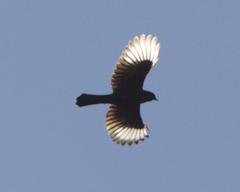
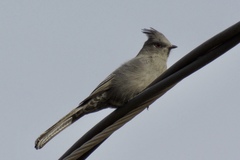
The phainopepla is a striking bird, 16–20 cm (6.3–7.9 in) long with a noticeable crest and a long tail; it is slender, and has an upright posture when it perches. Its bill is short and slender. The male is glossy black, and has a white wing patch that is visible when it flies; the female is plain gray and has a lighter gray wing patch. Both sexes have red eyes, but these are more noticeable in the female than the male.

The phainopepla ranges as far north as central California with the San Joaquin Valley and southern Utah, and south to central Mexico, the interior Mexican Plateau region; the southern edge of the plateau, the transverse mountains is its non-breeding home. It is found in hot areas, including desert oases, and is readily seen in the deserts of Arizona, southern Nevada, and southern California; also the Baja Peninsula, both Baja California-(north), and... Wikipedia →

Sounds

Call1:08

United States · 2024

© Richard E. Webster · XC1078194 · CC BY-NC-SA 4.0

Imitation0:47

United States · 2020

© Michael Morrison · XC579151 · CC BY-NC-SA 4.0

Call0:41

United States · 2022

© Paul Marvin · XC698971 · CC BY-NC-SA 4.0

Global Distribution

Parks Where Found

# Park Country Daily sighting probability
1 Joshua Tree National Park 🇺🇸 United States
~60%
2 Saguaro National Park 🇺🇸 United States
~50%
3 Death Valley National Park 🇺🇸 United States
~30%
4 Bahía de Loreto National Park 🇲🇽 Mexico
~30%
5 Guadalupe Mountains National Park 🇺🇸 United States
~10%
6 El Vizcaíno Biosphere Reserve 🇲🇽 Mexico
~10%
7 Cabo Pulmo National Park 🇲🇽 Mexico
~10%
8 Big Bend National Park 🇺🇸 United States
<5%
9 Zion National Park 🇺🇸 United States
<5%
10 Sequoia and Kings Canyon National Parks 🇺🇸 United States
<5%
11 Cumbres de Monterrey National Park 🇲🇽 Mexico
<5%
12 Grand Canyon National Park 🇺🇸 United States
<5%
13 Channel Islands National Park 🇺🇸 United States
<5%

Cities Where Found

# City Country Daily sighting probability
1 Las Vegas 🇺🇸 United States
~10%
2 Sacramento 🇺🇸 United States
~10%
3 Tijuana 🇲🇽 México
~10%
4 Phoenix 🇺🇸 United States
~10%
5 Los Angeles 🇺🇸 United States
<5%
6 Mesa 🇺🇸 United States
<5%
7 San Diego 🇺🇸 United States
<5%
8 Mexico City 🇲🇽 México
<5%
9 San Francisco 🇺🇸 United States
<5%

Before you go

What are the chances of seeing a Phainopepla in Sacramento?

With luck

About 10% of wildlife watchers report a Phainopepla sighting in Sacramento on a given day, based on 1,116 verified sightings from GBIF citizen-science data. It is the 80th most-seen of the 235 birds we can rate there. Over three days the chance rises to about 20%, and over a week to about 40%, if each day is a fresh chance.

When is the best time to see a Phainopepla in Sacramento?

June and September–March

In those months about 10% of wildlife watchers report a Phainopepla in Sacramento on a given day, against under 5% in April–May and July–August, the lowest months.

What time of day is best to see a Phainopepla?

Between 5 and 8 pm

Across all the parks we cover, that three-hour window holds the most Phainopepla sightings with a recorded time, and about 7 in 10 of them come between 6 am and 6 pm: it is most active around dawn and dusk.

Is Sacramento the best place to see a Phainopepla?

Among the best

Of the 9 cities where we can rate Phainopepla sightings, Sacramento ranks 2nd at about 10%, level with the leaders once rounded. The best odds are in Las Vegas (United States, about 10%).

Which relatives of the Phainopepla live in Sacramento?

Same order: Passeriformes

The closest relatives of the Phainopepla that you can see in Sacramento (order Passeriformes, Perching Birds) are California Scrub-Jay (about 90%), Black Phoebe (about 80%) and House Finch (about 80%), with each one's daily chance of a sighting.

Where does the Phainopepla sighting chance come from?

GBIF citizen-science records

It is estimated from how often the Phainopepla is recorded against all the birds logged in Sacramento (1,116 verified sightings), calibrated against known sighting rates. Figures are rounded to the nearest 10% because citizen-science data supports honest approximations, not decimals, and months with records from fewer than five people show "—". How it works.

← Back to Sacramento