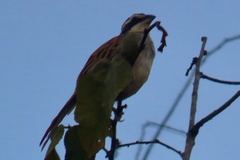

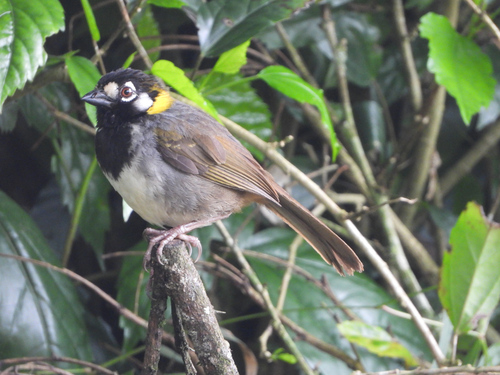
Stripe-headed Sparrow

Stripe-headed Sparrow

Peucaea ruficauda

Silhouette: L. Shyamal · PhyloPic

LCLeast ConcernNTVUENCR
Daily sighting probability <5% · Rare
at San José

In 3 days ~10%

423 Verified sightings at San José
1,910 In all 10 parks From 2019 to 2026
May Best month
☀️ Diurnal When it's spotted

About the Stripe-headed Sparrow

The stripe-headed sparrow (Peucaea ruficauda) is a species of bird in the family Passerellidae, the New World sparrows. It is found from Mexico to Costa Rica. The stripe-headed sparrow was formally described in 1853 with the binomial Chondestes ruficauda. It was later reassigned to genus Aimophila. Genus Peucaea had earlier been merged into Aimophila; in 2010 taxonomic systems began restoring Peucaea to generic status and moved the stripe-headed sparrow and several other species from Aimophila to it.

The stripe-headed sparrow's further taxonomic history is unsettled. The International Ornithologists' Union, AviList, and BirdLife International's Handbook of the Birds of the World assign it these four subspecies: Within the species it calls P. r. acuminata the "stripe-headed sparrow (northern)" and groups the other four subspecies as the "strip-headed sparrow (southern)".

This article... Wikipedia →

Sounds

Call0:35

Mexico · 2021

© Alán Palacios · XC686086 · CC BY-NC-SA 4.0

Recording0:36

Honduras · 2020

© Mario Reyes Jr · XC586172 · CC BY-NC-SA 4.0

Song1:11

Mexico · 2019

© Manuel Grosselet · XC455052 · CC BY-NC-SA 4.0

Global Distribution

Parks Where Found

# Park Country Daily sighting probability
1 Rincón de la Vieja National Park 🇨🇷 Costa Rica
~30%
2 Las Baulas Marine National Park 🇨🇷 Costa Rica
~20%
3 Palo Verde National Park 🇨🇷 Costa Rica
~10%
4 Cabo Blanco Absolute Nature Reserve 🇨🇷 Costa Rica
~10%
5 Santa Rosa National Park 🇨🇷 Costa Rica
~10%
6 Carara National Park 🇨🇷 Costa Rica
~10%
7 Ostional Wildlife Refuge 🇨🇷 Costa Rica
~10%
8 Masaya Volcano National Park 🇳🇮 Nicaragua
~10%
9 Tenorio Volcano National Park 🇨🇷 Costa Rica
<5%
10 Monteverde Cloud Forest Reserve 🇨🇷 Costa Rica
<5%

Cities Where Found

# City Country Daily sighting probability
1 Tegucigalpa 🇭🇳 Honduras
~10%
2 Guadalajara 🇲🇽 México
~10%
3 Managua 🇳🇮 Nicaragua
<5%
4 Mexico City 🇲🇽 México
<5%
5 San José 🇨🇷 Costa Rica
<5%
6 San Salvador 🇸🇻 El Salvador
<5%

Before you go

What are the chances of seeing a Stripe-headed Sparrow in San José?

Rare

Under 5% of wildlife watchers report a Stripe-headed Sparrow sighting in San José on a given day, based on 423 verified sightings from GBIF citizen-science data. It is the 118th most-seen of the 379 birds we can rate there. Over three days the chance rises to about 10%, if each day is a fresh chance.

When is the best time to see a Stripe-headed Sparrow in San José?

Any time of year

In every month with enough records, under 5% of wildlife watchers report a Stripe-headed Sparrow in San José on a given day, so our monthly data shows no clear season.

What time of day is best to see a Stripe-headed Sparrow?

Between 8 and 11 am

Across all the parks we cover, that three-hour window holds the most Stripe-headed Sparrow sightings with a recorded time, and about 9 in 10 of them come between 6 am and 6 pm: it is a daytime animal.

Is San José the best place to see a Stripe-headed Sparrow?

5th of 6

Of the 6 cities where we can rate Stripe-headed Sparrow sightings, San José ranks 5th at under 5%. The best odds are in Tegucigalpa (Honduras, about 10%), Guadalajara (México, about 10%) and Managua (Nicaragua, under 5%).

Which relatives of the Stripe-headed Sparrow live in San José?

Same family: Passerellidae

The closest relatives of the Stripe-headed Sparrow that you can see in San José (family Passerellidae, New World Sparrows) are Rufous-collared Sparrow (about 50%) and White-eared Ground-Sparrow (about 10%), with each one's daily chance of a sighting.

Where does the Stripe-headed Sparrow sighting chance come from?

GBIF citizen-science records

It is estimated from how often the Stripe-headed Sparrow is recorded against all the birds logged in San José (423 verified sightings), calibrated against known sighting rates. Figures are rounded to the nearest 10% because citizen-science data supports honest approximations, not decimals, and months with records from fewer than five people show "—". How it works.

← Back to San José