Common Giant Turtle Ant

Common Giant Turtle Ant

Cephalotes atratus

Daily sighting probability ~20% · Possible
at Santa Cruz de la Sierra

In 3 days ~50% in a week ~80%

12 Verified sightings at Santa Cruz de la Sierra
195 In all 8 parks From 2019 to 2026
August Best month
☀️ Diurnal When it's spotted

About the Common Giant Turtle Ant

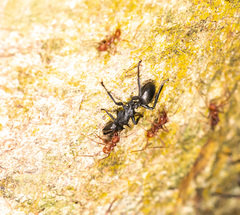
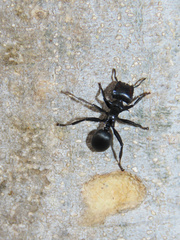
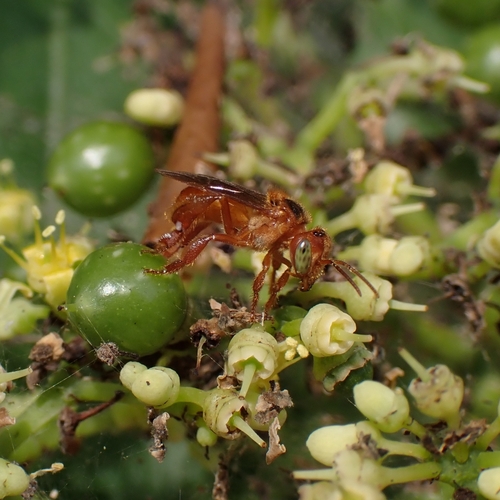
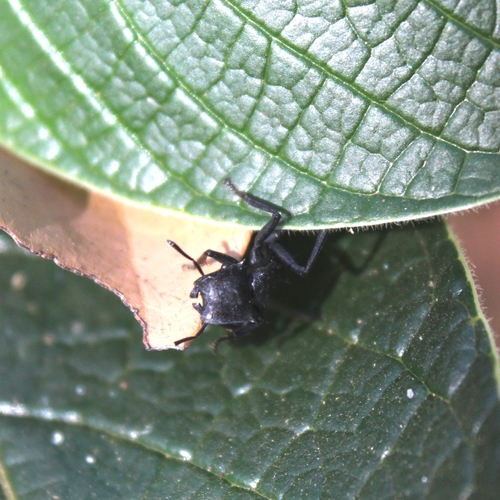
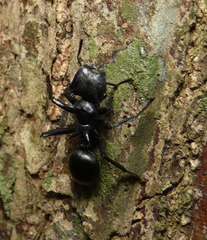
Cephalotes atratus is a species of arboreal ant in the genus Cephalotes, a genus characterized by its odd shaped head. These ants are known as gliding ants because of their ability to "parachute" by steering their fall if they lose their footing.

It is called kaka-sikikoko in the Kwaza language of Rondônia, Brazil. Cephalotes atratus is a large, mainly black ant; workers are 8 to 14 mm (0.3 to 0.6 in) in length and females 20 mm (0.8 in). Males are up to 14 mm (0.55 in) and have black heads and thoraxes, and dark reddish-brown gasters and limbs. The workers are spiny and heavily armoured with powerful mandibles for chewing through wood.

This ant occurs in lowland tropical rainforests in South America where its range extends from Panama and Venezuela to Peru, Bolivia, Paraguay, Uruguay and northern Argentina. It is a common arboreal species and colonies are found in forested areas, parkland with isolated trees, and urban habitats.

This ant usually builds its nest in a hollow in a large live or dead tree. A small entrance may lead to a complex of tunnels and chambers, all excavated by the ants. From the nest the workers emerge... Wikipedia →
Global Distribution

Parks Where Found

# Park Country Daily sighting probability
1 Main Ridge Forest Reserve 🇹🇹 Trinidad and Tobago
~20%
2 Anavilhanas National Park 🇧🇷 Brazil
~20%
3 Manu National Park 🇵🇪 Peru
~20%
4 Yasuní National Park 🇪🇨 Ecuador
~20%
5 Soberanía National Park 🇵🇦 Panama
~20%
6 Tambopata National Reserve 🇵🇪 Peru
~20%
7 Cuyabeno Wildlife Reserve 🇪🇨 Ecuador
~10%
8 Parque Natural Metropolitano 🇵🇦 Panama
~10%

Cities Where Found

# City Country Daily sighting probability
1 Valencia 🇻🇪 Venezuela
~30%
2 João Pessoa 🇧🇷 Brazil
~30%
3 Santa Cruz de la Sierra 🇧🇴 Bolivia
~20%
4 Recife 🇧🇷 Brazil
~20%
5 Belém 🇧🇷 Brazil
~10%
6 Goiânia 🇧🇷 Brazil
~10%
7 Brasilia 🇧🇷 Brazil
~10%
8 Manaus 🇧🇷 Brazil
~10%

Before you go

What are the chances of seeing a Common Giant Turtle Ant in Santa Cruz de la Sierra?

Possible

About 20% of wildlife watchers report a Common Giant Turtle Ant sighting in Santa Cruz de la Sierra on a given day, based on 12 verified sightings from GBIF citizen-science data. It is the 14th most-seen of the 48 insects we can rate there. Over three days the chance rises to about 50%, and over a week to about 80%, if each day is a fresh chance.

When is the best time to see a Common Giant Turtle Ant in Santa Cruz de la Sierra?

August

In that month about 40% of wildlife watchers report a Common Giant Turtle Ant in Santa Cruz de la Sierra on a given day, against under 5% in June and November–February, the lowest months. That is one of Santa Cruz de la Sierra's driest months, with about 40 mm of rain against 170 mm in January.

What time of day is best to see a Common Giant Turtle Ant?

Between 9 am and noon

Across all the parks we cover, that three-hour window holds the most Common Giant Turtle Ant sightings with a recorded time, and about 9 in 10 of them come between 6 am and 6 pm: it is a daytime animal.

Is Santa Cruz de la Sierra the best place to see a Common Giant Turtle Ant?

3rd of 8

Of the 8 cities where we can rate Common Giant Turtle Ant sightings, Santa Cruz de la Sierra ranks 3rd at about 20%. The best odds are in Valencia (Venezuela, about 30%) and João Pessoa (Brazil, about 30%).

Where does the Common Giant Turtle Ant sighting chance come from?

GBIF citizen-science records

It is estimated from how often the Common Giant Turtle Ant is recorded against all the insects logged in Santa Cruz de la Sierra (12 verified sightings), calibrated against known sighting rates. Figures are rounded to the nearest 10% because citizen-science data supports honest approximations, not decimals, and months with records from fewer than five people show "—". How it works.

← Back to Santa Cruz de la Sierra