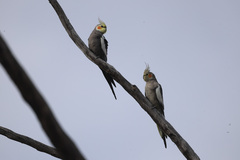
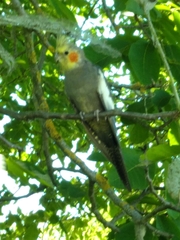
Cockatiel

Cockatiel

Nymphicus hollandicus

Silhouette: Matias · PhyloPic

LCLeast ConcernNTVUENCR
Daily sighting probability <5% · Rare
at São Paulo

In 3 days <5%

8 Verified sightings at São Paulo
121 In all 5 parks From 2019 to 2026
February Best month
☀️ Diurnal When it's spotted

About the Cockatiel

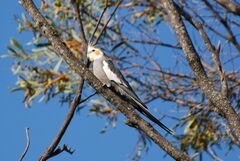
The cockatiel (Nymphicus hollandicus), also known as the weero/weiro or quarrion, is a species of small- to medium-sized parrot belonging to the cockatoo family (Cacatuidae), of which it is the smallest member. Native to Australia, it is the sole member of the genus Nymphicus.

Cockatiels are widely recognized for their expressive crests, long tail feathers, and sociable, playful nature, and their strong affinity for human interaction has made them among the most commonly kept companion parrots worldwide and one of the five most popular pet bird species; an estimated 4.8 million US households keep them. However, insufficient knowledge of their care contributes to one of the highest surrender rates among pet bird species.

Proper care requires regular social interaction with owners, as well as a suitable nutritionally appropriate diet, toy-based enrichment, annual veterinary check-ups and prompt attention when signs of illness or respiratory issues appear, perches of varying diameters, UV exposure, and about two hours of daily out-of-cage time. Due to many owners' unfamiliarity with these requirements, many cockatiels suffer chronic malnutrition and behavioral problems and are often relinquished to shelters within approximately 1.5 years of adoption.

The cockatiel is the only member of the genus Nymphicus. It was previously unclear whether the cockatiel is a crested parakeet or small cockatoo; however, more recent molecular studies have assigned it to its own subfamily, Nymphicinae. It is, therefore, now classified as the smallest subfamily of the Cacatuidae (cockatoo family). Cockatiels are native to Australia, favouring the Australian wetlands, scrublands, and bushlands. There are many different mutations of this bird. Wikipedia →

Sounds

Call0:23

France · 2026

© Thierry THOMAS · XC1163859 · CC BY-NC-SA 4.0

Flight call0:16

Netherlands · 2022

© Gerard van Aalst · XC743895 · CC BY-NC-SA 4.0

Call0:09

Portugal · 2022

© Jorge Leitão · XC766518 · CC BY-NC-SA 4.0

Global Distribution

Parks Where Found

# Park Country Daily sighting probability
1 Ningaloo Marine Park 🇦🇺 Australia
~10%
2 Cape Range 🇦🇺 Australia
~10%
3 Nitmiluk National Park 🇦🇺 Australia
~10%
4 Uluru-Kata Tjuta National Park 🇦🇺 Australia
~10%
5 Hattah-Kulkyne National Park 🇦🇺 Australia
<5%

Cities Where Found

# City Country Daily sighting probability
1 Mashhad 🇮🇷 Iran
<5%
2 Santiago 🇨🇱 Chile
<5%
3 Jerusalem 🇮🇱 Israel
<5%
4 Miami 🇺🇸 United States
<5%
5 São Paulo 🇧🇷 Brazil
<5%
6 Sydney 🇦🇺 Australia
<5%
7 Brisbane 🇦🇺 Australia
<5%
8 Houston 🇺🇸 United States
<5%
9 Los Angeles 🇺🇸 United States
<5%
10 Chicago 🇺🇸 United States
<5%

Zoos & Centres Where Found

# Zoo / Centre Country
1 Disney's Animal Kingdom 🇺🇸 United States In captivity
2 Pairi Daiza 🇧🇪 Belgium In captivity
3 Le Pal 🇫🇷 France In captivity
4 Walsrode World Bird Park 🇩🇪 Germany In captivity
5 Parc des oiseaux 🇫🇷 France In captivity
6 La Tanière 🇫🇷 France In captivity
7 Heinola bird sanctuary 🇫🇮 Finland In captivity
8 Nandankanan Zoological Park 🇮🇳 India In captivity
9 Dalian forest zoo 🇨🇳 China In captivity
10 Sri Venkateswara Zoological Park 🇮🇳 India In captivity
11 Zoo Miami 🇺🇸 United States In captivity
12 Beijing Wildlife Park 🇨🇳 China In captivity
13 Bondla Zoo 🇮🇳 India In captivity
14 Nehru Zoological Park 🇮🇳 India In captivity
15 Wildlife Safari 🇺🇸 United States In captivity
16 National Zoological Park Delhi 🇮🇳 India In captivity
17 Beijing Zoo 🇨🇳 China In captivity
18 Omaha’s Henry Doorly Zoo and Aquarium 🇺🇸 United States In captivity
19 WildFlorida Safaris 🇺🇸 United States In captivity
20 Mogilyov Zoo 🇧🇾 Belarus In captivity
21 Parque Zoológico de León - Zooleón 🇲🇽 Mexico In captivity
22 Dallas Zoo 🇺🇸 United States In captivity
23 Toledo Zoo 🇺🇸 United States In captivity
24 Africam Safari 🇲🇽 Mexico In captivity
25 Antalya Zoo 🇹🇷 Türkiye In captivity
26 Guadalajara Zoo 🇲🇽 Mexico In captivity
27 Nanning Zoo 🇨🇳 China In captivity
28 Kyiv Zoo 🇺🇦 Ukraine In captivity
29 Branson's Promised Land Zoo 🇺🇸 United States In captivity
30 Dyrehaven i Nørreskoven 🇩🇰 Denmark In captivity
31 Caldwell Zoo 🇺🇸 United States In captivity
32 Woodland Park Zoo 🇺🇸 United States In captivity
33 Parc zoologique et forestier Michel-Corbasson 🇫🇷 France In captivity
34 Temaikén 🇦🇷 Argentina In captivity
35 Brevard Zoo 🇺🇸 United States In captivity
36 Franklin Park Zoo 🇺🇸 United States In captivity
37 Fort Worth Zoo 🇺🇸 United States In captivity
38 Gatorland 🇺🇸 United States In captivity
39 Hobart Zoo and Aquarium 🇦🇺 Australia In captivity
40 Wilhelma 🇩🇪 Germany In captivity
41 Cleland Wildlife Park 🇦🇺 Australia In captivity
42 DierenPark Amersfoort 🇳🇱 Netherlands In captivity
43 Zoológico la pastroa 🇲🇽 Mexico In captivity
44 Fort Wayne Children's Zoo 🇺🇸 United States In captivity
45 Currumbin Wildlife Sanctuary 🇦🇺 Australia In captivity
46 Warangal Zoo 🇮🇳 India In captivity
47 Jijamata Udyaan 🇮🇳 India In captivity
48 San Antonio Zoo 🇺🇸 United States In captivity
49 Alipore Zoological Gardens 🇮🇳 India In captivity
50 Jaderpark 🇩🇪 Germany In captivity

Before you go

What are the chances of seeing a Cockatiel in São Paulo?

Rare

Under 5% of wildlife watchers report a Cockatiel sighting in São Paulo on a given day, based on 8 verified sightings from GBIF citizen-science data. It is the 319th most-seen of the 353 birds we can rate there. Over three days the chance rises to under 5%, if each day is a fresh chance.

When is the best time to see a Cockatiel in São Paulo?

Any time of year

In every month with enough records, under 5% of wildlife watchers report a Cockatiel in São Paulo on a given day, so our monthly data shows no clear season.

What time of day is best to see a Cockatiel?

Between 8 and 11 am

Across all the parks we cover, that three-hour window holds the most Cockatiel sightings with a recorded time, and about 9 in 10 of them come between 6 am and 6 pm: it is a daytime animal.

Is São Paulo the best place to see a Cockatiel?

Among the best

Of the 11 cities where we can rate Cockatiel sightings, São Paulo ranks 5th at under 5%, level with the leaders once rounded. The best odds are in Mashhad (Iran, under 5%), Santiago (Chile, under 5%) and Jerusalem (Israel, under 5%).

Which relatives of the Cockatiel live in São Paulo?

Same family: Psittacidae

The closest relatives of the Cockatiel that you can see in São Paulo (family Psittacidae, New World and African Parrots) are Plain Parakeet (about 80%), White-eyed Parakeet (about 40%) and Blue-fronted Parrot (about 30%), with each one's daily chance of a sighting.

Where does the Cockatiel sighting chance come from?

GBIF citizen-science records

It is estimated from how often the Cockatiel is recorded against all the birds logged in São Paulo (8 verified sightings), calibrated against known sighting rates. Figures are rounded to the nearest 10% because citizen-science data supports honest approximations, not decimals, and months with records from fewer than five people show "—". How it works.

← Back to São Paulo