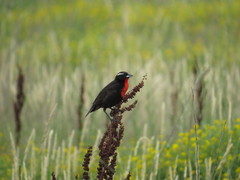
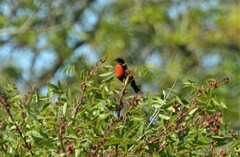
White-browed Meadowlark

White-browed Meadowlark

Sturnella superciliaris

Silhouette: Matt Wilkins · PhyloPic

Daily sighting probability <5% · Rare
at São Paulo

In 3 days <5%

7 Verified sightings at São Paulo
457 In all 8 parks From 2019 to 2026
October Best month
☀️ Diurnal When it's spotted

About the White-browed Meadowlark

The white-browed meadowlark (Leistes superciliaris) is a passerine bird in the New World family Icteridae. It was formerly named white-browed blackbird but is not closely related to the red-winged blackbird group. The white-browed meadowlark breeds in north-eastern Brazil and in southern South America from south-western Brazil through Paraguay, Uruguay and Argentina. Southern populations are partially migratory.

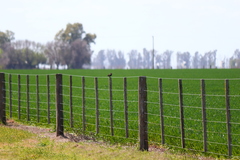
Like other meadowlarks, it is a bird associated with open country, including moist grasslands, pasture and cultivation, preferably with the odd bush or fence post for males to use as a songpost. In display the male flies up to 10 m in the air, then parachutes down on folded wings whilst singing an initially buzzing song, followed by a series of notes TZZZZZZ-teee-chu-chu-chak-chak. The call is a short chuck.

The white-browed meadowlark builds a deep grass-lined open cup nest on the ground amongst tall grasses, with several nests often close together. The normal clutch is three to five reddish brown-blotched greenish eggs. This species is often parasitised by the shiny cowbird, and on one occasion 19 cowbird eggs were found with one meadowlark egg in a nest.

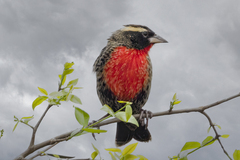
The white-browed meadowlark is a small icterid. The male has mainly black plumage, apart from a bright red throat, belly and wing epaulets, and a white supercilium. The female has buff edged dark brown upperpart feathers, buff underparts, and pale streaks through the crown and eye. Juveniles resemble the female, but are paler.

This species is very closely related to the red-breasted meadowlark, L. militaris, which breeds further north, and was formerly considered to be subspecies of that bird. The male white-browed is easily distinguished by his bright white supercilium, but females of the two species are almost identical. The female red-breasted meadowlark is longer billed, smaller, and shorter winged than the white-browed, with more red and less streaking on the underparts.

This gregarious bird feeds mainly on insects and some seeds, including rice, and forages on the ground like a bobolink. The white-browed meadowlark has benefited from the more open habitat created by forest clearance and ranching, and is extending its range. Wikipedia →

Sounds

Recording0:03

Brazil · 2022

© Danielly Cortes · iNaturalist · CC BY-NC 4.0

Recording0:09

Argentina · 2021

© Juan M. Atencio · iNaturalist · CC BY-NC 4.0

Recording0:23

Brazil · 2023

© Luciano Bernardes · iNaturalist · CC BY-NC 4.0

Global Distribution

Parks Where Found

# Park Country Daily sighting probability
1 Iberá National Park 🇦🇷 Argentina
~10%
2 El Impenetrable National Park 🇦🇷 Argentina
~10%
3 Emas National Park 🇧🇷 Brazil
<5%
4 Iguazú National Park 🇦🇷 Argentina
<5%
5 Serra da Canastra National Park 🇧🇷 Brazil
<5%
6 Iguaçu National Park 🇧🇷 Brazil
<5%
7 Serra dos Órgãos National Park 🇧🇷 Brazil
<5%
8 Parque Estadual Encontro das Águas 🇧🇷 Brazil
<5%

Cities Where Found

# City Country Daily sighting probability
1 Santa Cruz de la Sierra 🇧🇴 Bolivia
<5%
2 Campo Grande 🇧🇷 Brazil
<5%
3 Buenos Aires 🇦🇷 Argentina
<5%
4 Asuncion 🇵🇾 Paraguay
<5%
5 Montevideo 🇺🇾 Uruguay
<5%
6 Porto Alegre 🇧🇷 Brazil
<5%
7 Rio de Janeiro 🇧🇷 Brazil
<5%
8 Santos 🇧🇷 Brazil
<5%
9 São Paulo 🇧🇷 Brazil
<5%

Before you go

What are the chances of seeing a White-browed Meadowlark in São Paulo?

Rare

Under 5% of wildlife watchers report a White-browed Meadowlark sighting in São Paulo on a given day, based on 7 verified sightings from GBIF citizen-science data. It is the 319th most-seen of the 353 birds we can rate there. Over three days the chance rises to under 5%, if each day is a fresh chance.

When is the best time to see a White-browed Meadowlark in São Paulo?

Any time of year

In every month with enough records, under 5% of wildlife watchers report a White-browed Meadowlark in São Paulo on a given day, so our monthly data shows no clear season.

What time of day is best to see a White-browed Meadowlark?

Between 7 and 10 am

Across all the parks we cover, that three-hour window holds the most White-browed Meadowlark sightings with a recorded time, and about 9 in 10 of them come between 6 am and 6 pm: it is a daytime animal.

Is São Paulo the best place to see a White-browed Meadowlark?

Among the best

Of the 9 cities where we can rate White-browed Meadowlark sightings, São Paulo ranks 9th at under 5%, level with the leaders once rounded. The best odds are in Santa Cruz de la Sierra (Bolivia, under 5%), Campo Grande (Brazil, under 5%) and Buenos Aires (Argentina, under 5%).

Which relatives of the White-browed Meadowlark live in São Paulo?

Same family: Icteridae

The closest relatives of the White-browed Meadowlark that you can see in São Paulo (family Icteridae, New World Blackbirds and Orioles) are Shiny Cowbird (about 10%) and Chestnut-capped Blackbird (about 10%), with each one's daily chance of a sighting.

Where does the White-browed Meadowlark sighting chance come from?

GBIF citizen-science records

It is estimated from how often the White-browed Meadowlark is recorded against all the birds logged in São Paulo (7 verified sightings), calibrated against known sighting rates. Figures are rounded to the nearest 10% because citizen-science data supports honest approximations, not decimals, and months with records from fewer than five people show "—". How it works.

← Back to São Paulo