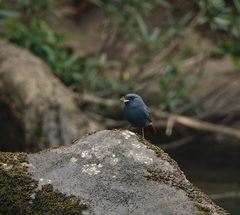
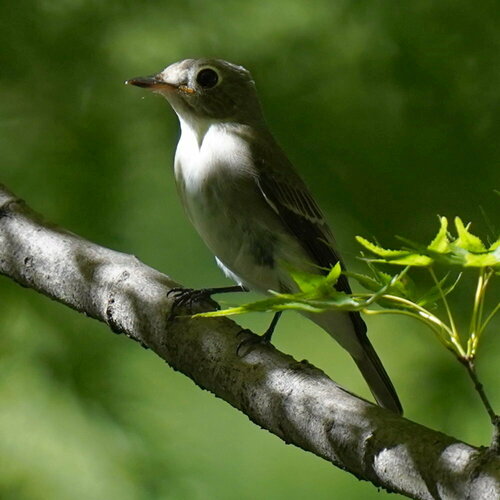
Plumbeous Water Redstart

Plumbeous Water Redstart

Phoenicurus fuliginosus

Silhouette: Martin Bulla, based on François Desbordes' illustration · PhyloPic

LCLeast ConcernNTVUENCR
Daily sighting probability <5% · Rare
at Seoul

In 3 days <5%

7 Verified sightings at Seoul
3,550 In all 10 parks From 2019 to 2026
January Best month
☀️ Diurnal When it's spotted

About the Plumbeous Water Redstart

The plumbeous water redstart (Phoenicurus fuliginosus) is a passerine bird in the Old World flycatcher family Muscicapidae. It is found in South Asia, Southeast Asia and China. Males are slate blue in colour, while females are grey. The bird's common name refers to its colour which resembles lead. They tend to live near fast-moving streams and rivers.

The plumbeous water redstart belongs to the order Passeriformes and the family Muscicapidae. It was previously placed in the genus Rhyacornis but was moved to Phoenicurus based on the results of a molecular phylogenetic study published in 2010. The species consists of two recognized subspecies – Phoenicurus fuliginosus fuliginosus and Phoenicurus fuliginosus affinis. The former was described by Nicholas Aylward Vigors in 1831, while the latter was described by William Robert Ogilvie-Grant in 1906 and is found in Taiwan. In China, the female and first-year male redstarts appear more brown at the top, leading to the possibility of classifying them as a separate race tenuirostris.

The plumbeous water redstart is typically 14 centimetres (5.5 in) long in total, with an average weight of 22 grams (0.78... Wikipedia →

Sounds

Song0:18

China · 2021

© JJSUN · XC1070708 · CC BY-NC-SA 4.0

Call0:12

Taiwan · 2024

© 蔡明剛 · XC914963 · CC BY-NC-SA 4.0

Song0:35

China · 2025

© Ding Li Yong · XC1008561 · CC BY-NC-ND 4.0

Global Distribution

Parks Where Found

# Park Country Daily sighting probability
1 Namdapha National Park 🇮🇳 India
~40%
2 Langtang National Park 🇳🇵 Nepal
~40%
3 Taroko National Park 🇹🇼 Taiwan
~30%
4 Jiuzhaigou National Park 🇨🇳 China
~30%
5 Royal Manas National Park 🇧🇹 Bhutan
~30%
6 Jim Corbett National Park 🇮🇳 India
~20%
7 Doi Inthanon National Park 🇹🇭 Thailand
~20%
8 Manas National Park 🇮🇳 India
~10%
9 Royal Bardia National Park 🇳🇵 Nepal
<5%
10 Chitwan National Park 🇳🇵 Nepal
<5%

Cities Where Found

# City Country Daily sighting probability
1 Guiyang 🇨🇳 China
~30%
2 Lanzhou 🇨🇳 China
~20%
3 Chengdu 🇨🇳 China
~10%
4 Chongqing 🇨🇳 China
~10%
5 Kathmandu 🇳🇵 Nepal
~10%
6 Kunming 🇨🇳 China
<5%
7 Hong Kong 🇨🇳 China
<5%
8 Srinagar 🇮🇳 India
<5%
9 Dushanbe 🇹🇯 Tajikistan
<5%
10 Dehradun 🇮🇳 India
<5%

Zoos & Centres Where Found

# Zoo / Centre Country
1 Leofoo Village Theme Park 🇹🇼 Taiwan In captivity
2 Fonghuanggu Bird and Ecology Park 🇹🇼 Taiwan In captivity

Before you go

What are the chances of seeing a Plumbeous Water Redstart in Seoul?

Rare

Under 5% of wildlife watchers report a Plumbeous Water Redstart sighting in Seoul on a given day, based on 7 verified sightings from GBIF citizen-science data. It is the 227th most-seen of the 231 birds we can rate there. Over three days the chance rises to under 5%, if each day is a fresh chance.

When is the best time to see a Plumbeous Water Redstart in Seoul?

Any time of year

In every month with enough records, under 5% of wildlife watchers report a Plumbeous Water Redstart in Seoul on a given day, so our monthly data shows no clear season.

What time of day is best to see a Plumbeous Water Redstart?

Between 8 and 11 am

Across all the parks we cover, that three-hour window holds the most Plumbeous Water Redstart sightings with a recorded time, and about 9 in 10 of them come between 6 am and 6 pm: it is a daytime animal.

Is Seoul the best place to see a Plumbeous Water Redstart?

17th of 17

Of the 17 cities where we can rate Plumbeous Water Redstart sightings, Seoul ranks 17th at under 5%. The best odds are in Guiyang (China, about 30%), Lanzhou (China, about 20%) and Chengdu (China, about 10%).

Where does the Plumbeous Water Redstart sighting chance come from?

GBIF citizen-science records

It is estimated from how often the Plumbeous Water Redstart is recorded against all the birds logged in Seoul (7 verified sightings), calibrated against known sighting rates. Figures are rounded to the nearest 10% because citizen-science data supports honest approximations, not decimals, and months with records from fewer than five people show "—". How it works.

← Back to Seoul