Asian Brown Flycatcher

Asian Brown Flycatcher

Muscicapa latirostris

Silhouette: Ekytza · PhyloPic

Daily sighting probability ~10% · With luck
at Seoul

In 3 days ~10% in a week ~30%

386 Verified sightings at Seoul
6,379 In all 34 parks From 2019 to 2026
September Best month
🌅 Crepuscular When it's spotted

About the Asian Brown Flycatcher

The Asian brown flycatcher (Muscicapa dauurica) is a small passerine bird in the flycatcher family Muscicapidae. The word Muscicapa comes from the Latin musca, a fly and capere, to catch. The specific dauurica refers to Dauria, an area of south-eastern Siberia named after a local nomadic tribe.

This is an insectivorous species which breeds in Japan, eastern Siberia and the Himalayas. It is migratory and winters in tropical southern Asia from southern India and Sri Lanka east to Indonesia. The correct specific epithet for this species is disputed.

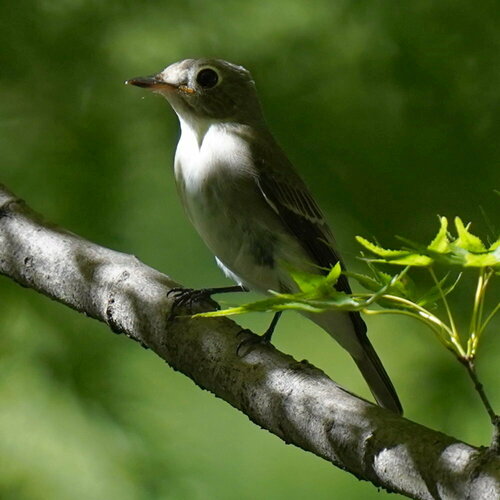
This species is 13 cm (5.1 in) long, including the cocked tail. It is similar in shape to the larger spotted flycatcher, but is relatively longer-tailed. The dark bill is relatively large and broad-based. The adult has grey-brown upperparts, which become greyer as the plumage ages, and whitish underparts with brown-tinged flanks. Young birds have scaly brown upperparts, head and breast.

Although usually treated as monotypic if the brown-streaked flycatcher is not included, Rasmussen and Anderton, in Birds of South Asia. The Ripley Guide argue that populations in the Indian subcontinent and the... Wikipedia →
Sounds

Recording0:16

Russia · 2024

© Vyacheslav Luzanov · iNaturalist · CC BY-NC 4.0

Recording0:11

Thailand · 2023

© David Tan · iNaturalist · CC BY-NC 4.0

Recording0:08

Taiwan · 2023

© abujudy · iNaturalist · CC BY-NC 4.0

Global Distribution

Parks Where Found

# Park Country Daily sighting probability
1 Khao Sok National Park 🇹🇭 Thailand
~40%
2 Cat Tien National Park 🇻🇳 Vietnam
~40%
3 Kaeng Krachan National Park 🇹🇭 Thailand
~40%
4 Khao Yai National Park 🇹🇭 Thailand
~30%
5 Khao Luang National Park 🇹🇭 Thailand
~30%
6 Periyar National Park 🇮🇳 India
~20%
7 Nikko National Park 🇯🇵 Japan
~20%
8 Mudumalai National Park 🇮🇳 India
~20%
9 Bandipur National Park 🇮🇳 India
~20%
10 Sinharaja Forest Reserve 🇱🇰 Sri Lanka
~20%
11 Minneriya National Park 🇱🇰 Sri Lanka
~20%
12 Nagarhole National Park 🇮🇳 India
~20%
13 Wilpattu National Park 🇱🇰 Sri Lanka
~10%
14 Gobi Gurvansaikhan National Park 🇲🇳 Mongolia
~10%
15 Gunung Leuser National Park 🇮🇩 Indonesia
~10%
16 Taman Negara National Park 🇲🇾 Malaysia
~10%
17 Cuc Phuong National Park 🇻🇳 Vietnam
~10%
18 Udawalawe National Park 🇱🇰 Sri Lanka
~10%
19 Kinabalu Park 🇲🇾 Malaysia
~10%
20 Doi Inthanon National Park 🇹🇭 Thailand
~10%
21 Yala National Park 🇱🇰 Sri Lanka
~10%
22 Danum Valley Conservation Area 🇲🇾 Malaysia
~10%
23 Way Kambas National Park 🇮🇩 Indonesia
<5%
24 Manas National Park 🇮🇳 India
<5%
25 Sepilok 🇲🇾 Malaysia
<5%
26 Kinabatangan Wildlife Sanctuary 🇲🇾 Malaysia
<5%
27 Horton Plains National Park 🇱🇰 Sri Lanka
<5%
28 Ranthambore National Park 🇮🇳 India
<5%
29 Jim Corbett National Park 🇮🇳 India
<5%
30 Royal Manas National Park 🇧🇹 Bhutan
<5%
31 Kerinci Seblat National Park 🇮🇩 Indonesia
<5%
32 Bandhavgarh National Park 🇮🇳 India
<5%
33 Kanha National Park 🇮🇳 India
<5%
34 Chitwan National Park 🇳🇵 Nepal
<5%

Cities Where Found

# City Country Daily sighting probability
1 Ho Chi Minh City 🇻🇳 Vietnam
~40%
2 Xiuying District 🇨🇳 China
~30%
3 Phnom Penh 🇰🇭 Cambodia
~30%
4 Kuala Lumpur 🇲🇾 Malaysia
~20%
5 Bangkok 🇹🇭 Thailand
~20%
6 Singapore 🇸🇬 Singapore
~20%
7 Hong Kong 🇨🇳 China
~20%
8 Jinhua 🇨🇳 China
~20%
9 Ningbo 🇨🇳 China
~10%
10 Hanoi 🇻🇳 Vietnam
~10%

Before you go

What are the chances of seeing an Asian Brown Flycatcher in Seoul?

With luck

About 10% of wildlife watchers report an Asian Brown Flycatcher sighting in Seoul on a given day, based on 386 verified sightings from GBIF citizen-science data. It is the 72nd most-seen of the 231 birds we can rate there. Over three days the chance rises to about 10%, and over a week to about 30%, if each day is a fresh chance.

When is the best time to see an Asian Brown Flycatcher in Seoul?

September

In that month about 30% of wildlife watchers report an Asian Brown Flycatcher in Seoul on a given day, against under 5% in June–July and November–April, the lowest months.

What time of day is best to see an Asian Brown Flycatcher?

Between 3 and 6 am

Across all the parks we cover, that three-hour window holds the most Asian Brown Flycatcher sightings with a recorded time, and about 6 in 10 of them come between 6 pm and 6 am: it is most active around dawn and dusk.

Is Seoul the best place to see an Asian Brown Flycatcher?

30th of 63

Of the 63 cities where we can rate Asian Brown Flycatcher sightings, Seoul ranks 30th at about 10%. The best odds are in Ho Chi Minh City (Vietnam, about 40%), Xiuying District (China, about 30%) and Phnom Penh (Cambodia, about 30%).

Where does the Asian Brown Flycatcher sighting chance come from?

GBIF citizen-science records

It is estimated from how often the Asian Brown Flycatcher is recorded against all the birds logged in Seoul (386 verified sightings), calibrated against known sighting rates. Figures are rounded to the nearest 10% because citizen-science data supports honest approximations, not decimals, and months with records from fewer than five people show "—". How it works.

← Back to Seoul