African Golden Oriole

African Golden Oriole

Oriolus auratus

Silhouette: Charles J. Sharp · PhyloPic

LCLeast ConcernNTVUENCR
Daily sighting probability <5% · Rare
at Serrekunda

In 3 days ~10%

15 Verified sightings at Serrekunda
539 In all 22 parks From 2019 to 2026
January Best month
☀️ Diurnal When it's spotted

About the African Golden Oriole

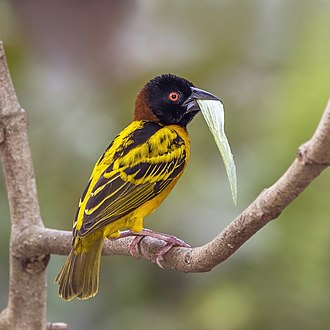
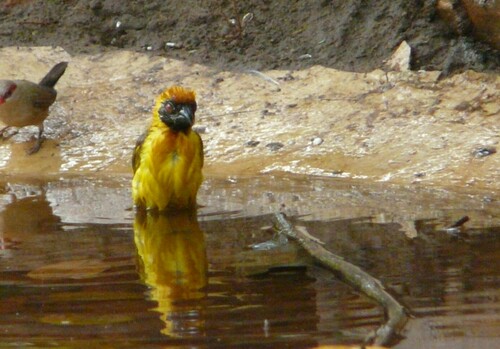
The African golden oriole (Oriolus auratus), or African oriole, is a member of the oriole family of passerine birds which is a resident breeder in Africa south of the Sahara desert. It is a bird of thick bush and other well-wooded areas. The hanging basket-shaped nest is built in a tree, and contains two eggs. The food is insects and fruit, especially figs, found in the tree canopies where the orioles spend much of their time.

The name "oriole" was first recorded (in the Latin form oriolus) by Albertus Magnus in about 1250, and was stated to be onomatopoeic, from the song of the golden oriole. The New World orioles are similar in appearance to the Oriolidae, but are icterids unrelated to the Old World birds.

Found from Angola to central Mozambique The male is striking in the typical oriole black and yellow plumage, although the plumage is predominantly yellow... Wikipedia →

Sounds

Song0:23

Senegal · 2025

© Azens · XC1059821 · CC BY-NC-SA 4.0

Call0:51

Senegal · 2024

© Frank Lambert · XC1041441 · CC BY-NC-ND 4.0

Call0:44

Malawi · 2024

© Magnus Wadstein · XC959335 · CC BY-NC-SA 4.0

Global Distribution

Parks Where Found

# Park Country Daily sighting probability
1 Mana Pools National Park 🇿🇼 Zimbabwe
~20%
2 Lower Zambezi National Park 🇿🇲 Zambia
~10%
3 Hwange National Park 🇿🇼 Zimbabwe
~10%
4 Gonarezhou National Park 🇿🇼 Zimbabwe
~10%
5 Mikumi National Park 🇹🇿 Tanzania
~10%
6 Kafue National Park 🇿🇲 Zambia
~10%
7 Liwonde National Park 🇲🇼 Malawi
~10%
8 Ruaha National Park 🇹🇿 Tanzania
~10%
9 Chobe National Park 🇧🇼 Botswana
<5%
10 Niokolo-Koba National Park 🇸🇳 Senegal
<5%
11 Gorongosa National Park 🇲🇿 Mozambique
<5%
12 South Luangwa National Park 🇿🇲 Zambia
<5%
13 Moremi Game Reserve 🇧🇼 Botswana
<5%
14 Arusha National Park 🇹🇿 Tanzania
<5%
15 Etosha National Park 🇳🇦 Namibia
<5%
16 Tarangire National Park 🇹🇿 Tanzania
<5%
17 Murchison Falls National Park 🇺🇬 Uganda
<5%
18 Lake Nakuru National Park 🇰🇪 Kenya
<5%
19 Nyungwe National Park 🇷🇼 Rwanda
<5%
20 Lake Mburo National Park 🇺🇬 Uganda
<5%
21 Queen Elizabeth National Park 🇺🇬 Uganda
<5%
22 Ngorongoro Conservation Area 🇹🇿 Tanzania
<5%

Cities Where Found

# City Country Daily sighting probability
1 Abuja 🇳🇬 Nigeria
~10%
2 Lusaka 🇿🇲 Zambia
~10%
3 Lilongwe 🇲🇼 Malawi
~10%
4 Harare 🇿🇼 Zimbabwe
<5%
5 Serrekunda 🇬🇲 Gambia
<5%

Before you go

What are the chances of seeing an African Golden Oriole in Serrekunda?

Rare

Under 5% of wildlife watchers report an African Golden Oriole sighting in Serrekunda on a given day, based on 15 verified sightings from GBIF citizen-science data. It is the 162nd most-seen of the 213 birds we can rate there. Over three days the chance rises to about 10%, if each day is a fresh chance.

When is the best time to see an African Golden Oriole in Serrekunda?

Any time of year

In every month with enough records, under 5% of wildlife watchers report an African Golden Oriole in Serrekunda on a given day, so our monthly data shows no clear season.

What time of day is best to see an African Golden Oriole?

Between 7 and 10 am

Across all the parks we cover, that three-hour window holds the most African Golden Oriole sightings with a recorded time, and about 9 in 10 of them come between 6 am and 6 pm: it is a daytime animal.

Is Serrekunda the best place to see an African Golden Oriole?

5th of 5

Of the 5 cities where we can rate African Golden Oriole sightings, Serrekunda ranks 5th at under 5%. The best odds are in Abuja (Nigeria, about 10%), Lusaka (Zambia, about 10%) and Lilongwe (Malawi, about 10%).

Which relatives of the African Golden Oriole live in Serrekunda?

Same order: Passeriformes

The closest relatives of the African Golden Oriole that you can see in Serrekunda (order Passeriformes, Perching Birds) are Pied Crow (about 90%), Common Bulbul (about 90%) and Beautiful Sunbird (about 70%), with each one's daily chance of a sighting.

Where does the African Golden Oriole sighting chance come from?

GBIF citizen-science records

It is estimated from how often the African Golden Oriole is recorded against all the birds logged in Serrekunda (15 verified sightings), calibrated against known sighting rates. Figures are rounded to the nearest 10% because citizen-science data supports honest approximations, not decimals, and months with records from fewer than five people show "—". How it works.

← Back to Serrekunda