Chestnut Munia

Chestnut Munia

Lonchura atricapilla

Silhouette: Ferran Sayol · PhyloPic

LCLeast ConcernNTVUENCR
Daily sighting probability <5% · Rare
at Singapore

In 3 days ~10% in a week ~30%

565 Verified sightings at Singapore
1,406 In all 9 parks From 2019 to 2026
January Best month
☀️ Diurnal When it's spotted

About the Chestnut Munia

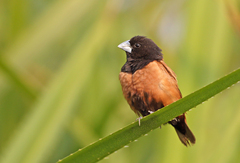
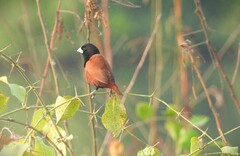
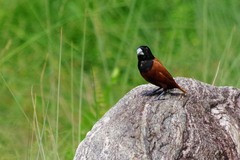
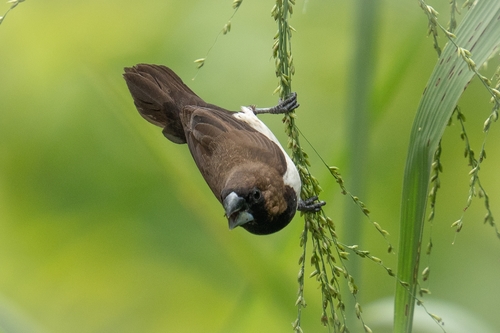
The chestnut munia or black-headed munia (Lonchura atricapilla) is a small passerine. It was formerly considered conspecific with the closely related tricoloured munia, but is now widely accepted as a separate species. This estrildid finch is a resident breeding bird in Bangladesh, Brunei, Cambodia, China, India, Indonesia, Laos, Malaysia, Burma, Nepal, the Philippines, Singapore, Taiwan, Thailand, Vietnam and Hawaii. It also has been introduced to all the Greater Antilles and Martinique in the Caribbean.

Before 1995, it was the national bird of the Philippines, where it is known in Tagalog as mayang pula ("red maya") because of the brick red patch on the lower back which is visible only when it flies. This distinguishes it from other birds locally called maya, notably the predominantly brownish "mayang simbahan" ("church maya", which specifically refers to the Eurasian tree sparrow) which is more common in urban areas.

The chestnut munia has seven subspecies accepted: Lonchura atricapilla rubronigra (Hodgson, 1836) Lonchura atricapilla atricapilla (Vieillot, 1807) Lonchura atricapilla deignani Parkes, 1958 Lonchura atricapilla sinensis (Blyth, 1852)

Lonchura atricapilla... Wikipedia →

Sounds

Song0:26

Malaysia · 2024

© Lim Ying Hien · XC917048 · CC BY-NC-ND 4.0

Call0:36

Singapore · 2026

© Ding Li Yong · XC1099305 · CC BY-NC-ND 4.0

Call0:39

Indonesia · 2025

© Richard E. Webster · XC1076204 · CC BY-NC-SA 4.0

Global Distribution

Parks Where Found

# Park Country Daily sighting probability
1 Sepilok 🇲🇾 Malaysia
~30%
2 Tangkoko Nature Reserve 🇮🇩 Indonesia
~20%
3 Kinabatangan Wildlife Sanctuary 🇲🇾 Malaysia
~10%
4 Kinabalu Park 🇲🇾 Malaysia
~10%
5 Manas National Park 🇮🇳 India
<5%
6 Kaziranga National Park 🇮🇳 India
<5%
7 Danum Valley Conservation Area 🇲🇾 Malaysia
<5%
8 Taroko National Park 🇹🇼 Taiwan
<5%
9 Kaeng Krachan National Park 🇹🇭 Thailand
<5%

Cities Where Found

# City Country Daily sighting probability
1 Cebu City 🇵🇭 Philippines
~60%
2 Davao City 🇵🇭 Philippines
~60%
3 Chattogram 🇧🇩 Bangladesh
~50%
4 Angeles 🇵🇭 Philippines
~40%
5 Makassar 🇮🇩 Indonesia
~40%
6 Manila 🇵🇭 Philippines
~20%
7 Dhaka 🇧🇩 Bangladesh
~10%
8 Savar 🇧🇩 Bangladesh
~10%
9 Kuching 🇲🇾 Malaysia
~10%
10 Taichung 🇹🇼 Taiwan
~10%

Zoos & Centres Where Found

# Zoo / Centre Country
1 Ukumarí Biopark 🇨🇴 Colombia In captivity
2 Taronga Zoo 🇦🇺 Australia In captivity
3 Kuala Lumpur Bird Park 🇲🇾 Malaysia In captivity

Before you go

What are the chances of seeing a Chestnut Munia in Singapore?

Rare

Under 5% of wildlife watchers report a Chestnut Munia sighting in Singapore on a given day, based on 565 verified sightings from GBIF citizen-science data. It is the 92nd most-seen of the 298 birds we can rate there. Over three days the chance rises to about 10%, and over a week to about 30%, if each day is a fresh chance.

When is the best time to see a Chestnut Munia in Singapore?

January–February, April–June and September

In those months about 10% of wildlife watchers report a Chestnut Munia in Singapore on a given day, against under 5% in March, July–August and October–December, the lowest months.

What time of day is best to see a Chestnut Munia?

Between 7 and 10 am

Across all the parks we cover, that three-hour window holds the most Chestnut Munia sightings with a recorded time, and about 9 in 10 of them come between 6 am and 6 pm: it is a daytime animal.

Is Singapore the best place to see a Chestnut Munia?

12th of 20

Of the 20 cities where we can rate Chestnut Munia sightings, Singapore ranks 12th at under 5%. The best odds are in Cebu City (Philippines, about 60%), Davao City (Philippines, about 60%) and Chattogram (Bangladesh, about 50%).

Where does the Chestnut Munia sighting chance come from?

GBIF citizen-science records

It is estimated from how often the Chestnut Munia is recorded against all the birds logged in Singapore (565 verified sightings), calibrated against known sighting rates. Figures are rounded to the nearest 10% because citizen-science data supports honest approximations, not decimals, and months with records from fewer than five people show "—". How it works.

← Back to Singapore