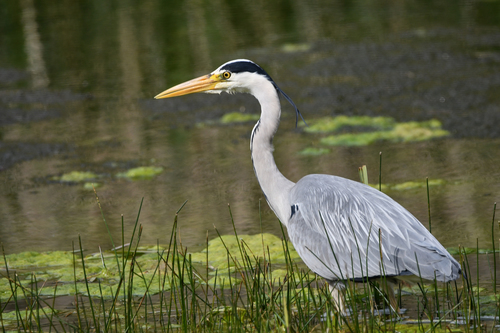
Great-billed Heron

Great-billed Heron

Ardea sumatrana

Silhouette: Giles Laurent · PhyloPic

LCLeast ConcernNTVUENCR
Daily sighting probability <5% · Rare
at Singapore

In 3 days <5%

25 Verified sightings at Singapore
1,096 In all 9 parks From 2019 to 2026
April Best month
☀️ Diurnal When it's spotted

About the Great-billed Heron

The great-billed heron (Ardea sumatrana) is a wading bird of the heron family, resident from southeast Asia to Papua New Guinea and Australia. The great-billed heron is a large bird, typically standing 115 cm (45 in) tall and weighing up to 2.6 kg (5.7 lb). It resembles the purple heron in appearance, although it is larger and darker. The plumage is largely dark grey above. In flight, it has a uniform dark grey upperwing.

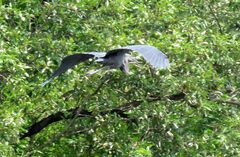
The flight is slow, with its neck retracted. This is characteristic of herons and bitterns, and distinguishes them from storks, cranes and spoonbills, which extend their necks. The species feeds in shallow water, spearing fish with its long, sharp bill. It will wait motionless for prey, or slowly stalk its victim.

Great-billed heron is polytypic, meaning that it has more than one subspecies. The two subspecies are most easily distinguished by their different locations: Ardea sumatrana mathewsae is found on the coasts of tropical northern Australia

Ardea sumatrana sumatrana is found on the coasts of southeastern Asia, Indonesia, Philippines, and New Guinea The great-billed heron has a very large range... Wikipedia →

Sounds

Call0:16

Singapore · 2023

© Ding Li Yong · XC855673 · CC BY-NC-ND 4.0

Display0:41

Australia · 2015

© Andrew Spencer · XC312072 · CC BY-NC-ND 4.0

Call0:08

Papua New Guinea · 2010

© Iain Woxvold · XC557635 · CC BY-NC-SA 4.0

Global Distribution

Parks Where Found

# Park Country Daily sighting probability
1 Daintree National Park 🇦🇺 Australia
~30%
2 Komodo National Park 🇮🇩 Indonesia
~20%
3 Nitmiluk National Park 🇦🇺 Australia
~10%
4 Raja Ampat 🇮🇩 Indonesia
~10%
5 Bali Barat National Park 🇮🇩 Indonesia
~10%
6 Danum Valley Conservation Area 🇲🇾 Malaysia
<5%
7 Kakadu National Park 🇦🇺 Australia
<5%
8 Tangkoko Nature Reserve 🇮🇩 Indonesia
<5%
9 Kinabatangan Wildlife Sanctuary 🇲🇾 Malaysia
<5%

Cities Where Found

# City Country Daily sighting probability
1 Denpasar 🇮🇩 Indonesia
<5%
2 Singapore 🇸🇬 Singapore
<5%

Before you go

What are the chances of seeing a Great-billed Heron in Singapore?

Rare

Under 5% of wildlife watchers report a Great-billed Heron sighting in Singapore on a given day, based on 25 verified sightings from GBIF citizen-science data. It is the 246th most-seen of the 298 birds we can rate there. Over three days the chance rises to under 5%, if each day is a fresh chance.

When is the best time to see a Great-billed Heron in Singapore?

Any time of year

In every month with enough records, under 5% of wildlife watchers report a Great-billed Heron in Singapore on a given day, so our monthly data shows no clear season.

What time of day is best to see a Great-billed Heron?

Between 9 am and noon

Across all the parks we cover, that three-hour window holds the most Great-billed Heron sightings with a recorded time, and about 9 in 10 of them come between 6 am and 6 pm: it is a daytime animal.

Is Singapore the best place to see a Great-billed Heron?

Among the best

Of the 2 cities where we can rate Great-billed Heron sightings, Singapore ranks 2nd at under 5%, level with the leaders once rounded. The best odds are in Denpasar (Indonesia, under 5%).

Which relatives of the Great-billed Heron live in Singapore?

Same genus: Ardea

The closest relatives of the Great-billed Heron that you can see in Singapore (genus Ardea, Great Herons and Egrets) are Grey Heron (about 20%) and Purple Heron (about 10%), with each one's daily chance of a sighting.

Where does the Great-billed Heron sighting chance come from?

GBIF citizen-science records

It is estimated from how often the Great-billed Heron is recorded against all the birds logged in Singapore (25 verified sightings), calibrated against known sighting rates. Figures are rounded to the nearest 10% because citizen-science data supports honest approximations, not decimals, and months with records from fewer than five people show "—". How it works.

← Back to Singapore