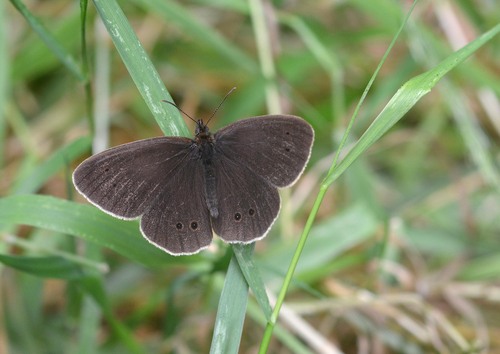
Buff-Tip

Buff-Tip

Phalera bucephala

Daily sighting probability ~10% · With luck
at Stockholm

In 3 days ~20% in a week ~40%

11 Verified sightings at Stockholm
270 In all 10 parks From 2019 to 2026
August Best month
☀️🌙 Day & Night When it's spotted

About the Buff-Tip

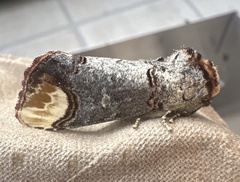
The buff-tip (Phalera bucephala) is a moth of the family Notodontidae. It is found throughout Europe and in Asia to eastern Siberia. The species was first described by Carl Linnaeus in his 1758 10th edition of Systema Naturae.

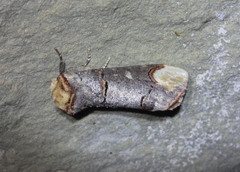
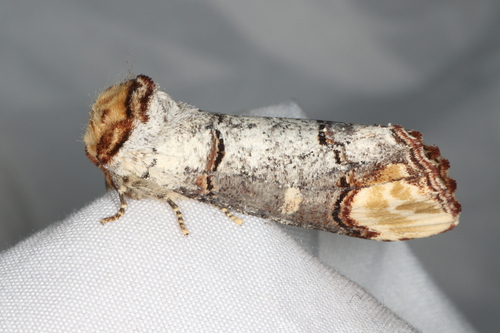
The moth is a fairly large, heavy-bodied species with a wingspan of 55–68 mm (2.2–2.7 in). The forewings are grey with a large prominent buff patch at the apex. As the thoracic hair is also buff, the moth resembles a broken twig when at rest. The hindwings are creamy white.

Seitz - Head, collar and centre of thorax brownish yellow, patagia greyish white with a black-brown double basal edge, on the transverse crest 2 black-brown transverse lines, hind margin greyish white. Abdomen yellowish grey to yellowish brown. Forewing greyish brown, broadly white at the base and along the hind margin, with prediscal dark brown and black double band; at the apex a large oval yellow patch reaching down to vein 4, proximally bordered by a dark red-brown semicircle, and traversed below the apex by a broad dentate dull ochreous submarginal spot; the black postdiscal band semicircular in the costal half, parallel with the dark border of the apical patch, and then... Wikipedia →
Global Distribution

Parks Where Found

# Park Country Daily sighting probability
1 Snowdonia National Park 🇬🇧 United Kingdom
~30%
2 Aigüestortes National Park 🇪🇸 Spain
~10%
3 Bavarian Forest National Park 🇩🇪 Germany
~10%
4 Wadden Sea National Park 🇩🇪 Germany
~10%
5 Triglav National Park 🇸🇮 Slovenia
~10%
6 Doñana National Park 🇪🇸 Spain
~10%
7 Pyrénées National Park 🇫🇷 France
~10%
8 Cairngorms National Park 🇬🇧 United Kingdom
~10%
9 Cévennes National Park 🇫🇷 France
~10%
10 Sierra de Guadarrama National Park 🇪🇸 Spain
<5%

Cities Where Found

# City Country Daily sighting probability
1 Porto 🇵🇹 Portugal
~10%
2 London 🇬🇧 United Kingdom
~10%
3 Manchester 🇬🇧 United Kingdom
~10%
4 Birmingham 🇬🇧 United Kingdom
~10%
5 Liverpool 🇬🇧 United Kingdom
~10%
6 Essen 🇩🇪 Germany
~10%
7 Stockholm 🇸🇪 Sweden
~10%
8 Helsinki 🇫🇮 Finland
~10%
9 Hamburg 🇩🇪 Germany
~10%
10 Copenhagen 🇩🇰 Denmark
~10%

Before you go

What are the chances of seeing a Buff-Tip in Stockholm?

With luck

About 10% of wildlife watchers report a Buff-Tip sighting in Stockholm on a given day, based on 11 verified sightings from GBIF citizen-science data. It is the 73rd most-seen of the 202 insects we can rate there. Over three days the chance rises to about 20%, and over a week to about 40%, if each day is a fresh chance.

When is the best time to see a Buff-Tip in Stockholm?

July and August

In those months about 10% of wildlife watchers report a Buff-Tip in Stockholm on a given day, against under 5% in September to June, the lowest months.

What time of day is best to see a Buff-Tip?

Between 9 am and noon

Across all the parks we cover, that three-hour window holds the most Buff-Tip sightings with a recorded time, and about 7 in 10 of them come between 6 am and 6 pm: it is seen both by day and at night.

Is Stockholm the best place to see a Buff-Tip?

Among the best

Of the 21 cities where we can rate Buff-Tip sightings, Stockholm ranks 7th at about 10%, level with the leaders once rounded. The best odds are in Porto (Portugal, about 10%), London (United Kingdom, about 10%) and Manchester (United Kingdom, about 10%).

Which relatives of the Buff-Tip live in Stockholm?

Same order: Lepidoptera

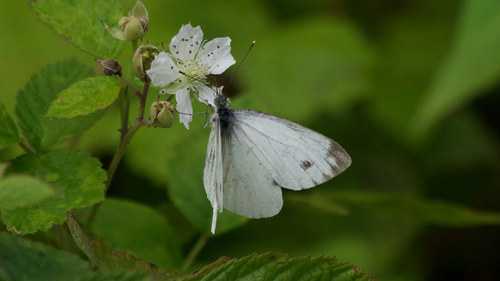
The closest relatives of the Buff-Tip that you can see in Stockholm (order Lepidoptera, Butterflies and Moths) are Green-Veined White (about 20%), European Peacock Butterfly (about 10%) and Red Admiral (about 10%), with each one's daily chance of a sighting.

Where does the Buff-Tip sighting chance come from?

GBIF citizen-science records

It is estimated from how often the Buff-Tip is recorded against all the insects logged in Stockholm (11 verified sightings), calibrated against known sighting rates. Figures are rounded to the nearest 10% because citizen-science data supports honest approximations, not decimals, and months with records from fewer than five people show "—". How it works.

← Back to Stockholm