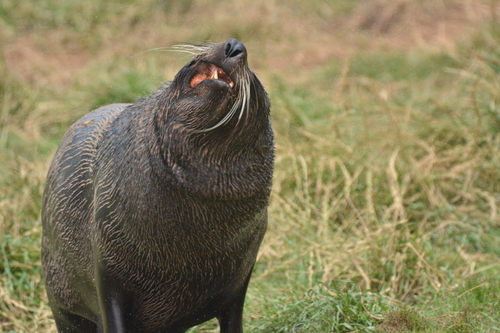
Wallaroo

Wallaroo

Macropus robustus

Silhouette: Pascal Abel · PhyloPic

Daily sighting probability <5% · Rare
at Sydney

In 3 days ~10% in a week ~20%

49 Verified sightings at Sydney
251 In all 6 parks From 2019 to 2026
July Best month
☀️ Diurnal When it's spotted

About the Wallaroo

The common wallaroo (Osphranter robustus), also known as the euro, hill wallaroo, or simply wallaroo, is a species of macropod (a family of marsupials that also includes kangaroos and wallabies). The word euro is particularly applied to one subspecies (O. r. erubescens).

The eastern wallaroo is mostly nocturnal and solitary, and is one of the more common macropods. It can make a loud hissing noise. All four subspecies are sexually dimorphic. There are four subspecies: the eastern wallaroo (O. r. robustus) – found in eastern Australia; males of this subspecies have dark grey fur, almost resembling the black wallaroo (Osphranter bernardus). Females are lighter, being almost sandy in colour.

the euro or western wallaroo (O. r. erubescens) – found covering most of the species' remaining range to the west; this subspecies is variable, but mostly brownish, in colour. the Barrow Island wallaroo (O. r. isabellinus) – this subspecies is restricted to Barrow Island in Western Australia and is comparatively small. It is uniformly reddish-brown.

the Kimberley wallaroo (O. r. woodwardi) – this subspecies is found in the Kimberley region of Western Australia and in a band roaming... Wikipedia →

Global Distribution

Parks Where Found

# Park Country Daily sighting probability
1 Flinders Ranges National Park 🇦🇺 Australia
~80%
2 Cape Range 🇦🇺 Australia
~50%
3 Ningaloo Marine Park 🇦🇺 Australia
~40%
4 Nitmiluk National Park 🇦🇺 Australia
~30%
5 Kakadu National Park 🇦🇺 Australia
~10%
6 Blue Mountains National Park 🇦🇺 Australia
~10%

Cities Where Found

# City Country Daily sighting probability
1 Sydney 🇦🇺 Australia
<5%

Before you go

What are the chances of seeing a Wallaroo in Sydney?

Rare

Under 5% of wildlife watchers report a Wallaroo sighting in Sydney on a given day, based on 49 verified sightings from GBIF citizen-science data. It is the 20th most-seen of the 22 mammals we can rate there. Over three days the chance rises to about 10%, and over a week to about 20%, if each day is a fresh chance.

When is the best time to see a Wallaroo in Sydney?

July

In that month about 10% of wildlife watchers report a Wallaroo in Sydney on a given day, against under 5% in August to June, the lowest months. That is one of Sydney's driest months, with about 45 mm of rain against 130 mm in February.

What time of day is best to see a Wallaroo?

Between 1 and 4 pm

Across all the parks we cover, that three-hour window holds the most Wallaroo sightings with a recorded time, and nearly all of them come between 6 am and 6 pm: it is a daytime animal.

Where else can you see a Wallaroo?

Only Sydney, in our data

Sydney is the only city on Wallace's Line with enough records to rate Wallaroo sightings: under 5% of wildlife watchers there report one on a given day.

Where does the Wallaroo sighting chance come from?

GBIF citizen-science records

It is estimated from how often the Wallaroo is recorded against all the mammals logged in Sydney (49 verified sightings), calibrated against known sighting rates. Figures are rounded to the nearest 10% because citizen-science data supports honest approximations, not decimals, and months with records from fewer than five people show "—". How it works.

← Back to Sydney