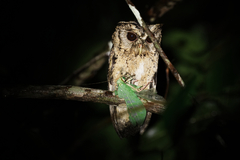
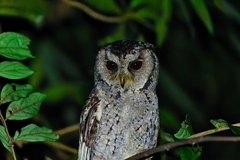
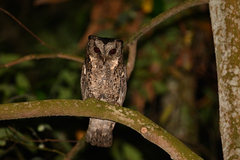
Collared Scops Owl

Collared Scops Owl

Otus lettia

Silhouette: Armelle Ansart (photograph), Maxime Dahirel (digitisation) · PhyloPic

LCLeast ConcernNTVUENCR
Daily sighting probability <5% · Rare
at Taipei

In 3 days ~10% in a week ~30%

1,268 Verified sightings at Taipei
1,232 In all 15 parks From 2019 to 2026
May Best month
☀️🌙 Day & Night When it's spotted

About the Collared Scops Owl

The collared scops owl (Otus lettia) is an owl which is a resident breeder in south Asia from northern Pakistan, northern India, Nepal, Bangladesh, the Himalayas east to southern China, and Taiwan. It is partially migratory, with some birds wintering in India, Sri Lanka and Malaysia. This species was formerly considered to be included within what is now separated as the Indian scops owl (O. bakkamoena).

This species is a part of the larger grouping of owls known as typical owls, Strigidae, which contains most species of owl. The other grouping is the barn owls, Tytonidae. The collared scops owl is a common breeding bird in forests and other well-wooded areas. It nests in tree hollows, laying 3-5 eggs.

The collared scops owl is a small (23–25 cm) owl, although it is the largest of the scops owls. Like other scops owls, it has small head tufts, or ears. The upperparts are grey or brown, depending on the subspecies, with faint buff spotting. The underparts are buff with fine darker streaking.

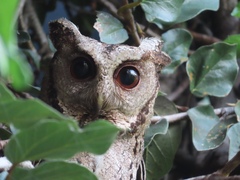
The facial disc is whitish or buff, and the eyes are orange or brown. There is a buff neckband. Sexes are similar. The flight is deeply undulating. This species is nocturnal but it can often be located by the small birds that mob it while it is roosting in a tree. It feeds mainly on insects. The call is a quiet goog gook.

This species is chiefly found in northern India and is replaced by the very similar looking oriental scops owl (Otus sunia, recently split) towards the south of its range. It is also very similar to the slightly smaller Indian scops owl. They are most easily separated in the field by their calls. It is sometimes considered as a sub-species of the Indian scops owl. Wikipedia →

Sounds

Call0:26

Vietnam · 2026

© Tim Dinh / Annambirding · XC1178660 · CC BY-NC-SA 4.0

Duet0:53

Malaysia · 2025

© Lim Ying Hien 林勇贤 · XC1056528 · CC BY-NC-ND 4.0

Song0:57

Malaysia · 2024

© Lim Ying Hien · XC919530 · CC BY-NC-ND 4.0

Global Distribution

Parks Where Found

# Park Country Daily sighting probability
1 Kaeng Krachan National Park 🇹🇭 Thailand
~10%
2 Cuc Phuong National Park 🇻🇳 Vietnam
~10%
3 Cat Tien National Park 🇻🇳 Vietnam
~10%
4 Taman Negara National Park 🇲🇾 Malaysia
~10%
5 Khao Luang National Park 🇹🇭 Thailand
~10%
6 Namdapha National Park 🇮🇳 India
<5%
7 Doi Inthanon National Park 🇹🇭 Thailand
<5%
8 Royal Manas National Park 🇧🇹 Bhutan
<5%
9 Khao Sok National Park 🇹🇭 Thailand
<5%
10 Khao Yai National Park 🇹🇭 Thailand
<5%
11 Sundarbans National Park 🇮🇳 India
<5%
12 Manas National Park 🇮🇳 India
<5%
13 Taroko National Park 🇹🇼 Taiwan
<5%
14 Chitwan National Park 🇳🇵 Nepal
<5%
15 Jim Corbett National Park 🇮🇳 India
<5%

Cities Where Found

# City Country Daily sighting probability
1 Taipei 🇹🇼 Taiwan
<5%
2 Dhaka 🇧🇩 Bangladesh
<5%
3 Tamluk 🇮🇳 India
<5%
4 Bangkok 🇹🇭 Thailand
<5%
5 Xiamen City 🇨🇳 China
<5%
6 Singapore 🇸🇬 Singapore
<5%
7 Guwahati 🇮🇳 India
<5%
8 Taichung 🇹🇼 Taiwan
<5%
9 Kuala Lumpur 🇲🇾 Malaysia
<5%
10 Tainan 🇹🇼 Taiwan
<5%

Zoos & Centres Where Found

# Zoo / Centre Country
1 Taipei Zoo 🇹🇼 Taiwan In captivity
2 Kadoorie Farm and Botanic Garden 🇭🇰 Hong Kong SAR China In captivity

Before you go

What are the chances of seeing a Collared Scops Owl in Taipei?

Rare

Under 5% of wildlife watchers report a Collared Scops Owl sighting in Taipei on a given day, based on 1,268 verified sightings from GBIF citizen-science data. It is the 68th most-seen of the 266 birds we can rate there. Over three days the chance rises to about 10%, and over a week to about 30%, if each day is a fresh chance.

When is the best time to see a Collared Scops Owl in Taipei?

May and July–November

In those months about 10% of wildlife watchers report a Collared Scops Owl in Taipei on a given day, against under 5% in June and December–April, the lowest months.

What time of day is best to see a Collared Scops Owl?

Between 8 and 11 pm

Across all the parks we cover, that three-hour window holds the most Collared Scops Owl sightings with a recorded time, and about half of them come between 6 pm and 6 am: it is seen both by day and at night.

Is Taipei the best place to see a Collared Scops Owl?

Yes

Of the 14 cities where we can rate Collared Scops Owl sightings, Taipei has the highest daily chance: under 5%. Next come Dhaka (Bangladesh, under 5%) and Tamluk (India, under 5%).

Where does the Collared Scops Owl sighting chance come from?

GBIF citizen-science records

It is estimated from how often the Collared Scops Owl is recorded against all the birds logged in Taipei (1,268 verified sightings), calibrated against known sighting rates. Figures are rounded to the nearest 10% because citizen-science data supports honest approximations, not decimals, and months with records from fewer than five people show "—". How it works.

← Back to Taipei