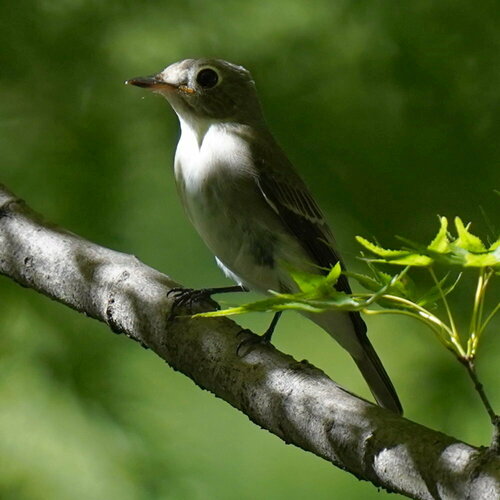
Blue-throated Flycatcher

Blue-throated Flycatcher

Cyornis rubeculoides

Silhouette: L. Shyamal · PhyloPic

LCLeast ConcernNTVUENCR
Daily sighting probability ~10% · With luck
at Tamluk

In 3 days ~20% in a week ~40%

36 Verified sightings at Tamluk
922 In all 10 parks From 2019 to 2026
March Best month
☀️ Diurnal When it's spotted

About the Blue-throated Flycatcher

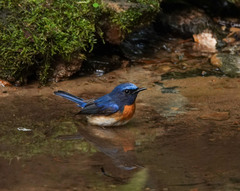
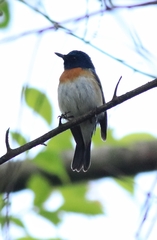
The blue-throated blue flycatcher (Cyornis rubeculoides) is a small passerine bird in the flycatcher family, Muscicapidae. It resembles Cyornis tickelliae but easily separated by the blue throat. The habitat of this species is a thicker forest than other species of flycatchers. The blue-throated flycatcher is found in much of the Indian subcontinent, all through the Himalayas, the plains and Western Ghats of India in the cold months, and also extends eastwards into Bangladesh, and to Arakan and the Tenasserim Hills in Myanmar.

Adult males have blue throats and orange breasts with a well defined white belly and flanks. Females have an olive head and upperparts with a poorly defined creamy-orange chest and a white belly. [1] Wikipedia →

Sounds

Alarm call0:13

Bhutan · 2026

© Sonam Dorji, Bhutan Quest Travel (www.bhutanbird.com) · XC1099385 · CC BY-NC-SA 4.0

Song0:15

Thailand · 2022

© Ding Li Yong · XC996754 · CC BY-NC-ND 4.0

Call0:40

China · 2025

© Vincent · XC994169 · CC BY-NC-SA 4.0

Global Distribution

Parks Where Found

# Park Country Daily sighting probability
1 Royal Manas National Park 🇧🇹 Bhutan
~30%
2 Doi Inthanon National Park 🇹🇭 Thailand
~10%
3 Periyar National Park 🇮🇳 India
~10%
4 Jim Corbett National Park 🇮🇳 India
~10%
5 Manas National Park 🇮🇳 India
<5%
6 Wilpattu National Park 🇱🇰 Sri Lanka
<5%
7 Nagarhole National Park 🇮🇳 India
<5%
8 Namdapha National Park 🇮🇳 India
<5%
9 Sundarbans National Park 🇮🇳 India
<5%
10 Chitwan National Park 🇳🇵 Nepal
<5%

Cities Where Found

# City Country Daily sighting probability
1 Tamluk 🇮🇳 India
~10%
2 Kathmandu 🇳🇵 Nepal
~10%
3 Kolkata 🇮🇳 India
~10%
4 Dehradun 🇮🇳 India
<5%
5 Jabalpur 🇮🇳 India
<5%
6 Bengaluru 🇮🇳 India
<5%
7 Dhaka 🇧🇩 Bangladesh
<5%
8 Thiruvananthapuram 🇮🇳 India
<5%
9 Thrissur 🇮🇳 India
<5%
10 Chennai 🇮🇳 India
<5%

Before you go

What are the chances of seeing a Blue-throated Flycatcher in Tamluk?

With luck

About 10% of wildlife watchers report a Blue-throated Flycatcher sighting in Tamluk on a given day, based on 36 verified sightings from GBIF citizen-science data. It is the 78th most-seen of the 136 birds we can rate there. Over three days the chance rises to about 20%, and over a week to about 40%, if each day is a fresh chance.

When is the best time to see a Blue-throated Flycatcher in Tamluk?

March and April

In those months about 20% of wildlife watchers report a Blue-throated Flycatcher in Tamluk on a given day, against under 5% in May–September and November, the lowest months. Those are among Tamluk's driest months, with about 40 mm of rain a month against 330 mm in July.

What time of day is best to see a Blue-throated Flycatcher?

Between 3 and 6 pm

Across all the parks we cover, that three-hour window holds the most Blue-throated Flycatcher sightings with a recorded time, and about 9 in 10 of them come between 6 am and 6 pm: it is a daytime animal.

Is Tamluk the best place to see a Blue-throated Flycatcher?

Yes

Of the 13 cities where we can rate Blue-throated Flycatcher sightings, Tamluk has the highest daily chance: about 10%. Next come Kathmandu (Nepal, about 10%) and Kolkata (India, about 10%).

Which relatives of the Blue-throated Flycatcher live in Tamluk?

Same family: Muscicapidae

The closest relatives of the Blue-throated Flycatcher that you can see in Tamluk (family Muscicapidae, Old World Flycatchers, Robins, and Chats) are Oriental Magpie-Robin (about 50%), Taiga Flycatcher (about 20%) and Siberian Rubythroat (about 10%), with each one's daily chance of a sighting.

Where does the Blue-throated Flycatcher sighting chance come from?

GBIF citizen-science records

It is estimated from how often the Blue-throated Flycatcher is recorded against all the birds logged in Tamluk (36 verified sightings), calibrated against known sighting rates. Figures are rounded to the nearest 10% because citizen-science data supports honest approximations, not decimals, and months with records from fewer than five people show "—". How it works.

← Back to Tamluk