Bay-backed Shrike

Bay-backed Shrike

Lanius vittatus

Silhouette: Andy Wilson · PhyloPic

LCLeast ConcernNTVUENCR
Daily sighting probability <5% · Rare
at Thiruvananthapuram

In 3 days <5%

8 Verified sightings at Thiruvananthapuram
1,864 In all 12 parks From 2019 to 2026
October Best month
🌅 Crepuscular When it's spotted

About the Bay-backed Shrike

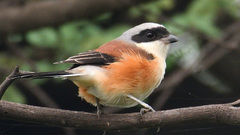
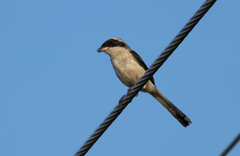
The bay-backed shrike (Lanius vittatus) is a member of the bird family Laniidae, the shrikes, resident in South Asia. It is smallish shrike at 17 cm, maroon-brown above with a pale rump and long black tail with white edges. The underparts are white, but with buff flanks. The crown and nape are grey, with a typical shrike black bandit mask through the eye. There is a small white wing patch, and the bill and legs are dark grey.

Sexes are similar, but young birds are washed-out versions of the adults. The bay-backed shrike has a characteristic upright "shrike" attitude perched on a bush, from which it sallies after lizards, large insects, small birds and rodents.

Prey may be impaled upon a sharp point, such as a thorn. Thus secured they can be ripped with the strong hooked bill, but its feet are not suited for tearing. It is a widespread resident or breeder in southern Asia and occurs in Iran, Afghanistan, Pakistan, Nepal, India, and Turkmenistan. It is occasionally found in Sri Lanka, Bhutan, Oman, United Arab Emirates, and Qatar. It nests in bushes in scrubby areas and cultivation, laying 3–5 eggs.

Bay... Wikipedia →

Sounds

Song0:50

United Arab Emirates · 2021

© Oscar Campbell · XC654157 · CC BY-NC-ND 4.0

Call1:24

India · 1998

© Jelle Scharringa · XC629645 · CC BY-NC-SA 4.0

Alarm call0:21

India · 2016

© Sreekumar Chirukandoth · XC444185 · CC BY-NC-SA 4.0

Global Distribution

Parks Where Found

# Park Country Daily sighting probability
1 Mudumalai National Park 🇮🇳 India
~40%
2 Keoladeo National Park 🇮🇳 India
~30%
3 Ranthambore National Park 🇮🇳 India
~20%
4 Bandipur National Park 🇮🇳 India
~20%
5 Gir National Park 🇮🇳 India
~10%
6 Satpura National Park 🇮🇳 India
<5%
7 Jim Corbett National Park 🇮🇳 India
<5%
8 Bandhavgarh National Park 🇮🇳 India
<5%
9 Nagarhole National Park 🇮🇳 India
<5%
10 Kanha National Park 🇮🇳 India
<5%
11 Chitwan National Park 🇳🇵 Nepal
<5%
12 Periyar National Park 🇮🇳 India
<5%

Cities Where Found

# City Country Daily sighting probability
1 Chhatrapati Sambhajinagar 🇮🇳 India
~20%
2 Jaipur 🇮🇳 India
~10%
3 Indore 🇮🇳 India
~10%
4 Nashik 🇮🇳 India
~10%
5 Rajkot 🇮🇳 India
~10%
6 Solapur 🇮🇳 India
~10%
7 Pune 🇮🇳 India
~10%
8 Tiruppur 🇮🇳 India
~10%
9 Jodhpur 🇮🇳 India
~10%
10 Nagpur 🇮🇳 India
<5%

Before you go

What are the chances of seeing a Bay-backed Shrike in Thiruvananthapuram?

Rare

Under 5% of wildlife watchers report a Bay-backed Shrike sighting in Thiruvananthapuram on a given day, based on 8 verified sightings from GBIF citizen-science data. It is the 158th most-seen of the 174 birds we can rate there. Over three days the chance rises to under 5%, if each day is a fresh chance.

When is the best time to see a Bay-backed Shrike in Thiruvananthapuram?

Any time of year

In every month with enough records, under 5% of wildlife watchers report a Bay-backed Shrike in Thiruvananthapuram on a given day, so our monthly data shows no clear season.

What time of day is best to see a Bay-backed Shrike?

Between 3 and 6 am

Across all the parks we cover, that three-hour window holds the most Bay-backed Shrike sightings with a recorded time, and about 6 in 10 of them come between 6 pm and 6 am: it is most active around dawn and dusk.

Is Thiruvananthapuram the best place to see a Bay-backed Shrike?

24th of 31

Of the 31 cities where we can rate Bay-backed Shrike sightings, Thiruvananthapuram ranks 24th at under 5%. The best odds are in Chhatrapati Sambhajinagar (India, about 20%), Jaipur (India, about 10%) and Indore (India, about 10%).

Where does the Bay-backed Shrike sighting chance come from?

GBIF citizen-science records

It is estimated from how often the Bay-backed Shrike is recorded against all the birds logged in Thiruvananthapuram (8 verified sightings), calibrated against known sighting rates. Figures are rounded to the nearest 10% because citizen-science data supports honest approximations, not decimals, and months with records from fewer than five people show "—". How it works.

← Back to Thiruvananthapuram