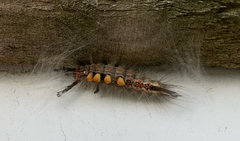
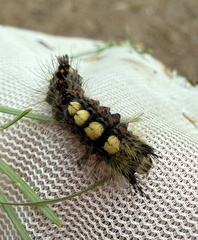
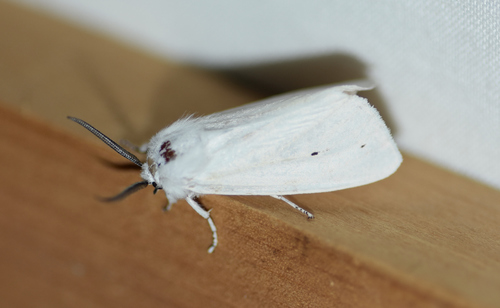
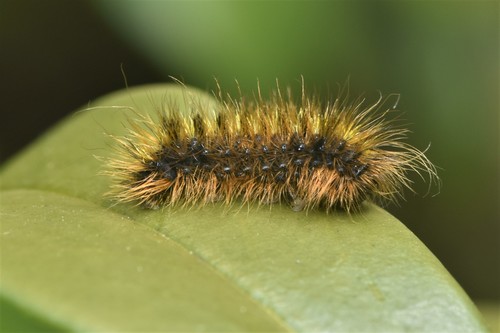
Rusty Tussock Moth

Rusty Tussock Moth

Orgyia antiqua

Daily sighting probability ~10% · With luck
at Vancouver

In 3 days ~20% in a week ~40%

126 Verified sightings at Vancouver
232 In all 13 parks From 2019 to 2026
August Best month
☀️ Diurnal When it's spotted

About the Rusty Tussock Moth

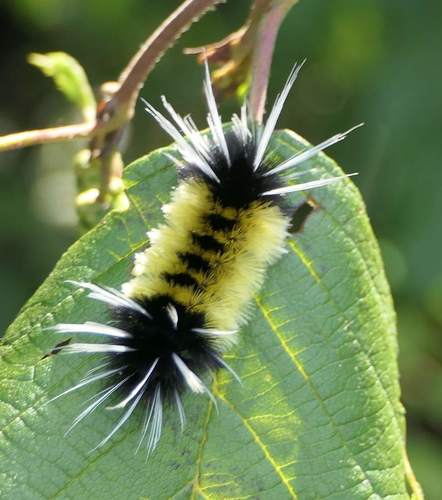
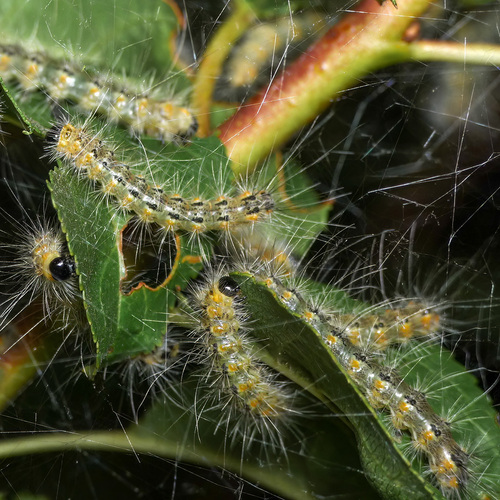
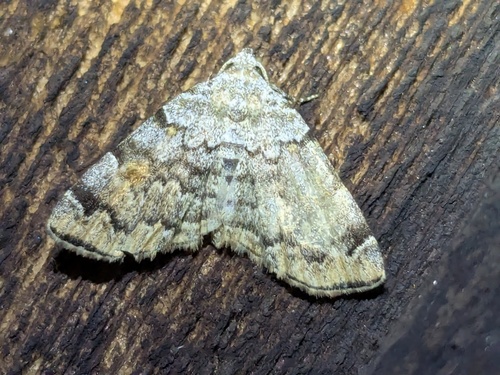
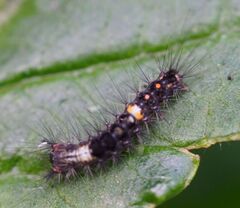
Orgyia antiqua, the rusty tussock moth or vapourer, is a moth in the family Erebidae. O. antiqua is native to Europe, but now has a transcontinental distribution in the Palaearctic and the Nearctic regions. The species is not on the IUCN (2007) Red List; and in the UK is considered a common resident.

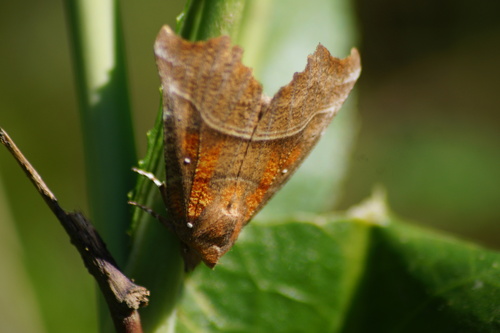
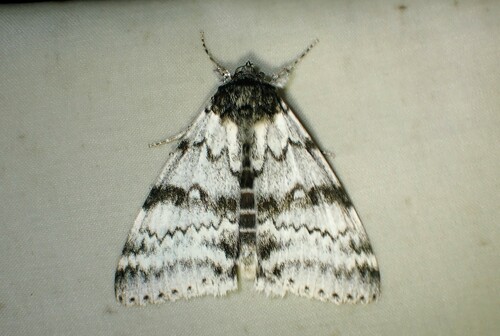
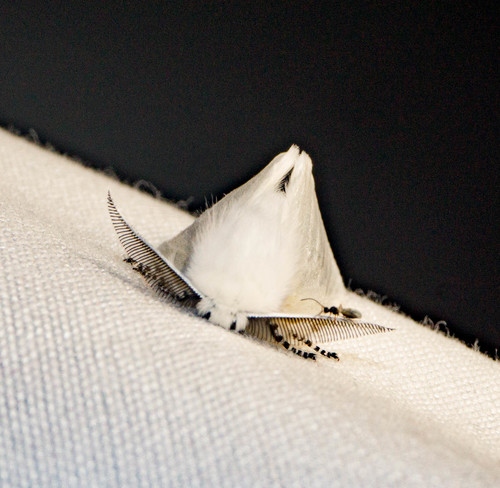
In the UK, O. antiqua may be encountered in a variety of shrub-based habitats, including gardens, parks, open woodland, fens, hedgerows, heaths, and moors. A striking dimorphism exists between the male and the female moths of this species. The male moth typically has orange- to red-brown (ochreous red and dark brown) wings; each fore wing has a white comma-shaped (tornal) spot. It has marked plumose (short, bipectinate) antennae. The wingspan measures between 35 and 38 mm. The female moth has vestigial wings and is flightless; it is light grey-brown (ochreous grey), has "shortly bipectinate" antennae, and a swollen abdomen. The compound eyes of the two sexes differ not only with regard to their size, number of facets and internal organization and ultrastructure, but also with regard to their sensitivity to ultraviolet radiation... Wikipedia →
Global Distribution

Parks Where Found

# Park Country Daily sighting probability
1 Cairngorms National Park 🇬🇧 United Kingdom
~20%
2 Denali National Park 🇺🇸 United States
~10%
3 Great Bear Rainforest 🇨🇦 Canada
~10%
4 Pacific Rim National Park Reserve 🇨🇦 Canada
~10%
5 Gros Morne National Park 🇨🇦 Canada
~10%
6 Bavarian Forest National Park 🇩🇪 Germany
~10%
7 Glacier National Park 🇺🇸 United States
~10%
8 Snowdonia National Park 🇬🇧 United Kingdom
~10%
9 Redwood National Park 🇺🇸 United States
~10%
10 Acadia National Park 🇺🇸 United States
~10%
11 Cévennes National Park 🇫🇷 France
<5%
12 Pyrénées National Park 🇫🇷 France
<5%
13 Wadden Sea National Park 🇩🇪 Germany
<5%

Cities Where Found

# City Country Daily sighting probability
1 Manchester 🇬🇧 United Kingdom
~20%
2 Liverpool 🇬🇧 United Kingdom
~10%
3 Birmingham 🇬🇧 United Kingdom
~10%
4 London 🇬🇧 United Kingdom
~10%
5 Leeds 🇬🇧 United Kingdom
~10%
6 Essen 🇩🇪 Germany
~10%
7 Dublin 🇮🇪 Ireland
~10%
8 Warsaw 🇵🇱 Poland
~10%
9 Vancouver 🇨🇦 Canada
~10%
10 Berlin 🇩🇪 Germany
~10%

Before you go

What are the chances of seeing a Rusty Tussock Moth in Vancouver?

With luck

About 10% of wildlife watchers report a Rusty Tussock Moth sighting in Vancouver on a given day, based on 126 verified sightings from GBIF citizen-science data. It is the 62nd most-seen of the 482 insects we can rate there. Over three days the chance rises to about 20%, and over a week to about 40%, if each day is a fresh chance.

When is the best time to see a Rusty Tussock Moth in Vancouver?

August

In that month about 20% of wildlife watchers report a Rusty Tussock Moth in Vancouver on a given day, against under 5% in October and December–June, the lowest months. That is one of Vancouver's driest months, with about 35 mm of rain against 210 mm in November.

What time of day is best to see a Rusty Tussock Moth?

Between 1 and 4 pm

Across all the parks we cover, that three-hour window holds the most Rusty Tussock Moth sightings with a recorded time, and about 9 in 10 of them come between 6 am and 6 pm: it is a daytime animal.

Is Vancouver the best place to see a Rusty Tussock Moth?

9th of 26

Of the 26 cities where we can rate Rusty Tussock Moth sightings, Vancouver ranks 9th at about 10%. The best odds are in Manchester (United Kingdom, about 20%), Liverpool (United Kingdom, about 10%) and Birmingham (United Kingdom, about 10%).

Which relatives of the Rusty Tussock Moth live in Vancouver?

Same family: Erebidae

The closest relatives of the Rusty Tussock Moth that you can see in Vancouver (family Erebidae, Underwing, Tiger, Tussock, and Allied Moths) are Isabella Tiger Moth (about 10%), Virginian Tiger Moth (about 10%) and Silver-Spotted Tiger Moth (about 10%), with each one's daily chance of a sighting.

Where does the Rusty Tussock Moth sighting chance come from?

GBIF citizen-science records

It is estimated from how often the Rusty Tussock Moth is recorded against all the insects logged in Vancouver (126 verified sightings), calibrated against known sighting rates. Figures are rounded to the nearest 10% because citizen-science data supports honest approximations, not decimals, and months with records from fewer than five people show "—". How it works.

← Back to Vancouver