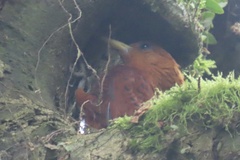
Chestnut-colored Woodpecker

Chestnut-colored Woodpecker

Celeus castaneus

Silhouette: Pepe Reigada · PhyloPic

LCLeast ConcernNTVUENCR
Daily sighting probability ~10% · With luck
at Cockscomb Basin Wildlife Sanctuary

In 3 days ~30% in a week ~50%

112 Verified sightings at Cockscomb Basin Wildlife Sanctuary From 2019 to 2026
2,082 In all 13 parks
October Best month
☀️ Diurnal When it's spotted

About the Chestnut-colored Woodpecker

The chestnut-colored woodpecker (Celeus castaneus) is a species of bird in subfamily Picinae of the woodpecker family Picidae. It is found in Belize, Costa Rica, Guatemala, Honduras, Mexico, Nicaragua, and Panama. The chestnut-colored woodpecker is monotypic.

The chestnut-colored woodpecker is 21.5 to 25 cm (8.5 to 9.8 in) long and weighs 80 to 105 g (2.8 to 3.7 oz). Both sexes' heads are dull ochraceous or tawny with a pointed crest. Males are bright red from the lores to behind the eye and down to the throat; the chin and upper throat sometimes also have some red. Females have no red. Both sexes of adults have rufous-chestnut upperparts with a cinnamon-buff rump and black bars on the back and uppertail coverts. Their flight feathers are rufous-chestnut with some dusky brown tips. Their tail feathers are dull black with chestnut bases. Their underparts are chestnut heavily marked with black "V" or "U" shapes. Individuals have some variation in the intensity of the black markings, especially the bars on their upperparts. The adult's bill is ivory-yellow with a blue-green tinge at its base, their iris chestnut or garnet brown, and their... Wikipedia →

Sounds

Call0:05

Belize · 2019

© Paul Driver · XC522432 · CC BY-NC-SA 4.0

Song0:10

Honduras · 2014

© Carlos Alexander Alberto · XC183139 · CC BY-NC-SA 4.0

Call0:19

Costa Rica · 2019

© Hans Matheve · XC517702 · CC BY-NC-ND 4.0

Global Distribution

Parks Where Found

# Park Country Daily sighting probability
1 Tikal National Park 🇬🇹 Guatemala
~30%
2 Pico Bonito National Park 🇭🇳 Honduras
~30%
3 Tortuguero National Park 🇨🇷 Costa Rica
~10%
4 Montes Azules Biosphere Reserve 🇲🇽 Mexico
~10%
5 Cockscomb Basin Wildlife Sanctuary 🇧🇿 Belize
~10%
6 Calakmul Biosphere Reserve 🇲🇽 Mexico
~10%
7 Gandoca-Manzanillo Wildlife Refuge 🇨🇷 Costa Rica
~10%
8 Cerro Azul Meámbar National Park 🇭🇳 Honduras
<5%
9 Biotopo Cerro Cahuí 🇬🇹 Guatemala
<5%
10 Sian Ka'an Biosphere Reserve 🇲🇽 Mexico
<5%
11 Braulio Carrillo National Park 🇨🇷 Costa Rica
<5%
12 Bastimentos Island National Marine Park 🇵🇦 Panama
<5%
13 La Amistad International Park (Panama) 🇵🇦 Panama
<5%

Before you go

What are the chances of seeing a Chestnut-colored Woodpecker in Cockscomb Basin Wildlife Sanctuary?

With luck

About 10% of wildlife watchers report a Chestnut-colored Woodpecker sighting in Cockscomb Basin Wildlife Sanctuary on a given day, based on 112 verified sightings from GBIF citizen-science data from 2019 to 2026. It is the 129th most-seen of the 277 birds we can rate there. Over three days the chance rises to about 30%, and over a week to about 50%, if each day is a fresh chance.

When is the best time to see a Chestnut-colored Woodpecker in Cockscomb Basin Wildlife Sanctuary?

October

In that month about 20% of wildlife watchers report a Chestnut-colored Woodpecker in Cockscomb Basin Wildlife Sanctuary on a given day, against under 5% in June, the lowest month. That is one of Cockscomb Basin Wildlife Sanctuary's wettest months, with about 270 mm of rain against 75 mm in April.

What time of day is best to see a Chestnut-colored Woodpecker?

Between 8 and 11 am

Across all the parks we cover, that three-hour window holds the most Chestnut-colored Woodpecker sightings with a recorded time, and about 9 in 10 of them come between 6 am and 6 pm: it is a daytime animal.

Is Cockscomb Basin Wildlife Sanctuary the best place to see a Chestnut-colored Woodpecker?

5th of 13

Of the 13 parks where we can rate Chestnut-colored Woodpecker sightings, Cockscomb Basin Wildlife Sanctuary ranks 5th at about 10%. The best odds are in Tikal National Park (Guatemala, about 30%), Pico Bonito National Park (Honduras, about 30%) and Tortuguero National Park (Costa Rica, about 10%).

Which relatives of the Chestnut-colored Woodpecker live in Cockscomb Basin Wildlife Sanctuary?

Same family: Picidae

The closest relatives of the Chestnut-colored Woodpecker that you can see in Cockscomb Basin Wildlife Sanctuary (family Picidae, Woodpeckers) are Pale-billed Woodpecker (about 40%), Golden-fronted Woodpecker (about 20%) and Smoky-brown Woodpecker (about 20%), with each one's daily chance of a sighting.

Where does the Chestnut-colored Woodpecker sighting chance come from?

GBIF citizen-science records

It is estimated from how often the Chestnut-colored Woodpecker is recorded against all the birds logged in Cockscomb Basin Wildlife Sanctuary (112 verified sightings from 2019 to 2026), calibrated against known sighting rates. Figures are rounded to the nearest 10% because citizen-science data supports honest approximations, not decimals, and months with records from fewer than five people show "—". How it works.

← Back to Cockscomb Basin Wildlife Sanctuary