
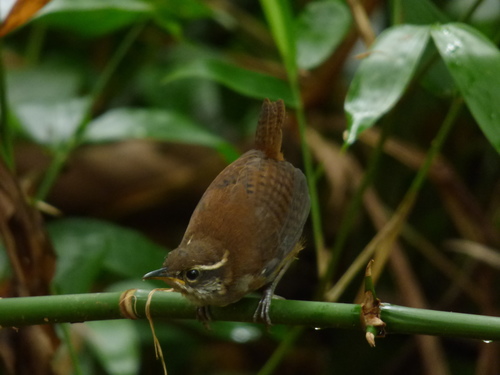
Green-backed Sparrow

Green-backed Sparrow

Arremonops chloronotus

Silhouette: L. Shyamal · PhyloPic

LCLeast ConcernNTVUENCR
Daily sighting probability ~20% · Possible
at Cockscomb Basin Wildlife Sanctuary

In 3 days ~40% in a week ~70%

165 Verified sightings at Cockscomb Basin Wildlife Sanctuary From 2019 to 2026
1,366 In all 9 parks
August Best month
☀️ Diurnal When it's spotted

About the Green-backed Sparrow

The green-backed sparrow (Arremonops chloronotus) is a species of bird in the family Passerellidae, the New World sparrows. It is found in Belize, Guatemala, Honduras, and Mexico. The green-backed sparrow was formally described in 1861 with the binomial Embernagra chloronatus. Eventually it was reassigned to genus Arremonops that Robert Ridgway erected in 1896, and for much of the first half of the twentieth century it was treated as conspecific with A. conirostris, now called the black-striped sparrow.

The green-backed sparrow is 15 to 16 cm (5.9 to 6.3 in) long and weighs 24 to 31 g (0.85 to 1.1 oz). The sexes have the same plumage. Adults of the nominate subspecies have a mostly slate gray head with wide black or brownish black strips on each side of the crown, a black or brownish spot in front of the eye, and a long black or brownish stripe behind the eye. Their upperparts, tail, and wings are bright olive green with canary yellow on the edge of the wings. Their chin and throat are dull white, their breast... Wikipedia →

Sounds

Call0:20

Guatemala · 2024

© Peter Boesman · XC879968 · CC BY-NC-ND 4.0

Song0:21

Belize · 2023

© Pritam Baruah · XC819214 · CC BY-NC-SA 4.0

Call0:41

Honduras · 2019

© Matt Wistrand · XC486475 · CC BY-NC-SA 4.0

Global Distribution

Parks Where Found

# Park Country Daily sighting probability
1 Calakmul Biosphere Reserve 🇲🇽 Mexico
~20%
2 Tikal National Park 🇬🇹 Guatemala
~20%
3 Sian Ka'an Biosphere Reserve 🇲🇽 Mexico
~20%
4 Cockscomb Basin Wildlife Sanctuary 🇧🇿 Belize
~20%
5 Montes Azules Biosphere Reserve 🇲🇽 Mexico
~20%
6 Cerro Azul Meámbar National Park 🇭🇳 Honduras
~10%
7 Biotopo Cerro Cahuí 🇬🇹 Guatemala
~10%
8 Lago de Yojoa 🇭🇳 Honduras
<5%
9 Cusuco National Park 🇭🇳 Honduras
<5%

Before you go

What are the chances of seeing a Green-backed Sparrow in Cockscomb Basin Wildlife Sanctuary?

Possible

About 20% of wildlife watchers report a Green-backed Sparrow sighting in Cockscomb Basin Wildlife Sanctuary on a given day, based on 165 verified sightings from GBIF citizen-science data from 2019 to 2026. It is the 104th most-seen of the 277 birds we can rate there. Over three days the chance rises to about 40%, and over a week to about 70%, if each day is a fresh chance.

When is the best time to see a Green-backed Sparrow in Cockscomb Basin Wildlife Sanctuary?

August

In that month about 40% of wildlife watchers report a Green-backed Sparrow in Cockscomb Basin Wildlife Sanctuary on a given day, against under 5% in January and October–November, the lowest months. That is one of Cockscomb Basin Wildlife Sanctuary's wettest months, with about 250 mm of rain against 75 mm in April.

What time of day is best to see a Green-backed Sparrow?

Between 7 and 10 am

Across all the parks we cover, that three-hour window holds the most Green-backed Sparrow sightings with a recorded time, and about 9 in 10 of them come between 6 am and 6 pm: it is a daytime animal.

Is Cockscomb Basin Wildlife Sanctuary the best place to see a Green-backed Sparrow?

Among the best

Of the 9 parks where we can rate Green-backed Sparrow sightings, Cockscomb Basin Wildlife Sanctuary ranks 4th at about 20%, level with the leaders once rounded. The best odds are in Calakmul Biosphere Reserve (Mexico, about 20%), Tikal National Park (Guatemala, about 20%) and Sian Ka'an Biosphere Reserve (Mexico, about 20%).

Where does the Green-backed Sparrow sighting chance come from?

GBIF citizen-science records

It is estimated from how often the Green-backed Sparrow is recorded against all the birds logged in Cockscomb Basin Wildlife Sanctuary (165 verified sightings from 2019 to 2026), calibrated against known sighting rates. Figures are rounded to the nearest 10% because citizen-science data supports honest approximations, not decimals, and months with records from fewer than five people show "—". How it works.

← Back to Cockscomb Basin Wildlife Sanctuary