
White-breasted Wood-Wren

White-breasted Wood-Wren

Henicorhina leucosticta

Silhouette: Matt Wilkins · PhyloPic

LCLeast ConcernNTVUENCR
Daily sighting probability ~60% · Likely
at Cockscomb Basin Wildlife Sanctuary

In 3 days ~90% in a week >90%

999 Verified sightings at Cockscomb Basin Wildlife Sanctuary From 2019 to 2026
17,583 In all 42 parks
July Best month
☀️ Diurnal When it's spotted

About the White-breasted Wood-Wren

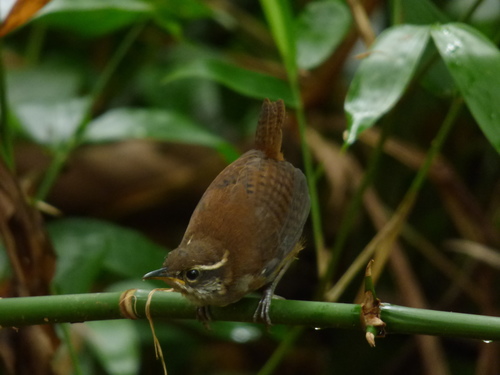
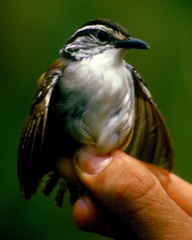
The white-breasted wood wren (Henicorhina leucosticta) is a small songbird of the wren family. It is a resident breeding species from central Mexico to northeastern Peru and Suriname. The adult white-breasted wood wren is 10 centimetres (3.9 in) long and weighs 16 grams (0.56 oz). It has chestnut brown upperparts with a darker crown, pale supercilia, and black-and-white streaked sides of the head and neck. The underparts are white becoming buff on the lower belly. The wings and very short tail are barred with black. Young birds have duller upperparts and grey underparts.

The call of this species is a sharp cheek or explosive tuck, and the song is cheer oweet oweet cheery weather; ornithologist and bioacoustics expert Luis Baptista of the California Academy of Sciences compared it to the opening bars of Beethoven's Fifth Symphony.

As with some other wrens, pairs often sing in duets. H. leucosticta breeds in lowlands and foothills up to 1,850 metres (6,070 ft) above sea level in tropical wet forest and adjacent tall second growth. Its neat roofed nest is constructed on the ground or occasionally very low in undergrowth, and is concealed by dense... Wikipedia →

Sounds

Song0:48

Ecuador · 2025

© Manuel Sánchez-Nivicela · XC1148582 · CC BY-NC-ND 4.0

Call0:11

Ecuador · 2025

© Marc Anderson · XC1094048 · CC BY-NC-ND 4.0

Subsong1:11

Colombia · 2024

© Andrés Mauricio López · XC973285 · CC BY-NC-SA 4.0

Global Distribution

Parks Where Found

# Park Country Daily sighting probability
1 Cockscomb Basin Wildlife Sanctuary 🇧🇿 Belize
~60%
2 Tenorio Volcano National Park 🇨🇷 Costa Rica
~40%
3 Pico Bonito National Park 🇭🇳 Honduras
~40%
4 Arenal Volcano National Park 🇨🇷 Costa Rica
~30%
5 Braulio Carrillo National Park 🇨🇷 Costa Rica
~30%
6 Chagres National Park 🇵🇦 Panama
~30%
7 Brownsberg Nature Park 🇸🇷 Suriname
~30%
8 Cusuco National Park 🇭🇳 Honduras
~20%
9 Darién National Park 🇵🇦 Panama
~20%
10 Montes Azules Biosphere Reserve 🇲🇽 Mexico
~20%
11 Cerro Azul Meámbar National Park 🇭🇳 Honduras
~20%
12 El Triunfo 🇲🇽 Mexico
~20%
13 Tikal National Park 🇬🇹 Guatemala
~20%
14 Soberanía National Park 🇵🇦 Panama
~20%
15 Rincón de la Vieja National Park 🇨🇷 Costa Rica
~10%
16 Tortuguero National Park 🇨🇷 Costa Rica
~10%
17 Tapantí-Macizo de la Muerte National Park 🇨🇷 Costa Rica
~10%
18 Biotopo Cerro Cahuí 🇬🇹 Guatemala
~10%
19 Utría National Natural Park 🇨🇴 Colombia
~10%
20 Monteverde Cloud Forest Reserve 🇨🇷 Costa Rica
~10%
21 Lago de Yojoa 🇭🇳 Honduras
~10%
22 Podocarpus National Park 🇪🇨 Ecuador
~10%
23 Gandoca-Manzanillo Wildlife Refuge 🇨🇷 Costa Rica
~10%
24 Cahuita National Park 🇨🇷 Costa Rica
~10%
25 Calakmul Biosphere Reserve 🇲🇽 Mexico
~10%
26 San Lorenzo Protected Forest 🇵🇦 Panama
~10%
27 Cañón del Sumidero National Park 🇲🇽 Mexico
<5%
28 La Amistad International Park (Panama) 🇵🇦 Panama
<5%
29 Yasuní National Park 🇪🇨 Ecuador
<5%
30 Farallones de Cali National Natural Park 🇨🇴 Colombia
<5%
31 Chirripó National Park 🇨🇷 Costa Rica
<5%
32 Poás Volcano National Park 🇨🇷 Costa Rica
<5%
33 Sierra de la Macarena National Park 🇨🇴 Colombia
<5%
34 Parque Natural Metropolitano 🇵🇦 Panama
<5%
35 Corcovado National Park 🇨🇷 Costa Rica
<5%
36 Volcán Barú National Park 🇵🇦 Panama
<5%
37 Piedras Blancas National Park 🇨🇷 Costa Rica
<5%
38 Marino Ballena National Park 🇨🇷 Costa Rica
<5%
39 Manuel Antonio National Park 🇨🇷 Costa Rica
<5%
40 Los Nevados National Natural Park 🇨🇴 Colombia
<5%
41 Bastimentos Island National Marine Park 🇵🇦 Panama
<5%
42 Carara National Park 🇨🇷 Costa Rica
<5%

Cities Where Found

# City Country Daily sighting probability
1 Cali 🇨🇴 Colombia
<5%
2 Panama City 🇵🇦 Panama
<5%
3 San José 🇨🇷 Costa Rica
<5%

Before you go

What are the chances of seeing a White-breasted Wood-Wren in Cockscomb Basin Wildlife Sanctuary?

Likely

About 60% of wildlife watchers report a White-breasted Wood-Wren sighting in Cockscomb Basin Wildlife Sanctuary on a given day, based on 999 verified sightings from GBIF citizen-science data from 2019 to 2026. It is the 8th most-seen of the 277 birds we can rate there. Over three days the chance rises to about 90%, and over a week to over 90%, if each day is a fresh chance.

When is the best time to see a White-breasted Wood-Wren in Cockscomb Basin Wildlife Sanctuary?

July

In that month about 80% of wildlife watchers report a White-breasted Wood-Wren in Cockscomb Basin Wildlife Sanctuary on a given day, against about 30% in May, the lowest month.

What time of day is best to see a White-breasted Wood-Wren?

Between 8 and 11 am

Across all the parks we cover, that three-hour window holds the most White-breasted Wood-Wren sightings with a recorded time, and about 9 in 10 of them come between 6 am and 6 pm: it is a daytime animal.

Is Cockscomb Basin Wildlife Sanctuary the best place to see a White-breasted Wood-Wren?

Yes

Of the 42 parks where we can rate White-breasted Wood-Wren sightings, Cockscomb Basin Wildlife Sanctuary has the highest daily chance: about 60%. Next come Tenorio Volcano National Park (Costa Rica, about 40%) and Pico Bonito National Park (Honduras, about 40%). All parks ranked.

Where does the White-breasted Wood-Wren sighting chance come from?

GBIF citizen-science records

It is estimated from how often the White-breasted Wood-Wren is recorded against all the birds logged in Cockscomb Basin Wildlife Sanctuary (999 verified sightings from 2019 to 2026), calibrated against known sighting rates. Figures are rounded to the nearest 10% because citizen-science data supports honest approximations, not decimals, and months with records from fewer than five people show "—". How it works.

← Back to Cockscomb Basin Wildlife Sanctuary