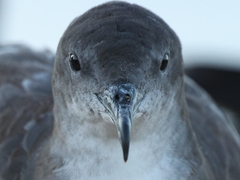
Wedge-tailed Shearwater

Wedge-tailed Shearwater

Puffinus pacificus

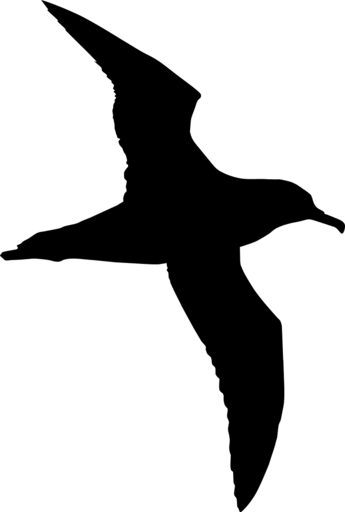
Silhouette: Juan Carlos Jerí · PhyloPic

LCLeast ConcernNTVUENCR
Daily sighting probability <5% · Rare
at Corcovado National Park

In 3 days <5%

8 Verified sightings at Corcovado National Park From 2019 to 2026
349 In all 10 parks
May Best month
☀️ Diurnal When it's spotted

About the Wedge-tailed Shearwater

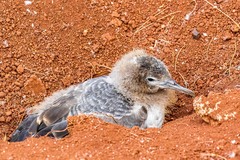
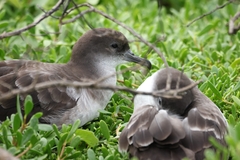
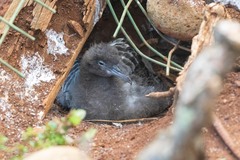
The wedge-tailed shearwater (Ardenna pacifica) (Uau Kani or Koto in Hawaiian) is a medium-large shearwater in the seabird family Procellariidae. It is one of the shearwater species that is sometimes referred to as a muttonbird, like the sooty shearwater of New Zealand and the short-tailed shearwater of Australia. It is found throughout the tropical Pacific and Indian Oceans, roughly between latitudes 35°N and 35°S. It breeds on the islands off Japan, on the Islas Revillagigedo, the Hawaiian Islands, the Seychelles, the Northern Mariana Islands, and off Eastern and Western Australia.

Its Hawaiian name "Uau Kani" reflects the sound of their bird call. Native Hawaiians had sometimes named birds after the nature of their melody. The wedge-tailed shearwater was formally described in 1789 by the German naturalist Johann Friedrich Gmelin in his revised and expanded edition of Carl Linnaeus's Systema Naturae. He placed it with the petrels in the genus Procellaria and coined the binomial name Procellaria pacifica. Gmelin based his description on the "Pacific petrel" that had been described in 1785 by the English ornithologist John Latham in his book A General Synopsis of Birds... Wikipedia →

Sounds

Recording0:16

United States · 2025

Damien Wallace · iNaturalist · CC0

Recording0:10

United States · 2023

© Chalon Boesel · iNaturalist · CC BY-NC 4.0

Recording0:17

United States · 2026

© Melinda Fawver · iNaturalist · CC BY-NC 4.0

Global Distribution

Parks Where Found

# Park Country Daily sighting probability
1 Cabo Blanco Absolute Nature Reserve 🇨🇷 Costa Rica
~10%
2 Isla del Coco National Park 🇨🇷 Costa Rica
~10%
3 Rottnest Island 🇦🇺 Australia
~10%
4 Ningaloo Marine Park 🇦🇺 Australia
~10%
5 Cabo Pulmo National Park 🇲🇽 Mexico
<5%
6 Royal National Park 🇦🇺 Australia
<5%
7 Raja Ampat 🇮🇩 Indonesia
<5%
8 Manuel Antonio National Park 🇨🇷 Costa Rica
<5%
9 Corcovado National Park 🇨🇷 Costa Rica
<5%
10 Galápagos Islands 🇪🇨 Ecuador
<5%

Cities Where Found

# City Country Daily sighting probability
1 Sydney 🇦🇺 Australia
<5%
2 Colombo [Sri Jayawardenepura Kotte] 🇱🇰 Sri Lanka
<5%

Zoos & Centres Where Found

# Zoo / Centre Country
1 Sea Life Park Hawaii 🇺🇸 United States In captivity

Before you go

What are the chances of seeing a Wedge-tailed Shearwater in Corcovado National Park?

Rare

Under 5% of wildlife watchers report a Wedge-tailed Shearwater sighting in Corcovado National Park on a given day, based on 8 verified sightings from GBIF citizen-science data from 2019 to 2026. It is the 323rd most-seen of the 332 birds we can rate there. Over three days the chance rises to under 5%, if each day is a fresh chance.

When is the best time to see a Wedge-tailed Shearwater in Corcovado National Park?

Any time of year

In every month with enough records, under 5% of wildlife watchers report a Wedge-tailed Shearwater in Corcovado National Park on a given day, so our monthly data shows no clear season.

What time of day is best to see a Wedge-tailed Shearwater?

Between 11 am and 2 pm

Across all the parks we cover, that three-hour window holds the most Wedge-tailed Shearwater sightings with a recorded time, and nearly all of them come between 6 am and 6 pm: it is a daytime animal.

Where does the Wedge-tailed Shearwater sighting chance come from?

GBIF citizen-science records

It is estimated from how often the Wedge-tailed Shearwater is recorded against all the birds logged in Corcovado National Park (8 verified sightings from 2019 to 2026), calibrated against known sighting rates. Figures are rounded to the nearest 10% because citizen-science data supports honest approximations, not decimals, and months with records from fewer than five people show "—". How it works.

← Back to Corcovado National Park