Executioner Paper Wasp

Executioner Paper Wasp

Polistes carnifex

Daily sighting probability <5% · Rare
at Cumbres de Monterrey National Park

In 3 days ~10% in a week ~20%

5 Verified sightings at Cumbres de Monterrey National Park From 2019 to 2026
54 In all 7 parks
August Best month
☀️ Diurnal When it's spotted

About the Executioner Paper Wasp

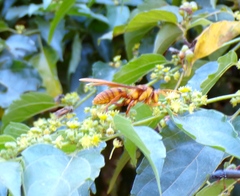
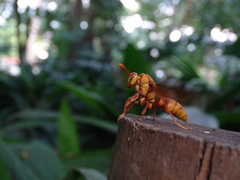
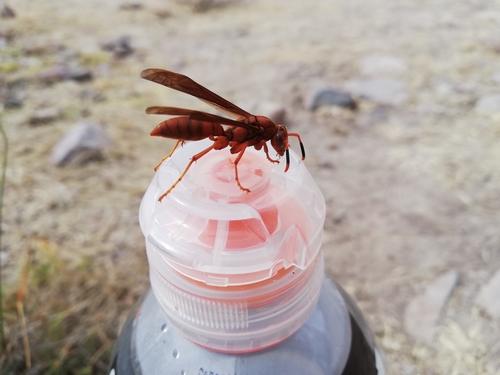
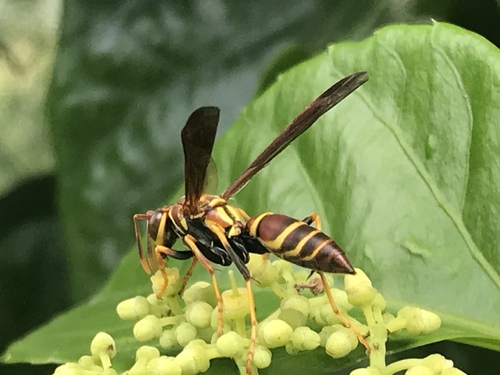
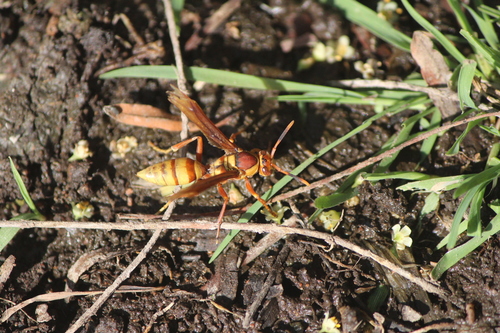
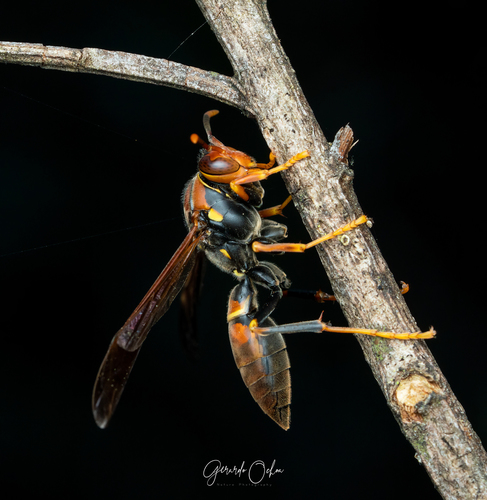
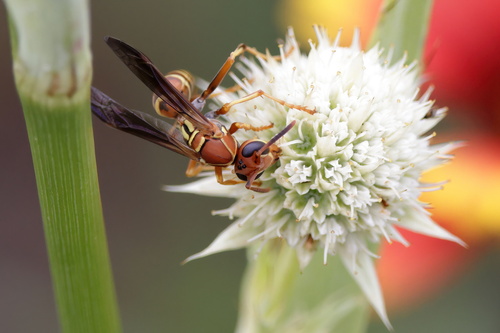
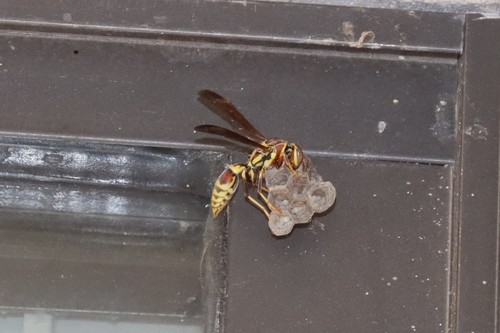
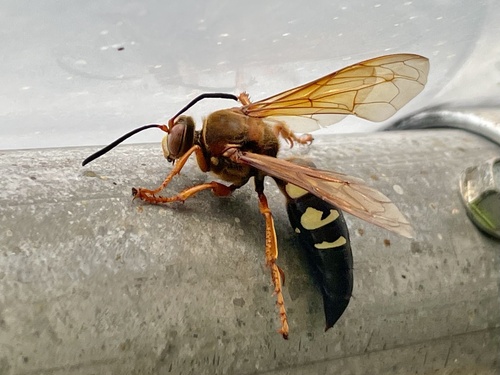
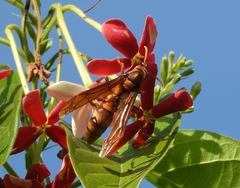
Polistes carnifex, commonly known as the executioner wasp or executioner paper wasp, is a neotropical vespid wasp in the cosmopolitan genus Polistes. It is a large yellow and brown paper wasp with a mandible that contains teeth. It establishes small colonies, founded by solitary queens, which build nests under the eaves of buildings or suspended from branches. Foraging adults bring nectar and macerated prey back to the nest to feed to the developing larvae which are individually housed in separate cells in the nest.

As its range includes only small portions of the English-speaking Americas, P. carnifex has only recently taken on an English vernacular name, but in the mid-2010s the name executioner wasp was proposed, a calque upon the Latin specific name carnifex "executioner, hangman".

In Paraguay, it is usually known in Guaraní as kava mainomby "hummingbird wasp", in reference to its great size; less commonly, it is called kava alazán "brown wasp" (more usually used for P. cavapyta), or kava sa'yju "yellow wasp" (more usually used for Agelaia multipicta or A. pallipes). In the Mexican state of Guerrero, speakers of Malinaltepec refer to the executioner wasp and... Wikipedia →

Global Distribution

Parks Where Found

# Park Country Daily sighting probability
1 Palo Verde National Park 🇨🇷 Costa Rica
~20%
2 Rincón de la Vieja National Park 🇨🇷 Costa Rica
~20%
3 Bastimentos Island National Marine Park 🇵🇦 Panama
~20%
4 Gandoca-Manzanillo Wildlife Refuge 🇨🇷 Costa Rica
~10%
5 La Amistad International Park (Panama) 🇵🇦 Panama
~10%
6 Arenal Volcano National Park 🇨🇷 Costa Rica
<5%
7 Cumbres de Monterrey National Park 🇲🇽 Mexico
<5%

Cities Where Found

# City Country Daily sighting probability
1 Cali 🇨🇴 Colombia
~30%
2 João Pessoa 🇧🇷 Brazil
~20%
3 Medellín 🇨🇴 Colombia
~20%
4 Guatemala City 🇬🇹 Guatemala
~10%
5 Porto Alegre 🇧🇷 Brazil
~10%
6 Guadalajara 🇲🇽 México
~10%

Before you go

What are the chances of seeing an Executioner Paper Wasp in Cumbres de Monterrey National Park?

Rare

Under 5% of wildlife watchers report an Executioner Paper Wasp sighting in Cumbres de Monterrey National Park on a given day, based on 5 verified sightings from GBIF citizen-science data from 2019 to 2026. It is the 390th most-seen of the 431 insects we can rate there. Over three days the chance rises to about 10%, and over a week to about 20%, if each day is a fresh chance.

When is the best time to see an Executioner Paper Wasp in Cumbres de Monterrey National Park?

August and November–December

In those months about 10% of wildlife watchers report an Executioner Paper Wasp in Cumbres de Monterrey National Park on a given day, against under 5% in January–July and September–October, the lowest months. Those are among Cumbres de Monterrey National Park's driest months, with about 55 mm of rain a month against 180 mm in September.

What time of day is best to see an Executioner Paper Wasp?

Between 10 am and 1 pm

Across all the parks we cover, that three-hour window holds the most Executioner Paper Wasp sightings with a recorded time, and about 9 in 10 of them come between 6 am and 6 pm: it is a daytime animal.

Which relatives of the Executioner Paper Wasp live in Cumbres de Monterrey National Park?

Same genus: Polistes

The closest relatives of the Executioner Paper Wasp that you can see in Cumbres de Monterrey National Park (genus Polistes, Umbrella Paper Wasps) are Neotropical Red Paper Wasp (about 10%), Unstable Paper Wasp (about 10%) and Horse Paper Wasp (about 10%), with each one's daily chance of a sighting.

Where does the Executioner Paper Wasp sighting chance come from?

GBIF citizen-science records

It is estimated from how often the Executioner Paper Wasp is recorded against all the insects logged in Cumbres de Monterrey National Park (5 verified sightings from 2019 to 2026), calibrated against known sighting rates. Figures are rounded to the nearest 10% because citizen-science data supports honest approximations, not decimals, and months with records from fewer than five people show "—". How it works.

← Back to Cumbres de Monterrey National Park