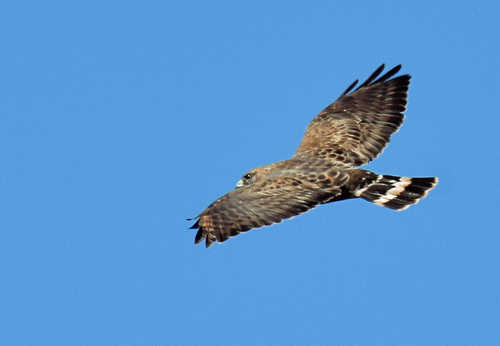
Red-shouldered Hawk

Red-shouldered Hawk

Buteo lineatus

Silhouette: Andy Wilson · PhyloPic

LCLeast ConcernNTVUENCR
Daily sighting probability <5% · Rare
at Cumbres de Monterrey National Park

In 3 days <5% in a week ~10%

42 Verified sightings at Cumbres de Monterrey National Park From 2019 to 2026
18,484 In all 16 parks
November Best month
☀️ Diurnal When it's spotted

About the Red-shouldered Hawk

The red-shouldered hawk (Buteo lineatus) is a medium-sized buteo. Its breeding range spans eastern North America, along the coast of California and northern to northeastern-central Mexico. It is a permanent resident throughout most of its range, though northern birds do migrate, mostly to central Mexico. The main conservation threat to the widespread species is deforestation.

The red-shouldered hawk was formally described in 1788 by the German naturalist Johann Friedrich Gmelin in his revised and expanded edition of Carl Linnaeus's Systema Naturae. He placed it with the eagles, hawks and relatives in the genus Falco and coined the binomial name Falco lineatus. Gmelin based his account on the "barred-breasted buzzard" of John Latham and the "red shouldered falcon" of Thomas Pennant. Latham had described a preserved specimen from North America in the Leverian collection while Pennant's specimen formed part of the collection of Anna Blackburne and had come from Long Island. The red-shouldered hawk is now placed with 27 other species in the genus Buteo that was introduced in 1799 by Bernard Germain de Lacépède.

The genus name Buteo is Latin for a "buzzard". The specific... Wikipedia →

Sounds

Kleer series0:44

United States · 2024

© Valerie Heemstra · XC933584 · CC BY-NC-SA 4.0

Call0:54

United States · 2023

© David A. Brinkman · XC809281 · CC BY-NC-SA 4.0

Song0:10

United States · 2020

© Brian Hendrix · XC564543 · CC BY-NC-SA 4.0

Global Distribution

Parks Where Found

# Park Country Daily sighting probability
1 Big Cypress National Preserve 🇺🇸 United States
~70%
2 Everglades National Park 🇺🇸 United States
~60%
3 Congaree National Park 🇺🇸 United States
~50%
4 Merritt Island National Wildlife Refuge 🇺🇸 United States
~30%
5 Great Smoky Mountains National Park 🇺🇸 United States
~20%
6 Shenandoah National Park 🇺🇸 United States
~20%
7 Yosemite National Park 🇺🇸 United States
~10%
8 Redwood National Park 🇺🇸 United States
~10%
9 Sequoia and Kings Canyon National Parks 🇺🇸 United States
~10%
10 Death Valley National Park 🇺🇸 United States
~10%
11 Channel Islands National Park 🇺🇸 United States
~10%
12 Point Pelee National Park 🇨🇦 Canada
<5%
13 Cumbres de Monterrey National Park 🇲🇽 Mexico
<5%
14 El Vizcaíno Biosphere Reserve 🇲🇽 Mexico
<5%
15 Acadia National Park 🇺🇸 United States
<5%
16 Big Bend National Park 🇺🇸 United States
<5%

Cities Where Found

# City Country Daily sighting probability
1 Orlando 🇺🇸 United States
~60%
2 Sacramento 🇺🇸 United States
~40%
3 San Antonio 🇺🇸 United States
~40%
4 Austin 🇺🇸 United States
~30%
5 Washington 🇺🇸 United States
~30%
6 Houston 🇺🇸 United States
~30%
7 Tijuana 🇲🇽 México
~30%
8 San Francisco 🇺🇸 United States
~30%
9 San Diego 🇺🇸 United States
~30%
10 Los Angeles 🇺🇸 United States
~30%

Zoos & Centres Where Found

# Zoo / Centre Country
1 Ecomuseum Zoo 🇨🇦 Canada In captivity
2 World Bird Sanctuary 🇺🇸 United States In captivity
3 Birmingham Zoo 🇺🇸 United States In captivity
4 Staten Island Zoo 🇺🇸 United States In captivity
5 Trevor Zoo 🇺🇸 United States In captivity
6 Ralph Perkins II Wildlife Center and Woods Garden 🇺🇸 United States In captivity
7 Texas State Aquarium 🇺🇸 United States In captivity
8 Lindsay Wildlife Experience 🇺🇸 United States In captivity
9 Belle Isle Nature Center 🇨🇦 Canada In captivity
10 Carolina Raptor Center 🇺🇸 United States In captivity
11 Cascades Raptor Center 🇺🇸 United States In captivity
12 Chouette à voir! 🇨🇦 Canada In captivity
13 Maymont Farm 🇺🇸 United States In captivity
14 Museum of Life and Science 🇺🇸 United States In captivity
15 Seaside Seabird Sanctuary 🇺🇸 United States In captivity

Before you go

What are the chances of seeing a Red-shouldered Hawk in Cumbres de Monterrey National Park?

Rare

Under 5% of wildlife watchers report a Red-shouldered Hawk sighting in Cumbres de Monterrey National Park on a given day, based on 42 verified sightings from GBIF citizen-science data from 2019 to 2026. It is the 183rd most-seen of the 275 birds we can rate there. Over three days the chance rises to under 5%, and over a week to about 10%, if each day is a fresh chance.

When is the best time to see a Red-shouldered Hawk in Cumbres de Monterrey National Park?

November and December

In those months about 10% of wildlife watchers report a Red-shouldered Hawk in Cumbres de Monterrey National Park on a given day, against under 5% in January to October, the lowest months. Those are among Cumbres de Monterrey National Park's driest months, with about 35 mm of rain a month against 180 mm in September.

What time of day is best to see a Red-shouldered Hawk?

Between 5 and 8 pm

Across all the parks we cover, that three-hour window holds the most Red-shouldered Hawk sightings with a recorded time, and about 7 in 10 of them come between 6 am and 6 pm: it is a daytime animal.

Which relatives of the Red-shouldered Hawk live in Cumbres de Monterrey National Park?

Same genus: Buteo

The closest relatives of the Red-shouldered Hawk that you can see in Cumbres de Monterrey National Park (genus Buteo, Buteos) are Red-tailed Hawk (about 10%), Gray-lined Hawk (about 10%) and Short-tailed Hawk (about 10%), with each one's daily chance of a sighting.

Where does the Red-shouldered Hawk sighting chance come from?

GBIF citizen-science records

It is estimated from how often the Red-shouldered Hawk is recorded against all the birds logged in Cumbres de Monterrey National Park (42 verified sightings from 2019 to 2026), calibrated against known sighting rates. Figures are rounded to the nearest 10% because citizen-science data supports honest approximations, not decimals, and months with records from fewer than five people show "—". How it works.

← Back to Cumbres de Monterrey National Park