Philippine Slow Loris

Philippine Slow Loris

Nycticebus menagensis

Silhouette: Mareike C. Janiak · PhyloPic

LCNTVUVulnerableENCR
Daily sighting probability ~30% · Possible
at Danum Valley Conservation Area

In 3 days ~70% in a week ~90%

25 Verified sightings at Danum Valley Conservation Area From 2019 to 2026
151 In all 3 parks
December Best month
☀️ Diurnal When it's spotted

About the Philippine Slow Loris

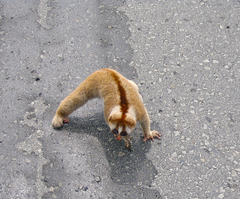
The Philippine slow loris (Nycticebus menagensis) is a strepsirrhine primate and a species of slow loris that is native to the north and east coastal areas of the island of Borneo, as well as the Sulu Archipelago in the Philippines. The species was first named as the Bornean slow loris in 1892, but lumped into the widespread Sunda slow loris (N. coucang) in 1952. However, it was promoted to full species status – again as the Bornean slow loris – based on molecular analysis in 2006. In 2013, two former subspecies of the Bornean slow loris were elevated to species status, and a new species—N. kayan—was recognized among the Bornean population.

Weighing 265–300 grams (9.3–10.6 oz), it is one of the smallest of the slow lorises, and can be distinguished from other slow lorises by its pale golden to red fur, the lack of markings on its head, and consistent absence of a second upper incisor. Like other slow lorises, it has a vestigial tail, round head, short ears, a curved grooming claw for grooming, and a gland that produces an oily toxin that the animal uses for defense. The Philippine slow loris is arboreal, nocturnal, and occurs in low densities, making it difficult to locate. It is also the least studied of Indonesia's slow lorises. It is found at elevations between 35–100 meters (115–328 ft) in primary and secondary lowland forest, gardens, and plantations. Information about its diet is limited, but it is suspected to be one of the more insectivorous slow loris species, and is also known to eat gum from woody plants.

The Bornean slow loris species complex – including the Philippine slow loris – was classified as "Vulnerable" by the International Union for Conservation of Nature (IUCN) in 2008, is included in CITES Appendix I, which prevents international commercial trade, and is protected by Indonesian law. Prior to being divided into four distinct species in 2013, it was found in numerous protected areas within its range, making it the least threatened of the slow lorises. However, since the taxonomic split, it may face a higher risk of extinction. It is sparsely distributed throughout its range and is threatened by illegal wildlife trade, including the exotic pet trade, and habitat loss. Wikipedia →

Global Distribution

Parks Where Found

# Park Country Daily sighting probability
1 Danum Valley Conservation Area 🇲🇾 Malaysia
~30%
2 Sepilok 🇲🇾 Malaysia
~30%
3 Kinabatangan Wildlife Sanctuary 🇲🇾 Malaysia
~20%

Before you go

What are the chances of seeing a Philippine Slow Loris in Danum Valley Conservation Area?

Possible

About 30% of wildlife watchers report a Philippine Slow Loris sighting in Danum Valley Conservation Area on a given day, based on 25 verified sightings from GBIF citizen-science data from 2019 to 2026. It is the 17th most-seen of the 26 mammals we can rate there. Over three days the chance rises to about 70%, and over a week to about 90%, if each day is a fresh chance.

When is the best time to see a Philippine Slow Loris in Danum Valley Conservation Area?

August and December

In those months about 50% of wildlife watchers report a Philippine Slow Loris in Danum Valley Conservation Area on a given day, against under 5% in February, April–May and July, the lowest months.

What time of day is best to see a Philippine Slow Loris?

Between noon and 3 pm

Across all the parks we cover, that three-hour window holds the most Philippine Slow Loris sightings with a recorded time, and about 8 in 10 of them come between 6 am and 6 pm: it is a daytime animal.

Is Danum Valley Conservation Area the best place to see a Philippine Slow Loris?

Yes

Of the 3 parks where we can rate Philippine Slow Loris sightings, Danum Valley Conservation Area has the highest daily chance: about 30%. Next come Sepilok (Malaysia, about 30%) and Kinabatangan Wildlife Sanctuary (Malaysia, about 20%).

Which relatives of the Philippine Slow Loris live in Danum Valley Conservation Area?

Same order: Primates

The closest relatives of the Philippine Slow Loris that you can see in Danum Valley Conservation Area (order Primates) are Maroon Leaf Monkey (about 80%), Bornean Orangutan (about 50%) and Horsfield's Tarsier (about 40%), with each one's daily chance of a sighting.

Where does the Philippine Slow Loris sighting chance come from?

GBIF citizen-science records

It is estimated from how often the Philippine Slow Loris is recorded against all the mammals logged in Danum Valley Conservation Area (25 verified sightings from 2019 to 2026), calibrated against known sighting rates. Figures are rounded to the nearest 10% because citizen-science data supports honest approximations, not decimals, and months with records from fewer than five people show "—". How it works.

← Back to Danum Valley Conservation Area