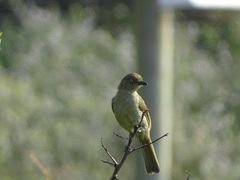
Sombre Greenbul

Sombre Greenbul

Andropadus importunus

Silhouette: PhyloPic

LCLeast ConcernNTVUENCR
Daily sighting probability ~30% · Possible
at De Hoop Nature Reserve

In 3 days ~60% in a week ~90%

146 Verified sightings at De Hoop Nature Reserve From 2019 to 2026
7,628 In all 20 parks
May Best month
☀️ Diurnal When it's spotted

About the Sombre Greenbul

The sombre greenbul (Andropadus importunus) is a member of the bulbul family of passerine birds. It is a resident breeder in coastal bush, evergreen forest and dry shrub land in eastern and southern Africa. It is the only member of the genus Andropadus.

Eighteen species of greenbuls originally described in the genus Andropadus were re-classified to the genera Arizelocichla, Stelgidillas and Eurillas in 2010. This has left Andropadus as a monotypic genus with the sombre greenbul remaining as its sole extant species.

The sombre greenbul was originally described in the genus Turdus and was later re-classified to the genus Andropadus. Alternatively, some authorities classify the sombre greenbul in the genus Pycnonotus. Alternate names for the sombre greenbul include the sombre bulbul, southern sombre bulbul and southern sombre greenbul.

Includes Frick's greenbul which was also originally described as a separate species. Found from southern Ethiopia and southern Somalia to eastern... Wikipedia →

Sounds

Song0:37

South Africa · 2026

© JJSUN · XC1078356 · CC BY-NC-SA 4.0

Duet0:10

Kenya · 2025

© Louis A. Hansen · XC1068036 · CC BY-NC-SA 4.0

Recording0:13

South Africa · 2025

© Craig Peter · iNaturalist · CC BY-NC 4.0

Global Distribution

Parks Where Found

# Park Country Daily sighting probability
1 Garden Route National Park 🇿🇦 South Africa
~60%
2 uMkhuze Game Reserve 🇿🇦 South Africa
~60%
3 iSimangaliso Wetland Park 🇿🇦 South Africa
~50%
4 Addo Elephant National Park 🇿🇦 South Africa
~50%
5 Gorongosa National Park 🇲🇿 Mozambique
~30%
6 De Hoop Nature Reserve 🇿🇦 South Africa
~30%
7 Table Mountain National Park 🇿🇦 South Africa
~30%
8 Hluhluwe-Imfolozi Park 🇿🇦 South Africa
~20%
9 Kruger National Park 🇿🇦 South Africa
~20%
10 Mkomazi National Park 🇹🇿 Tanzania
~20%
11 Gonarezhou National Park 🇿🇼 Zimbabwe
~20%
12 Nairobi National Park 🇰🇪 Kenya
~20%
13 Mikumi National Park 🇹🇿 Tanzania
~10%
14 Arusha National Park 🇹🇿 Tanzania
~10%
15 Tsavo West National Park 🇰🇪 Kenya
~10%
16 Meru National Park 🇰🇪 Kenya
~10%
17 Tsavo East National Park 🇰🇪 Kenya
~10%
18 Liwonde National Park 🇲🇼 Malawi
~10%
19 Lower Zambezi National Park 🇿🇲 Zambia
~10%
20 Mana Pools National Park 🇿🇼 Zimbabwe
~10%

Cities Where Found

# City Country Daily sighting probability
1 Mombasa 🇰🇪 Kenya
~60%
2 Zanzibar City 🇹🇿 Tanzania
~40%
3 Dar es-Salaam 🇹🇿 Tanzania
~30%
4 Durban 🇿🇦 South Africa
~20%
5 Cape Town 🇿🇦 South Africa
<5%

Before you go

What are the chances of seeing a Sombre Greenbul in De Hoop Nature Reserve?

Possible

About 30% of wildlife watchers report a Sombre Greenbul sighting in De Hoop Nature Reserve on a given day, based on 146 verified sightings from GBIF citizen-science data from 2019 to 2026. It is the 57th most-seen of the 189 birds we can rate there. Over three days the chance rises to about 60%, and over a week to about 90%, if each day is a fresh chance.

When is the best time to see a Sombre Greenbul in De Hoop Nature Reserve?

March, May, September–October and December

In those months about 40% of wildlife watchers report a Sombre Greenbul in De Hoop Nature Reserve on a given day, against about 10% in February, the lowest month. June has too few records to rate.

What time of day is best to see a Sombre Greenbul?

Between 8 and 11 am

Across all the parks we cover, that three-hour window holds the most Sombre Greenbul sightings with a recorded time, and nearly all of them come between 6 am and 6 pm: it is a daytime animal.

Where does the Sombre Greenbul sighting chance come from?

GBIF citizen-science records

It is estimated from how often the Sombre Greenbul is recorded against all the birds logged in De Hoop Nature Reserve (146 verified sightings from 2019 to 2026), calibrated against known sighting rates. Figures are rounded to the nearest 10% because citizen-science data supports honest approximations, not decimals, and months with records from fewer than five people show "—". How it works.

← Back to De Hoop Nature Reserve