Long-nosed Leopard Lizard

Long-nosed Leopard Lizard

Gambelia wislizenii

Silhouette: Jose Carlos Arenas-Monroy · PhyloPic

LCLeast ConcernNTVUENCR
Daily sighting probability ~40% · Likely
at Death Valley National Park

In 3 days ~70% in a week >90%

58 Verified sightings at Death Valley National Park From 2019 to 2026
524 In all 3 parks
September Best month
☀️ Diurnal When it's spotted

About the Long-nosed Leopard Lizard

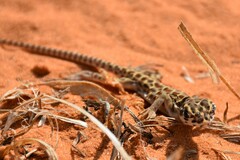
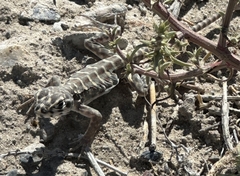
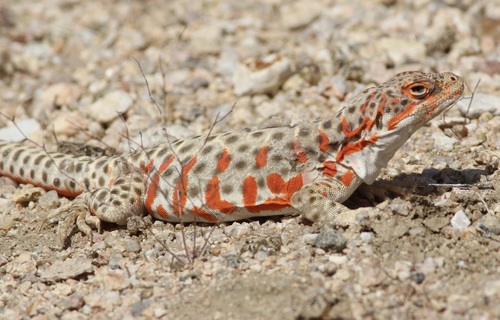
The long-nosed leopard lizard (Gambelia wislizenii) is a species of relatively large North American lizard in the family Crotaphytidae. Gambelia wislizenii ranges in snout-to-vent length (SVL) from 8.3 to 14.6 cm (3+1⁄4 to 5+3⁄4 in). It has a large head, a long nose, and a long round tail that can be longer than its body. It is closely related to the blunt-nosed leopard lizard (Gambelia sila), which closely resembles the long-nosed leopard lizard in body proportions, but has a conspicuously blunt snout. The species G. wislizenii, once considered part of the genus Crotaphytus, is under moderate pressure because of habitat destruction but is categorized as "least concern".

The specific name or epithet, wislizenii, is in honor of the German-American surgeon and naturalist Frederick Adolph Wislizenus, who caught the first specimen near Santa Fe, New Mexico. Gambelia wislizenii has granular dorsal scales that can be white, cream, or gray with irregular brown or dark gray spots along its body and head. Sometimes they have dark bars across their back. The tail also has dark bars across it. Juveniles have more highly contrasted markings compared to adults... Wikipedia →
Global Distribution

Parks Where Found

# Park Country Daily sighting probability
1 Joshua Tree National Park 🇺🇸 United States
~50%
2 Death Valley National Park 🇺🇸 United States
~40%
3 Saguaro National Park 🇺🇸 United States
~10%

Zoos & Centres Where Found

# Zoo / Centre Country
1 Living Desert Zoo and Gardens 🇺🇸 United States In captivity
2 Entopia 🇲🇾 Malaysia In captivity

Before you go

What are the chances of seeing a Long-nosed Leopard Lizard in Death Valley National Park?

Likely

About 40% of wildlife watchers report a Long-nosed Leopard Lizard sighting in Death Valley National Park on a given day, based on 58 verified sightings from GBIF citizen-science data from 2019 to 2026. It is the 11th most-seen of the 30 reptiles we can rate there. Over three days the chance rises to about 70%, and over a week to over 90%, if each day is a fresh chance.

When is the best time to see a Long-nosed Leopard Lizard in Death Valley National Park?

September

In that month about 60% of wildlife watchers report a Long-nosed Leopard Lizard in Death Valley National Park on a given day, against under 5% in July and November–January, the lowest months. That is one of Death Valley National Park's driest months, with about 5 mm of rain against 30 mm in March.

What time of day is best to see a Long-nosed Leopard Lizard?

Between 10 am and 1 pm

Across all the parks we cover, that three-hour window holds the most Long-nosed Leopard Lizard sightings with a recorded time, and about 9 in 10 of them come between 6 am and 6 pm: it is a daytime animal.

Is Death Valley National Park the best place to see a Long-nosed Leopard Lizard?

2nd of 3

Of the 3 parks where we can rate Long-nosed Leopard Lizard sightings, Death Valley National Park ranks 2nd at about 40%. The best odds are in Joshua Tree National Park (United States, about 50%).

Where does the Long-nosed Leopard Lizard sighting chance come from?

GBIF citizen-science records

It is estimated from how often the Long-nosed Leopard Lizard is recorded against all the reptiles logged in Death Valley National Park (58 verified sightings from 2019 to 2026), calibrated against known sighting rates. Figures are rounded to the nearest 10% because citizen-science data supports honest approximations, not decimals, and months with records from fewer than five people show "—". How it works.

← Back to Death Valley National Park