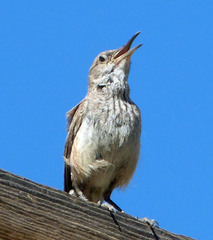
Rock Wren

Rock Wren

Salpinctes obsoletus

Silhouette: Edwin Price · PhyloPic

LCLeast ConcernNTVUENCR
Daily sighting probability ~30% · Possible
at Death Valley National Park

In 3 days ~70% in a week ~90%

759 Verified sightings at Death Valley National Park From 2019 to 2026
12,152 In all 19 parks
April Best month
☀️ Diurnal When it's spotted

About the Rock Wren

The rock wren (Salpinctes obsoletus) is a small songbird of the wren family native to the rocky areas of western North America. There are 8 subspecies of the rock wren, one of which is extinct. They are similar in size to other wrens, with a grey-brown coat, a brown rump, and a speckled white throat.

They are visually similar to the canyon wren, which they share a habitat with. They are noted for their variable song and song pattern, used for territory defense, as well as their habit of building "pavements" with flat rocks around their nest to help nestlings stay dry. Rock wrens are serially monogamous, forming pairs for nesting season. Nestbuilding usually begins in March, usually in crevices, and the first brood are laid late April to June, with a possible second brood later in June.

They are largely terrestrial foragers, rarely flying. Their diet consists of insects, mostly weevils, during the spring and summer, shifting to grain during autumn and winter. Though they are a least-concern species, their population size has declined by 13% from 2010 to 2020.

The rock wren was first described by Thomas Say, published in Edwin James' book Account of an Expedition from... Wikipedia →

Sounds

Song0:30

United States · 2026

© Scott Olmstead · XC1080773 · CC BY-NC-SA 4.0

Call1:01

Mexico · 2022

© Manuel Grosselet · XC698480 · CC BY-NC-SA 4.0

Alarm call1:15

United States · 2012

© Andrew Spencer · XC109273 · CC BY-NC-SA 3.0

Global Distribution

Parks Where Found

# Park Country Daily sighting probability
1 Badlands National Park 🇺🇸 United States
~70%
2 Joshua Tree National Park 🇺🇸 United States
~60%
3 Guadalupe Mountains National Park 🇺🇸 United States
~60%
4 Grand Canyon National Park 🇺🇸 United States
~40%
5 Big Bend National Park 🇺🇸 United States
~30%
6 Death Valley National Park 🇺🇸 United States
~30%
7 Zion National Park 🇺🇸 United States
~20%
8 Saguaro National Park 🇺🇸 United States
~20%
9 Sequoia and Kings Canyon National Parks 🇺🇸 United States
~10%
10 Cumbres de Monterrey National Park 🇲🇽 Mexico
~10%
11 Yosemite National Park 🇺🇸 United States
~10%
12 Bahía de Loreto National Park 🇲🇽 Mexico
<5%
13 Rocky Mountain National Park 🇺🇸 United States
<5%
14 Yellowstone National Park 🇺🇸 United States
<5%
15 El Vizcaíno Biosphere Reserve 🇲🇽 Mexico
<5%
16 Channel Islands National Park 🇺🇸 United States
<5%
17 Grand Teton National Park 🇺🇸 United States
<5%
18 Glacier National Park 🇺🇸 United States
<5%
19 Redwood National Park 🇺🇸 United States
<5%

Cities Where Found

# City Country Daily sighting probability
1 Phoenix 🇺🇸 United States
~10%
2 Mesa 🇺🇸 United States
<5%
3 Las Vegas 🇺🇸 United States
<5%
4 Denver 🇺🇸 United States
<5%
5 Los Angeles 🇺🇸 United States
<5%
6 Salt Lake City 🇺🇸 United States
<5%
7 San Diego 🇺🇸 United States
<5%
8 Sacramento 🇺🇸 United States
<5%
9 San Francisco 🇺🇸 United States
<5%
10 Mexico City 🇲🇽 México
<5%

Before you go

What are the chances of seeing a Rock Wren in Death Valley National Park?

Possible

About 30% of wildlife watchers report a Rock Wren sighting in Death Valley National Park on a given day, based on 759 verified sightings from GBIF citizen-science data from 2019 to 2026. It is the 19th most-seen of the 213 birds we can rate there. Over three days the chance rises to about 70%, and over a week to about 90%, if each day is a fresh chance.

When is the best time to see a Rock Wren in Death Valley National Park?

March and April

In those months about 40% of wildlife watchers report a Rock Wren in Death Valley National Park on a given day, against about 20% in July–August and October–November, the lowest months.

What time of day is best to see a Rock Wren?

Between 8 and 11 am

Across all the parks we cover, that three-hour window holds the most Rock Wren sightings with a recorded time, and about 9 in 10 of them come between 6 am and 6 pm: it is a daytime animal.

Which relatives of the Rock Wren live in Death Valley National Park?

Same family: Troglodytidae

The closest relatives of the Rock Wren that you can see in Death Valley National Park (family Troglodytidae, Wrens) are Bewick's Wren (about 30%) and Marsh Wren (about 30%), with each one's daily chance of a sighting.

Where does the Rock Wren sighting chance come from?

GBIF citizen-science records

It is estimated from how often the Rock Wren is recorded against all the birds logged in Death Valley National Park (759 verified sightings from 2019 to 2026), calibrated against known sighting rates. Figures are rounded to the nearest 10% because citizen-science data supports honest approximations, not decimals, and months with records from fewer than five people show "—". How it works.

← Back to Death Valley National Park